
Date First Published: January 9, 2015
Date Last Revised: October 7, 2020
“I think one’s feelings waste themselves in words; they ought all to be distilled into actions which bring results.”—Florence Nightingale
This article hopes to clarify some of the issues regarding the development and use of standardized plans in the delivery of patient care. I have thought about this issue over many years. This article has taken months to prepare and I have not come to the end of trying to express my understanding the subject fully. It is a complex subject both in breadth and depth and trying to get through this article may be quite daunting. I am discussing it in four separate articles i.e.,
- Planning Patient Care
- Standard Operating Procedures / Care Plans: Concepts and Function
- Development of Standard Operating Procedures and Clinical Care Plans (current page)
- Documentation of Standard Operating Procedures (SOP) / Care Plans for Healthcare
- Implementing SOP/Care Plans in Clinical Patient Care
However, a SOP/Care Plan is designed to improve consistency such that details are necessary. There are repetitions and for some content, details are spread over a few sections. I have tried to write as simply as is possible. I hope you will bear with me and persevere in trying to go through it. The outline below may help in its understanding.
| . | Subject |
|---|---|
| 1 | The Need for Formalized Planning in Healthcare |
| 2 | Adoption of Standard Operating Procedure |
| 3 | Strategies in Design Based on: a. Quality by Design Concept b. Practice of Evidence-based Medicine c. Incorporation of the Total Patient Care Concept |
| 4 | Factors to be Considered in Construction of the SOP/Care Plan a. Consideration for Variations b. Factors Contributing to Variations c. Identification of Needs d. Diagnosis e. Patient Profile f. Care Objectives and Standards g. Clinical Work Process h. Phases of Care i. Workflow |
| 5 | Conversion of Reference Plan to Actual Plan |
| 6 | Structure and Content of the SOP/Care Plan Title. Care objectives Description of the Clinical Work Processes Workflow Specific Work Instructions The Work schedule Guide on documentation Reference tables Quality Control Methods |
| 7 | Examples |
The design and documentation of SOP/Care plans is further elaborated in a separate article.
STRUCTURE AND CONTENT
This article concentrates on the use of SOP/Care Plans for clinical care services.
Use of Standard Operating Procedures in Administration of Patient Care
a
Use of Standard Operating Procedures in Supportive
Adoption of the Use of Standard Operating Procedures in Clinical Patient Care
Clinical services are designed according to the needs of patients. The SOP can be taken to be a detailed plan applicable to the delivery of services to typical patients with a typical disease condition (the service product) in a particular facility or organization. Almost invariably, customization of the SOP would be necessary when the actual care of an individual patient is provided. As in any other service, the design and planning of clinical care involves translating the needs of recipients (patients) into uniform specifications and standards of both the service delivery itself and more importantly the final outcome of the service.
Terms used in SOP
| Term | Meaning |
|---|---|
| operations | the entire effort of producing a product or delivering a service |
| product | the useful outcome (object or benefit) of an effort (work) |
| processes | the most elementary unit of work |
| procedure | tasks, a series or set of processes |
| standard | the common way to conduct an operation |
| SOP | description of the proposed/prescribed way of the work of producing a product |
| TERM | MEANING |
|---|---|
| Uniformity | the consistently similar manner by which services are provided for defined patient groups affected by the same disease, illness, or health problem (case types). |
| Standardization | the use of agreed specifications for resources, methodology, and outcome including the terms used to describe them. |
| Customization | making slight alterations through additions or omissions depending on certain conditions or situations |
Standard Operating Procedures in Patient Care
Service Products
Yet if the products of services are described by equally uniform characteristics and outcomes, they can be called service products for which a SOP can also be designed. Even then, in service industries including healthcare, the specifications of the service need not be defined very strictly. Often, there is a need for the delivery to be customized and personalized to fit the special needs of the recipient.
A SOP must match the capability of the organization. Hence when, building the SOP, the following factors must be taken into consideration:
- the aim of the organization in providing the service,
- the environment existing within the organization,
- the resources available,
- how the delivery of the service is organized
If the organization intends to improve the capacity or quality of its services, it must upgrade the above requirements. This means that each facility or organization must create its own sets of SOPs.
There is a need to demonstrate that these plans are feasible and effective through trial or pilot studies. Before being adopted, it should be verified by the managers responsible for governance of the services and formally endorsed by the executive body of the organization. After adoption the feasibility and outcome must be constantly appraised and improved upon.
SERVICES OFFERED BY A PATIENT CARE FACILITY
A healthcare facility offering patient care services encompasses two main group of activities, functions and services i.e.:
- Managing the patient care facility as a business entity, a provider of hospitality services and a physical facility
- The core business of providing patient care services
SOP/Care Plan for Managing the Facility
Patient care as a service require complex resources and methods. The viability of health service delivery facility requires attention to optimization of costs. Those depending on funds or grants by the government or charity must work within the budget allocated. Facilities whose expenditure depends on money accumulated from payments, whether made directly by patients or through insurance schemes, must take into account affordability and competitiveness. The SOP supports the framework for the calculation of costs because it details out the processes performed, the resources and the environment required to perform them. I will devote an entire article on the subject of costing, charges and funding.
SOP/Care Plan for Provision of Patent Care
The Patient Care Service itself consists of:
- the services provided by direct care providers i.e. clinicians; and is separately termed as ‘clinical patient care’,
- the administrative aspects facilitating clinical care,
- services that support clinical activities
The service provision for administrative, supportive and facilitatory aspects of patient care is not very different from those in other services. SOPs have been used successfully in these areas.
However, the effort required for achieving uniformity and standardization in clinical patient is more demanding. Currently, clinical care providers including doctors, nurses, allied health personnel and other professionals follow universally agreed approach to delivering care. The challenge is the need to provide a wide variety of service products to match various types of diseases and their variants. Yet, it is the patient and not the disease that we are looking after. Hence, the service must take into consideration the individual needs the patient. A clear understanding of principles, concepts and methods used in patient care is required if SOPs are to be developed and used. .
Modification of SOP/Care Plans for Different Facilities
The facilities that offer patient care services include:
- Hospitals (with inpatient and outpatient services)
- Stand-alone clinics or polyclinics (outpatient services)
- Daycare centers
Structure and Content of SOP/Care Plan in Patient Care Services
Some aspects of patient care services are not very different from other services in as much as they have fairly uniform output characteristics. Also, the policies and procedures can be followed fairly rigidly. Such areas include:
- Management functions and services
- Client (Patient) Administration services (i.e. registration, scheduling appointments, resource allocation)
- Clinical Patient Care
- Clinical support services (e.g. laboratory, imaging, endoscopy, sterilization),
- Ordering and supply of resources
- Work assignment (Rostering, worklists, schedules)
SOP for Clinical Patient Care
The applicability of SOP in Clinical Patient Care setting is less clearly worked out mainly because of the wide variety of illnesses, diseases and health problems. However, currently there is a realization among managers and clinical care providers including doctors, nurses, allied health personnel and other professionals on the need for standardization. Foremost among these is the effort by professional bodies generate consensus via the development of Practice guidelines.
Differentiating Service Products by Diagnosis
Service products must be provided for many types of illnesses, diseases and health problems and therefore SOPs has to be developed for service products to correspondingly match these wide variety of needs. The type of disease and the needs of the patient is defined predominantly by the diagnosis. Hence, service products and their SOPs must be developed based on diagnosis.
The objective should be to retain and apply the common principles, concepts and methods of patient care for each one of them while giving due consideration to the special needs of each type of case. Yet, it is the patient and not the disease that that the service is being provided for. So, there must be a method for modification and customization of the SOP to cater for the special needs of each patient.
In summary, Clinical Patient Care services are provided according to the patient’s illnesses, disease or health problem as defined by the diagnosis. Since there are many types of diseases, there are corresponding wide varieties of service products. It must be remembered that the diagnosis becomes clearer as the care process progresses. Hence, SOP/Care plans must be designed for the early phase (symptom complexes, clinical syndromes) as well as the later phase (specific disease and its variants).
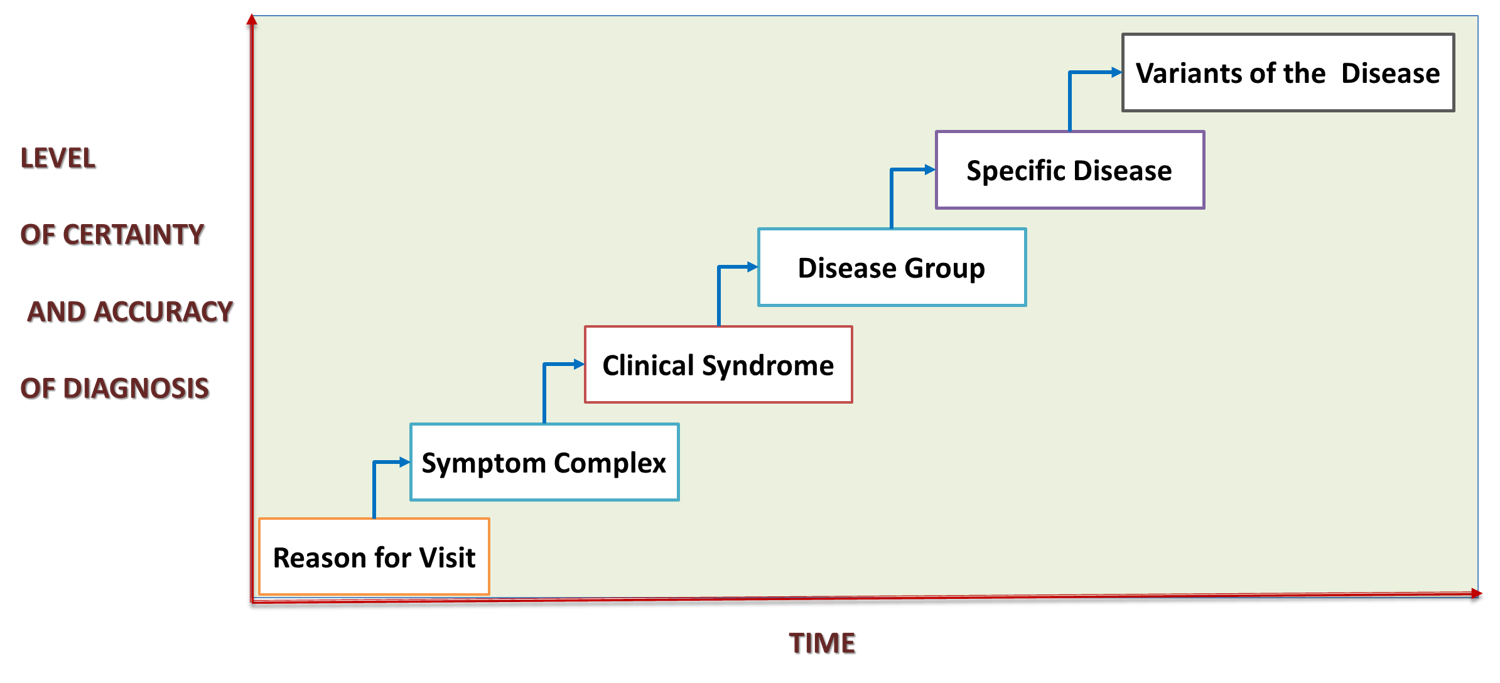
Preferably, SOPs must be made available for all of them. This would be a tremendous challange, but I propose that the use of the Standard Operating Procedure (SOP), is not only applicable but also necessary.
Technical Difficulties
The technical difficulties in applying SOP methods to patient care stem from two main factors:
- there are wide varieties of service products each with varying policies and procedures
- the workflow in patient care is not exactly sequential, it is often iterative.
The clinical care process is generally sequential but certain criteria must be met for the workflow to move on. Often repetitions of processes or procedures are necessary. The cyclical or iterative nature of clinical care need to be understood and incorporated into the SOP.
Also in many instances, the care or even part of the care cannot be completed at one sitting due to time constraints or the need to wait for outcome or results. The delivery of care need to be broken up into:
- phases according to the application of the clinical care processes
- practical sessions (blocks of activities, time slots).
A Re-look at Care Plans
Many attempts has been made to develop proper methods of planning in patient care. Currently within the healthcare community, the design of the service for a typical patient with an episode of a specific illness is often called the ‘Plan for the Management of a Patient’, ‘Case management protocols’, Care bundles, ‘Care Plan’ or ‘Care Pathways’. There are many conceptions and formats of what is called ‘Care Plans’. It is common to depict the Care Plan as a table or matrix. This is not the best way to express it because tables limit the amount of content and do not show sequence and layout clearly. It is better for the content of patient care plans to be in structured narrative format similar to the SOP used in other industries. The term Good Clinical Practice (GCP) is also used but unfortunately it is only applied in research settings. Despite its name, it is not concerned with proper clinical care but on how to conduct a clinical trial.
Both the Care Plan and SOP refer to the predicted or planned policies and procedures in managing a problem. If the the same methods, structure, and content as used in developing ‘Standard Operating Procedure (SOP) in other industries is adopted, with some modifications, then the Care Plan and SOP can be seen as equivalents.
If it is more acceptable, the term Care Plan can used in lieu of the term SOP. In practice either term can be used interchangeably. Henceforth in this discussion, the SOP and Care Plans are deemed to be synonymous. Both terms will be used together abbreviated as SOP/Care Plans.
The way to document SOP/Care Plans is discussed in another article.
Each SOP/Care Plan describes the plan for the realization of a specific service product i.e., the care of patients with a particular disease or health problem. There should be an SOP/Care Plan for every service product. Each one has the following functions:
- explain the theoretical basis for the way of the service is delivered
- ensure that service providers adhere to policies and procedures
- help care providers make the right decisions
- act as a source of knowledge to help the care provider give safe, effective, and appropriate care.
Hence, the SOP/Care Plans can act as reference document for use as:
- the guide to carrying out work
- resource material for training
- the standard for comparing actual performance with what is expected
Reference vs Actual Plans
For a start, the SOP/Care Plans can be taken to be a guide to the delivery of services to typical patients affected by a typical disease condition (the service product) in a particular facility or organization. Almost invariably, customization of the SOP/Care Plans would be necessary when the actual care of an individual patient is provided. As in any other service, the design and planning of clinical care involves translating the needs of recipients (patients) into uniform specifications and standards of both the service delivery itself and more importantly the final outcome of the service.
GUIDING PHILOSOPHIES AND STRATEGIES IN THE DESIGN OF THE SOP/CARE PLAN
Some of the philosophy, principles and strategies that can guide the development of a SOP/Care Plan for patient care include:
- Application of modern management concepts and techniques
- Ensuring that the plan is feasible (usable within the facility) and acceptable to users
- Based on evidence-based medicine
- Imbued with the Total Patient Care concept (holistic care taking into consideration all needs of the patient)
- Reflect a team approach (care through interdisciplinary involvement and collaboration)
- Incorporation of quality by design concept, quality standards and quality control
- Cater for an enlightened patient, advocate empowerment and encourage self help
- Harness information technology
- Follow a two-step process i.e. choosing an appropriate plan to be used as a reference and using it to create the plan which will be used in the actual care of the patient.
These principles and strategies are deliberated further below.
Application of Modern Management Concepts and Techniques
The time has come for clinical patient care to adopt practices successfully used in other industries in order to take advantage of experiences and innovations in the latter.
Product Design Based On “Quality By Design” Concepts
The time has come for clinical patient care to adopt practices successfully used in other industries in order to take advantage of experiences and innovations in the latter.
Standard operating procedures has long been used to guide operations in many industries. The design of a SOP follows closely the design of the product. How the SOP that has been written and used universally consists of a systematic sequence of steps i.e.:
- Identification of the needs of the client
- Defining the characteristics and specifications of the service or product
- Describing the service delivery system (Facility. Policies and Procedures)
- Ensuring adherence by putting in place quality control methods
The design of patient care service delivery is like the design of other service delivery systems (advocated by Juran and others). The delivery of a healthcare service product can be described in the form of a Standard Operating Procedure (SOP) / Care Plan. As a product, the delivery should be guided by the quality management strategy of:
- Quality by design
- Quality control
- Quality improvement
The SOP/Care Plan must describe the characteristics of the product and the processes involved in achieving those characteristics. The service delivery must be strictly controlled and whenever possible improved.
Modern clinical care practice has within it the means of compelling adherence to a prescribed method. These should be taken advantage of and further enhanced.
In terms of improvement, because the plan of the delivery of care is dynamic (subject to reviews by the profession), there are constant efforts at quality improvement for each particular patient type. Within each facility, through the application of Medical Audit (a variant of statistical quality control), improvements can be made for the delivery of the typical service product. It is also interesting to note that even as the service is being delivered to an ongoing case, the care can be improved based on review and evaluation (iterations).
The quality management aspects of clinical care as applied to a service product will be discussed in relevant sections below.
The topic of Quality by Design is discussed in a separate article.
Use of the “PDCA CYCLE” During Development
The Shewhart-Deming PDCA Cycle is the most effective method of developing a plan that is effective and can be implemented. At the start, the strategy, methods and layout of implementation of the plan are thought out and documented (the Plan stage). Simulations, trial runs or pilot projects are carried out (the Do stage). Various quality measures of input, processes and output are measured (the Check stage). These are used to determine feasibility, productivity, efficiency, costs and most importantly, achievement of an outcome that conforms to the desired standards. Where shortcomings in the design are detected, changes or fine-tuning is done (the Amend stage). The design of the service delivery may be altered to ensure that outcome meets desired specifications. However, it may be necessary to make only minor changes to the service specifications to make the service delivery feasible. The cycle is repeated for every change made until a satisfactory plan is “Adopted”.
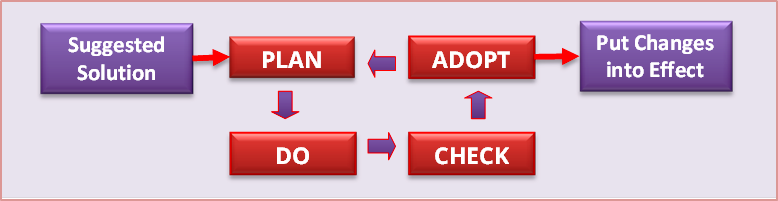
Once developed, the plans will act as the standard to be followed by everyone who manages a patient suffering from the disease, syndrome or symptom complex, in the facilities within the organization. This approach to standardization should not, in any way, discourage care providers from altering practices in peculiar situations and for unique demands. Allowance for variations may be written into the plans.
Once adopted and put into practice there is a need for audits to be performed to monitor conformance and to determine its effectiveness. Development of plans is a never ending continuous learning process.
PRACTICE OF EVIDENCE-BASED MEDICINE
Evidence-based Practice of Medicine
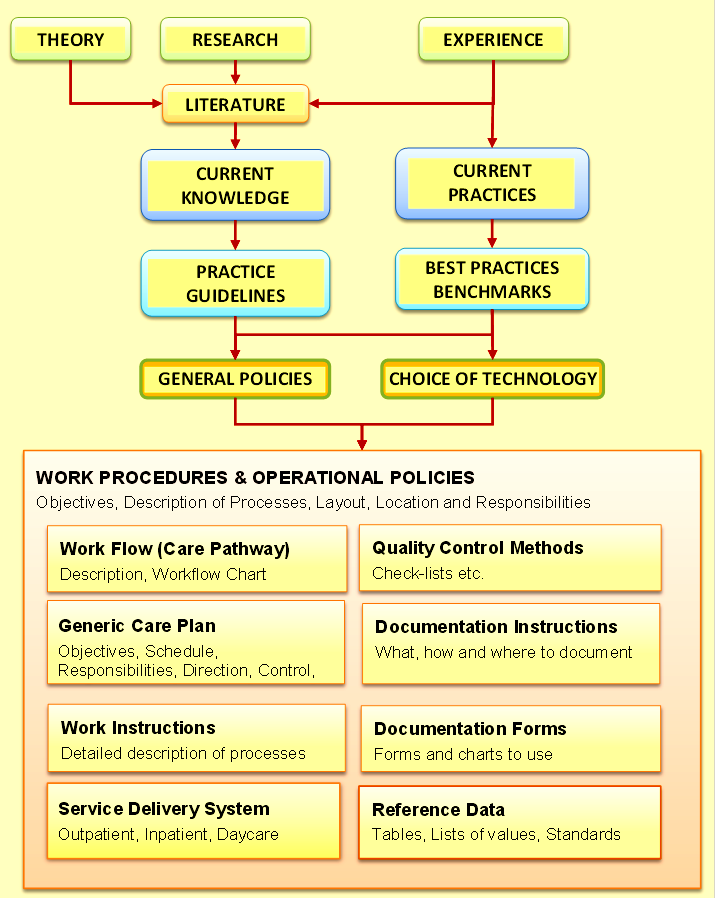
The design of SOP/Care Plans are made easier because currently there are already generic plans designed in advance by experts (e.g. professional bodies) who have thorough understanding of clinical care processes and the modalities available for investigations, treatment and monitoring. These generic plans take the form of Practice Guidelines. Based on these, more precise plans for more specific disease and patient groups can be deigned as SOP/Care Plans.
The care provider is confronted with multiple possibilities when choosing strategies, methods, approaches, technologies and modalities for investigation and treatment. Their effectiveness, appropriateness, efficiency, cost-effectiveness and safety are difficult to ascertain. Yet, it is essential that the SOPs/Care Plans in healthcare are based on evidence as well as consensus. How policies and procedures can be derived from evidence, by taking advantage of tried and tested practices, is outlined diagrammatically below:
Choice of Technology – Technology Assessment
The efficacy, effectiveness and safety of materials and machines used for delivering care need to be assessed strictly. Technology assessment is usually undertaken by a government body in charge of standards (e.g. FDA), or professional organizations. Health care facilities should only use approved machines, instruments or items and must ensure that the requirements surrounding their use are adhered to.
Practice Guidelines
The development of practice guidelines is a major step in attempting to identify and promote care approaches with proven efficacy, effectiveness and safety (evidence-based medicine). These guidelines when available, provides the ideal basis for developing a system of care.
PLANNING AS PART OF THE CARE PROCESS
Moving Away from the Traditional Way of Planning in Clinical Patient Care
The traditional way planning as practiced in patient care differs significantly from the approach in industries. In clinical patient care, based on the SOAP approach, the planning process occurs after the diagnosis has been made.
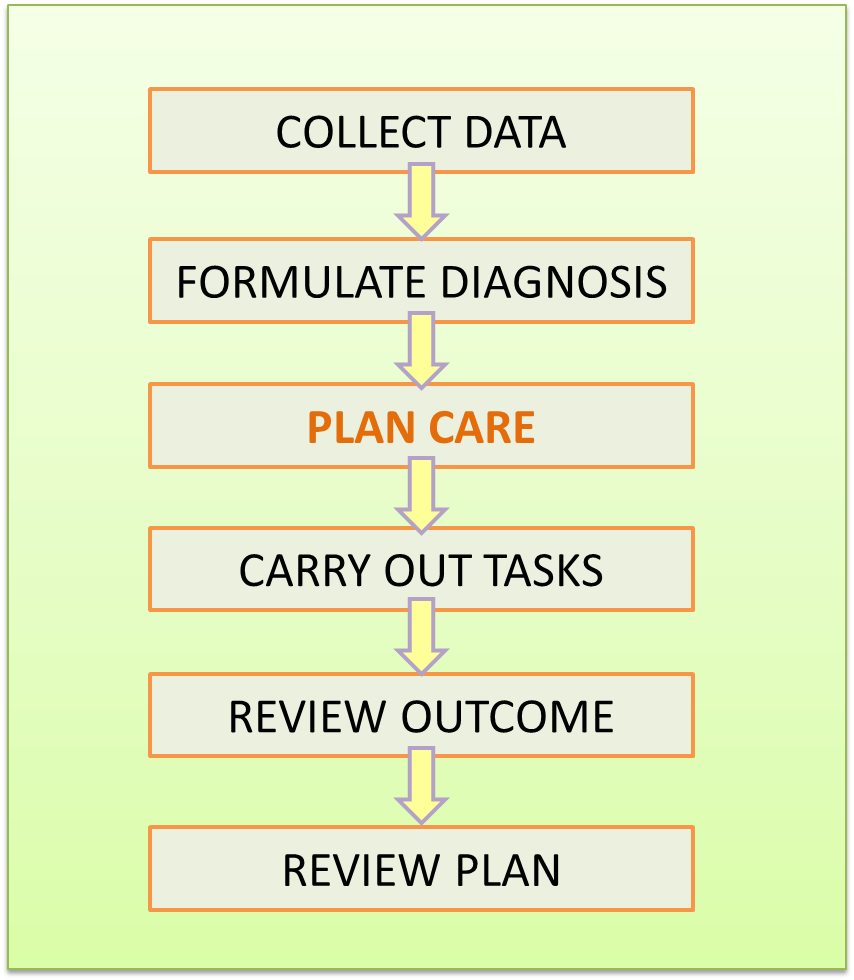
The Better Approach to Planning
Planning is part of the series of processes in the delivery of patient care (described in another article). It is a series of thought processes that are then documented. These consist of:
Planning should be a preparatory series of thought processes that are then documented. The steps as applied to all types of services and service products should be as follows:
- Identifying the case type (service product)
- Determining the objectives of care
- Deciding on and choosing the approach and method
- Deciding on and scheduling the sequence and layout of actions
- Ensuring that resources are available to carry out the plan
- Assigning responsibilities
- Anticipating issues that may arise
- Documenting the plan
The plan is then executed and the results are evaluated. It is redrawn if necessary.
When building the SOP for an organization, the following factors must be taken into consideration:
When building the SOP for an organization, the following factors must be taken into consideration:
- goals of the organization in providing the service,
- the environment existing within it,
- the resources available and its readiness
- how service delivery is organized
Managers of healthcare facilities are concerned with the viability of the service and therefore are focused on efficiency and cost-effectiveness. Clinicians on the other hand are interested in the effectiveness, appropriateness and comprehensiveness of the care given. The SOP must address all these concerns.
Plans must be feasible. Services are offered only when the facility or organization has adequate resources and capability. Otherwise, the organization must improve its ability to meet the requirements. When the plan is executed, its applicability and effectiveness should be evaluated. It is redrawn if necessary.
Patient Care as a Service Product
Defining the Characteristics of the Service Product in Patient Care
It is proposed here that the delivery of a healthcare service product is best described in the form of a Standard Operating Procedure (SOP) which otherwise can be termed as the Care Plan. Both terms refer to the predicted or planned policies and procedures in managing a clinical problem. Although it is common to depict the Care Plan as a table or matrix, this is not the best way to explain it. Tables limit the amount of content and do not show sequence and layout clearly. It is better for the structure and content of patient care plans to be similar to the SOP used in other industries.
A SOP is meant to be used as the guide to production of a particular item or the delivery of a specific service. Services in healthcare are numerous and diverse. The challenge in healthcare is to define the service for which the SOP/Care Plan is written.
Diagnosis as the Main Criteria for Differentiating Service Products
The needs of a patient (usually referred to as a case) is defined primarily by the identified diagnosis (disease, illness, or health problem). Therefore, the logical approach would be to design the SOP/Care Plans for the provision of services for patient groups (case types) affected by the same disease, illness, or health problem. That service and its outcome can be identified as a ‘service product’.
Even though diseases are diverse, the medical profession, in general, follows a uniform way of managing them as described in
https://drdollah.com/clinical-care-processes/
The Range of Service Products in Clinical Patient Care
The unique problem in patient care is that the care provider provides care as and when patients request for it. At the start, the diagnosis is rarely obvious but in most cases is uncertain. The solution is to widen the use of the term ‘diagnosis’ to include illnesses and health problems rather than just specific diseases. Therefore, when the disease is uncertain, there is a need to address the general condition first and later as the actual presenting illness, health problem, or specific disease.
The subject of the levels of accuracy and certainty is discussed in the article entitled Formulation of diagnosis.
Design of Standard Operating Procedures in Patient Care
When consolidating the design two aspects have to be looked at:
- what procedures are to be done and in what way
- how the above is to be documented
What procedures are to done and in what way must be thought out first by the persons responsible for the design. For it to be understood and followed it must be documented and made available as a written SOP/Care Plan. The content and structure of the document must then reflect the way the service is to be delivered. However, once the document is made available it becomes the the authorized guide for all care providers in the facility to follow.
Documenting what is to be done —-> Carry out what is documented
The outline of the steps to be followed by an institution or facility when developing SOP/Care Plans is outlined below:
- Identify the clients and any variations in their needs
- Identify the Service products to be offered.
- Define the expected outcome,
- Propose the service delivery system
- Propose the policies and procedures to be followed
- Outline the layout and sequence of tasks (Workflow) including alternatives where necessary
- Allocate responsibilities (organization of the care team, work schedule, task lists)
- Define the control limits of both processes and outcome (policies)
- Incorporate methods to ensure compliance with them (built-in Quality control),
The design of SOP/Care Plans in patient care requires incorporation of knowledge and methods used in other industries. With training, the terms and conventions used in operations management in other industries can be understood and adopted for use by healthcare providers, just as effectively. This would allow people in other fields such as information technology, accounting and management to understand clinical care processes.
SOP/Care Plan as a Disease-Specific Service Product Delivery Plan
The care of a patient with an illness, usually referred to as a case, is based primarily on the identified diagnosis or health problem. Therefore, the logical approach would be to design of SOP/Care Plans for the provision of services for patient groups (case types) affected by the same disease. The case types can be a symptom-complex, a clinical syndrome or a specific disease. That service can be called a service product.
Even though diseases are diverse, their classification and names (nomenclature) have been standardized e.g. as in ICD-10 Classification of diseases and SNOMED.
However, even for a particular case, the diagnosis changes as more information about it is obtained, The method would be to work from the general to the specific. The diagnosis is rather general at the beginning when it may be identified as Symptom complex and later a Syndrome or belonging to a Diagnostic related group. Subsequently with more information it the diagnosis becomes more specific and be identified as named diseases and their variants.
When diagnosed as a symptom complex, clinical syndrome, or belonging to a Diagnostic related group, patients share common problems and be given correspondingly similar initial care. SOP/Care Plans must be created for the care of patients belonging to these groups.
Subsequently, SOP/Care Plans should be developed for specific diseases. On top of that, variations of the SOP/Care Plans will have to be developed for sub-types of the disease based on pathological grading, urgency, stage at presentation, severity level, presence of complications and etc. Where there are distinct variations, services for these sub-types or variants can be considered as essentially different service products. A separate sub-set of the SOP/Care Plan should be created for each one of the sub-types or variants.
If the patient has more than one health problem, then the combination of various plans would be required.
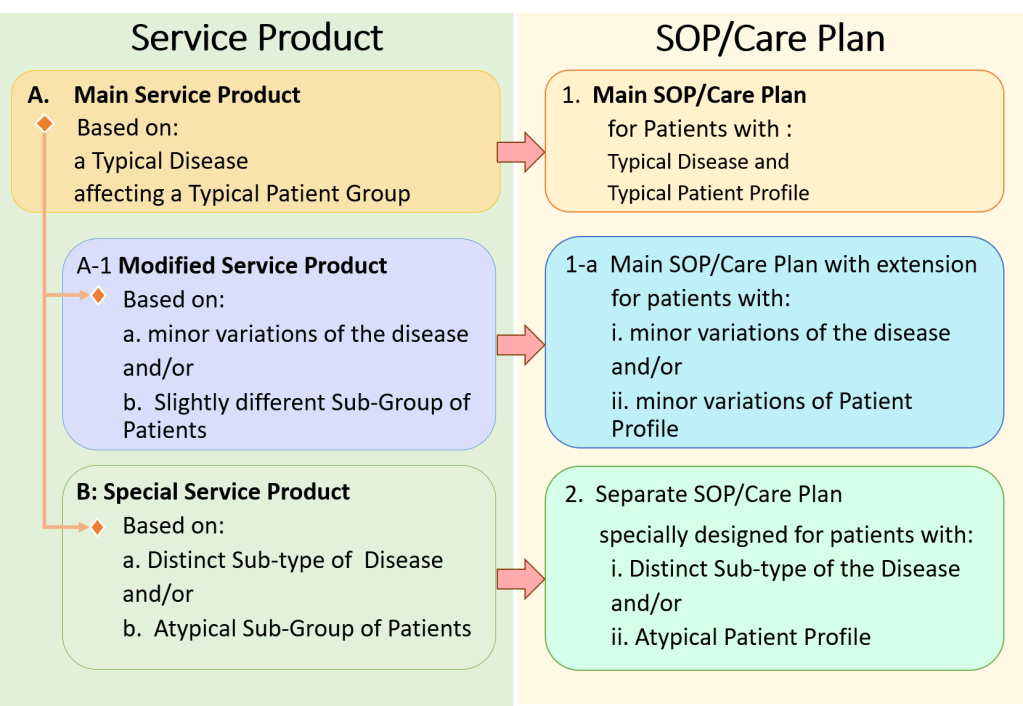
USE OF STANDARD OPERATING PROCEDURES IN PATIENT CARE
The Unique Features of the Work Procedure and Processes of Clinical Patient Care
Details regarding the steps in design is discussed in detail later. How the SOP/Care Plan is documented is discussed at length in another article.
Many methodologies, procedures and processes used in Clinical Patient Care are different from those followed in other industries. The SOP/Care Plan takes into consideration these differences. Details regarding the clinical patient care work procedure and processes will be discussed in detail later.
The design of SOP/Care Plans in patient care requires the use of many tools. Their content and structure should have the following characteristics:
- Describe an accepted way of providing care for a case
Clarify objectives of care (expected outcome, therapeutic end points) - Identify variations in patient needs and provide alternatives (Care pathway, Decision making steps)
- Outline the layout and sequence of tasks (Workflow)
- Allocate responsibilities (organization of the care team, Work schedule, Task lists)
- Define the control limits of both processes and outcome and incorporate methods to ensure compliance with them (built-in Quality control)
With training, the nomenclature and conventions used in operations management in other industries can be understood and adopted for use by clinicians, just as effectively. This would allow people in other fields such as information technology, accounting and management to understand clinical care processes. The documents and their parts making up the SOP/Care Plan for a specific case type are discussed below.
Use of the Problem Solving Methodology
Patients are persons with some sort of health problem. The service of patient care uses the problem-solving methodology and take the resolution of the problem as its anticipated outcome. Steps in resolving the problem are
- Identify the problem
- Attend to the effects of the problem
- Determine the causes
- Remove the causes if possible
- Retain the improvement
- Prevent reoccurrence
The nature of problems vary from disease to disease as well as case to case. When the variation is major, a separate SOP/Care Plan need to be written. Therefore, the SOP/Care Plan need to anticipate variations in the disease as well as eventualities in the care of the patient and provide solutions to them.
DESIGN OF THE SOP/CARE PLAN
SOP/Care Plans are basically packages of tasks bundled together, arranged and sequenced according to the clinical workflow. The overall plan provides direction to the clinician on tasks to be performed for a patient from the beginning to the end of the care episode. It is then further broken up into sections for various phases, visits and encounters within the episode.
In current practice and literature, there are many conceptions and formats that are called ‘Care Plans’ discussed in an earlier article. There is a need to develop a more effective alternative approach as proposed here.
GUIDING PHILOSOPHIES AND STRATEGIES IN THE DESIGN OF THE SOP/CARE PLAN
Some of the philosophy, principles and strategies that can guide the development of a SOP/Care Plan for patient care include:
- Application of modern management concepts and techniques
- Ensuring that the plan is feasible (usable) and acceptable to users
- Based on evidence-based medicine
- Imbued with the Total Patient Care concept (Holistic Care taking into consideration all needs of the patient)
- Reflect a team approach (care through interdisciplinary involvement and collaboration)
- Incorporation of quality standards and quality control
Cater for an enlightened patient, advocate empowerment and encourage self help - Harness information technology
- Follow a two-step process i.e. choosing an appropriate plan to be used as a reference and using it to create the plan which will be used in the actual care of the patient.
These principles and strategies are deliberated further below.
Application of Modern Management Concepts and Techniques
Strategy Based on “Quality by Design” Concepts
The design of patient care service delivery is similar to the design of other service delivery systems as practised in modern quality management (as advocated by Juran and others). These consist of a systematic sequence of steps i.e.:
- Identification of primary needs of the client (the health problem, diagnosis)
- Identification of additional / special needs based on specific client characteristics
- Setting the expected or desired outcome
- Clarifying the components of the service delivery system
- Delineating the sequence and layout of workflow (the Care Pathway)
- Clarifying and detailing the processes involved (the Work Procedure)
- Choosing the most appropriate technology/modalities to be used
- Assignment of responsibilities to various service providers
Identifying the monitoring and control measures (Monitoring, Review and Evaluation, Quality Control) - Providing the means for data documentation (Clinical Documentation, Forms, Charts)
- Catering for variations, exceptions and contingencies by providing alternatives
The topic of Quality by Design is discussed in a separate article.
Use of the Problem Solving Methodology
Patients are persons with some sort of health problem. The service of patient care uses the problem-solving methodology and take the resolution of the problem as its anticipated outcome. Steps in resolving the problem are
- Identify the problem
- Attend to the effects of the problem
- Determine the causes
- Remove the causes if possible
- Retain the improvement
- Prevent reoccurrence
The nature of problems vary from disease to disease as well as case to case. When the variation is major, a separate SOP/Care Plan need to be written. Therefore, the SOP/Care Plan need to anticipate variations in the disease as well as eventualities in the care of the patient and provide solutions to them.
Transformation of Guidelines into SOP/Care Plan
Guidelines need to be transformed (operationalized) into plans that take into account the resources, environment and objectives of the organizations providing the service. There is a need to show that these plans are feasible, effective, usable and acceptable before being adopted and endorsed by the people in charge (e.g. Clinical Services Committee, Medical Advisory Committee, Clinical Governance Committee and the Hospital Management). As such, the SOP/Care Plan is valid for use within the organization that develops it.
For the SOP/Care Plan to remain valid it has to be continually updated. The best way is to audit the SOP/Care Plan both in terms of the adherence to them and also their effectiveness in achieving intended objectives. Findings from the audit is then used to improve conformance as well as to rectify the SOP/Care Plan itself.
Inclusion of All Steps of the Clinical Care Process
In the past, care plans tend to focus on treatment. It is proposed here that the scope of the SOP/Care plan should be comprehensive so as to include all the clinical care processes. The content will therefore include:
- Generating, obtaining, gathering and collection of data about the patient and his/her disease (interview, physical examination, simple tests)
- Analysis and interpretation of data to determine the diagnosis and needs of the patient
- Formulating the actual care plan
- Treatment (symptomatic, supportive, preventive, rehabilitative, palliative)
- Monitoring of the progress of the disease (using various parameters)
- Monitoring of the effects of treatment (outcome, adverse effects)
- Review of diagnosis and management
- Disposal of the case (continuation, discontinuation of care)
Instead of ‘treatment’ or ‘therapy’ the term ‘care’ is used to reflect this inclusiveness and cohesiveness. Hence, the philosophy and practice of Total Patient Care or holistic care which addresses all aspects of the patient’s health issues for both the short-term as well as the long-term should be adopted.
INCORPORATION OF THE TOTAL PATIENT CARE CONCEPT (HOLISTIC CARE)
The care must also be comprehensive in terms of the objectives such that the following modes of therapy are included:
- Symptomatic therapy
- Supportive therapy
- Preventive therapy
- Rehabilitative therapy
- Palliative therapy
- Promotion of Health
The SOP/Care Plans need to be comprehensive, cohesive and orderly. A comprehensive patient care plan based on the philosophy of Total Patient Care or holistic care to patient care should be adopted. and This approach addresses all aspects of the patient’s health issues for both the short-term as well as the long-term. The design of such SOP/Care Plans would require the contribution of all relevant health care professionals involved in the care of each class of patients. This can be achieved through the formation of Interdepartmental or Cross-Functional Teams. The SOP/Care Plan must be based on good evidence (e.g. Clinical Practice Guidelines) supplemented by knowledge and experiences of members of the team. (For details, please refer to the article entitled “The Total Patient Care Concept”).
Involvement of All Healthcare Professionals
The design of such SOP/Care Plans would require the contribution of all relevant health care professionals involved in the care of each class of patients. This can be achieved through the formation of Interdepartmental, or Interdisciplinary or Cross-Functional Teams. The SOP/Care Plan must be based on good evidence (e.g., Clinical Practice Guidelines) supplemented by knowledge and experiences of members of the team. (For details, please refer to the article entitled “The Total Patient Care Concept”). The involvement of all relevant health care professionals encourages each of them to:
- be interested in the overall well-being of the patient,
- understand the overall care plan,
- be able to respond to a patient’s query regarding every aspect of his/her care
- contribute to the success of the overall plan, wherever possible
Catering for an Enlightened Patient, Advocating Empowerment and Encouraging Self Help
Most patients have sufficient knowledge about health in general and about their illness. The SOP/Care Plans should enable the patient’s involvement in the care of his/her own illness, either by assisting the care providers or through self-care. Patients with minimal knowledge and interest regarding their health should be persuaded to be involved in the care of their own health through education and encouragement. There should be a built-in policy of providing explanations to patients regarding their illness and the care being given. Patients should also be consulted and allowed to make choices when there are alternatives.
Management of Exposure of Risks to patients
Patients are open to risks when receiving care. They can be affected by
- the predispositions induced by the infirmity induced by their illness
- adverse effects of the modalities of treatment,
- the environment of the healthcare facility
Assessment of risks
Anticipation
Prevention
Composition of the SOP/CARE PLAN
SOP/Care Plans are made up of tasks to be performed to produce a product or to offer a service (a service product) and the policies that govern them. For them to be standardized, they need to be documented in a structured way. There should be an SOP/Care Plan for every service product.
Plans must take into consideration the resources, environment and goals of the organization providing the service. There is a need to demonstrate that these plans are feasible and effective through trial or pilot studies. Before being adopted, it should be verified by the persons/committee responsible for Clinical Governance and formally endorsed by the executive body of the organization.
DIFFERENCES BETWEEN IMPLEMENTING SOP IN CLINICAL CARE AS COMPARED TO OTHER SERVICES
In manufacturing industries the products have well defined specifications and so also are the input and processes used. In service delivery, the service product has specifications that are not so strictly defined and often there is a need for the delivery to be customized and personalized to fit the special needs of the recipient. This need is more acute in healthcare services.
As such, the main SOP/Care Plan can be a general plan for a typical disease, Variations in the disease itself can be anticipated and plans for its care can be written as extensions to this main SOP/Care Plans. When the variation is major a separate SOP/Care Plan need to be written. In addition, another step, i.e. the conversion to the plan that will be used for actual care, is necessary.
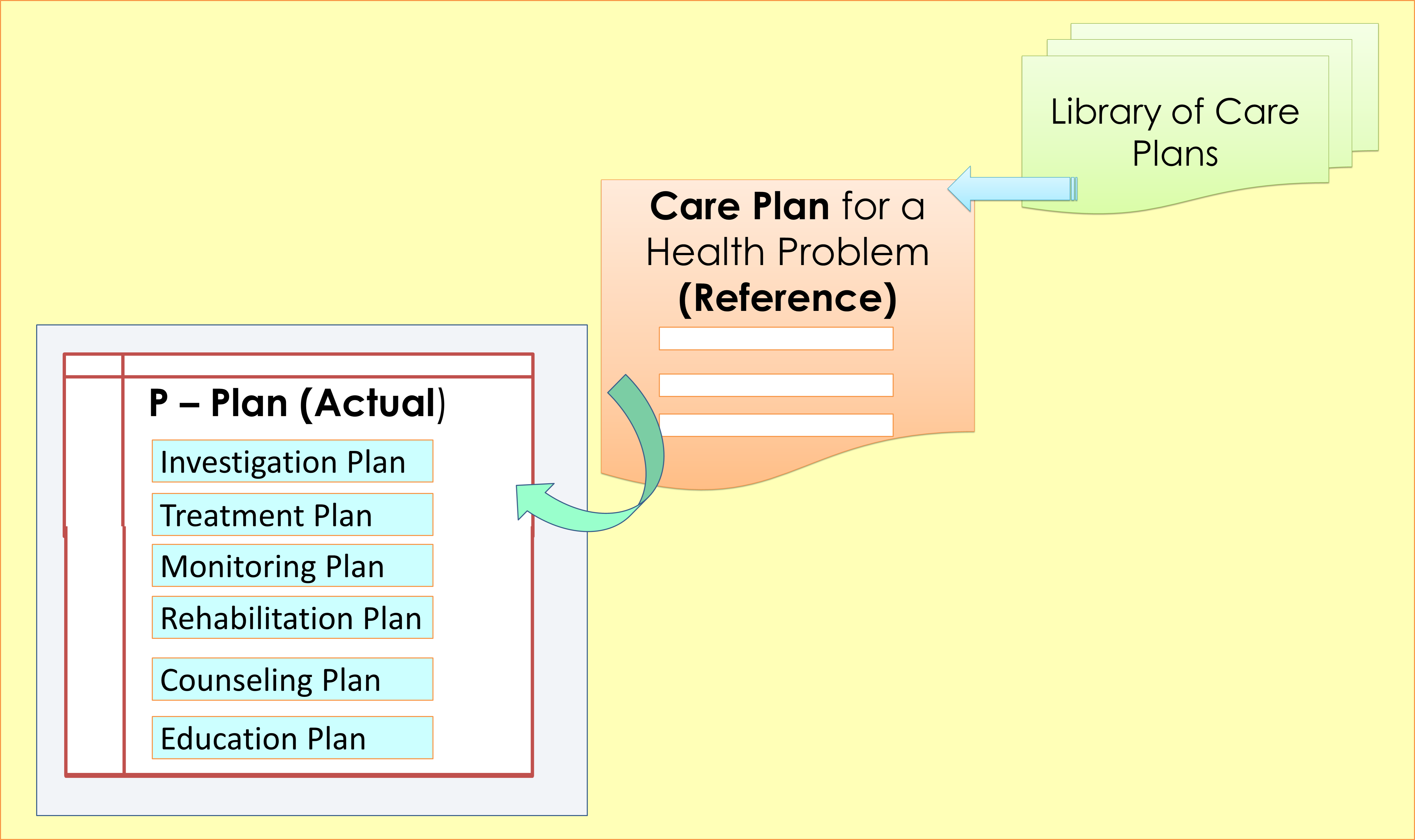
The Unique Features of the Work Procedure and Processes of Clinical Patient Care
Details regarding the steps in design is discussed in detail later. How the SOP/Care Plan is documented is discussed at length in another article.
Many methodologies, procedures and processes used in Clinical Patient Care are different from those followed in other industries. The SOP/Care Plan takes into consideration these differences. Details regarding the clinical patient care work procedure and processes will be discussed in detail later.
Flexibility in Design
SOPs are often criticized for being rigid. In fact, the opposite is true. By offering different directions and paths, the SOP/Care Plans offer alternatives in managing a patient based on various valid criteria. SOPs/Care plans are designed to suit different anticipated scenarios (see below). Where there is a choice of methods (e.g. tests) or material (e.g. drug, suture) without major difference in effectiveness or safety, the care provider is given an option to choose one based on being the best suited, available or or according to the patient’s preference. Indeed, the care provider may choose to modify procedures and plans as long as these do not deviate from core policies as long as the variance (intentional or otherwise) is noted.
Varied Nature of Clinical Patient Care as Service Products
To clinicians, the ‘care’ or ‘the management of a patient’ is the provision of the entire service or care for a certain patient according to his/her needs which are determined largely on the identified diagnosis or health problem. The title of the reference SOP/Care Plan should show that it is designed for the ‘care’ of this specific disease or health problem. As such, the Service product consists of a well-defined set of services to be provided for a typical patient (case) who has an episode of a specific illness. Yet it is, to a certain extent, still generic and would need customization, by additions or omissions, when it is used as the Actual SOP/Care Plan in the actual care of an individual patient.
The needs of each patient varies quite significantly depending on many factors. Thus personalization i.e. variation of the care given to a particular patient must be done not only at the beginning of the service but also throughout the service delivery period because the needs often varies as the care and the disease progresses. Hence, it is necessary to modify the original SOP/Care Plan, from time to time (throughout the phases of care) during actual implementation.
Concept of Reference vs Actual SOP/Care Plan
In most industries, in order to produce products that are consistent, the SOP is used directly and strictly by all workers with little or no modification. This approach is not advisable for services in healthcare. Standard SOP/Care Plans cannot satisfy a patient’s needs fully. Besides the attention to the illness and its effects, care plans also need to have consideration for the general needs of the patient (i.e. a sick person). These are often unique and cannot be anticipated. Therefore the clinician is given some leeway in making some alterations when necessary.
Planning has always been regarded as an essential clinical process. Without a guide, the clinician thinks out the plan intuitively by applying his/her innate knowledge to the problem at hand. If the problem is common and familiar, he/she will repeat the plan that he/she has used before. However, the drawback is that often the time available to think out the plan is limited or he/she may find his/her knowledge and experience inadequate to put together a solution for the problem at hand. The reference SOP/Care Plans fulfill the need for a reliable, comprehensive, and easily applicable guide. However, it must allow for flexibility during implementation.
Two Step Process in Implementing SOP/Care Plan
As discussed earlier the documented SOP/Care Plan cannot be used directly. Instead, it is made available for reference based on which the actual operating procedure for a particular case is devised.
The Reference Plan is provided as a document. To use it, each relevant part is adopted with or without modification and re-documented in the system controlling the operations of the service delivery (paper medical record or computerized information systems). The Actual SOP/Care Plan is a statement of intent listing out the intended sets of tasks to be performed and their objectives (expected results or outcome). It is derived from the Reference Plan.
Therefore, it is essential that planning of patient care follow a two step process i.e. choosing an appropriate plan (termed as the Reference plan) and using it to create the plan which will be used in the actual care of the patient (termed as the Actual plan). The Reference Plan is transformed into an Actual plan or in other words, the Actual Plan is derived from the Reference Plan.
In practice, when using a SOP/Care plan, the planning process is done in two major steps i.e.:
- Choosing the appropriate Reference (Model) Plan from the library of previously prepared care plans
- Converting the chosen reference plan into an Actual (Operations) Plan by customizing it to cater for the special needs of the patient
In practice, the Actual plan is the definite plan and is documented as part of the Medical Record. Constructing the Actual plan is the responsibility of the clinician(s) looking after the patient. However, there are exceptional instances when a practitioner from a different professional group make take the lead. Constructing the Actual plan is the joint responsibility of all the clinicians looking after the patient.
For each case, the primary provider of care (usually the doctor in charge) acts as the leader and is the most suitable person to choose the appropriate Reference plan. However, there are exceptional instances when a practitioner from a different professional group make take the lead. Constructing the Actual plan is the joint responsibility of all the clinicians looking after the patient.
After choosing a plan that matches the needs of the individual patient, the care provider uses his/her own special knowledge, skills and discretion to modify it. Patient care plans need to be individualized and customized by the care provider by putting together all available information, choosing the most relevant subset of the plans, combining them and adding or omitting certain options. In a computerized system the choice and combination can be prompted or suggested. The resultant plan is then the actual operating procedure or plan of care to be implemented.
Use of the SOP/Care Plan as the Reference Plan
The Reference Plan
Conversion of Generic SOP/Care Plans for Use on an Individual Patient
Reference plans are generic. They give comprehensive instructions on the care to be given and the expected outcome. Besides reference SOP/Care plans for various levels of accuracy of the diagnosis, consideration must be made for the needs of various types of patients (e.g. age, co-morbid status, health status before illness). These considerations may be made available as extensions, addendum or exceptions.
At the beginning, the efforts must be made within the healthcare facility to design standardized plans that are generic in nature i.e. applicable to typical patients with a typical disease condition. All such plans should be made available (by whatever means) as a properly indexed comprehensive library. The Reference plan for a particular case is selected from this library.
The planning of care of an individual patient is devised based on the working diagnosis. Parts of the SOP/Care Plans constantly guides the clinician on the tasks to be done including alternative actions to take at certain points as the care progresses. This means that various alternative plans must be prepared for various possible scenarios. A care provider who starts with a particular plan may switch to an alternative plan later.
All aspects of care must be addressed at the time of the development and design of Reference Plans. As far as possible all objectives (outcome), policies and processes are thought out, eventualities anticipated, and variations considered. As the care of a patient is a multidisciplinary effort, each professional group should be involved. For example, a section for nursing care should be included in the Reference plan. It should address the aspects of nursing required for the disease, illness, or health problem for which the plan is written. There should not be a separate Nursing Care Plan standing on its own. The same is true for plans for rehabilitation or the care for psycho-social issues. This is in contradistinction with current practice.
After choosing a plan that matches the needs of the individual patient, the care provider uses his/her own special knowledge, skills and discretion to modify it. Patient care plans need to be individualized and customized by the care provider by putting together all available information, choosing the most relevant subset of the plans, combining them and adding or omitting certain options. The resultant plan is then the Actual Care Plan to be implemented.
The planning of care of an individual patient is devised based on the working diagnosis. Parts of the SOP/Care Plans constantly guides the clinician on the tasks to be done including alternative actions to take at certain points as the care progresses. This means that various alternative plans must be prepared for various possible scenarios. A care provider who starts with a particular plan may switch to an alternative plan later.
The process of conversion of the Reference plan to the actual plan will be discussed in detail later.
Building Reference Plans for Alternatives, Variations, Options and Contingencies
Care Plans are designed mainly on the basis of diagnosis. At the initial phase of care, the diagnosis is broad or general. Subsequently, as more information is available, a different diagnosis may be made. Hence, it is not good enough to continue using the SOP/Care Plan based on the initial diagnosis. If the diagnosis differs significantly a more appropriate SOP/Care Plan must be chosen as a replacement.
During the course of patient care, the amount and clarity of information available to the care provider increases and the diagnosis becomes more accurate or new problems emerge. If the change is minor then the plan is revised accordingly. If these changes are significant, another more relevant plan or sub-type of it is chosen. The SOP/Care plans must be changed to reflect the type of care required for any change in diagnosis. Hence, appropriate reference plans need to be built and made available for:
- the variant of the disease (pathological grade, clinical onset)
- the stage of its natural history (early, late)
- severity grading
- patient profile / category (age, gender, risk factors, confounding factors)
Reference SOP/Care Plans are constructed, compiled, indexed and kept as a set of reference documents (a properly indexed library of those documents referred to in industry as the Work Procedure Manual) and made accessible to care providers. Each document consists of various components that address various aspects of care (written as sections and paragraphs). The components would be like those in SOPs already in use in other industries as will be outlined below.
If the patient has more than one health problem, then the application of a combination/amalgamation of the generic plans into one actual plan would be necessary (as depicted below).
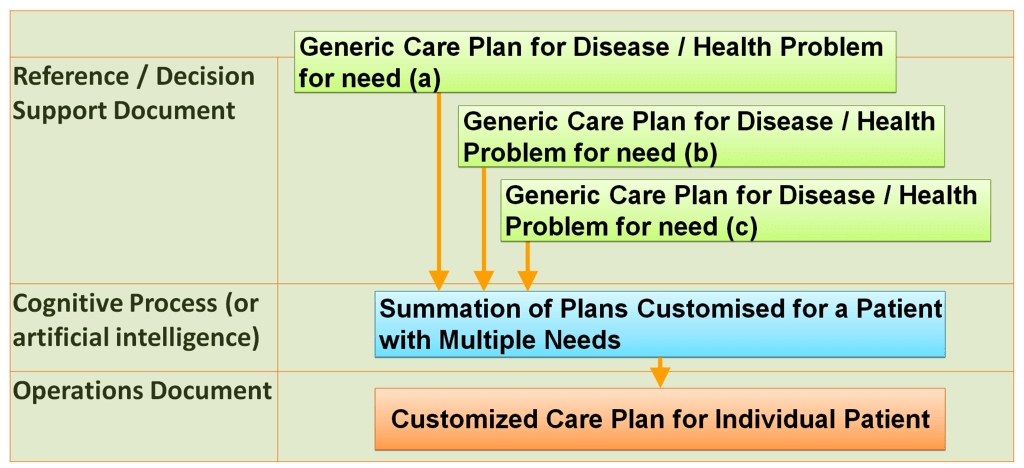
Steps in Developing SOP in Patient Care
The steps relate to the thinking processes used in planning rather than the way the SOP document is written. How SOP is developed in industry (described earlier) plus ideas used in the development of Care Plans and lessons learned from it is adopted with some modifications for use in clinical patient care. The steps are as outlined below and each will be discussed in detail.
Technique of Converting Reference Plans into Actual Plans
Steps in Developing SOP in Patient Care
The steps relate to the thinking processes used in planning rather than the way the SOP document is written. How SOP is developed in industry (described earlier) plus ideas used in the development of Care Plans and lessons learned from it is adopted with some modifications for use in clinical patient care. The steps are as outlined below and each will be discussed in detail.
- Identification of the Service Product to be Delivered based on the Needs of the Patient
- Setting the Standards for the Expected or Desired Outcome
- Putting in Place the Service Delivery System (specifications and standards of the input and process)
- Design and Construction of the Methods of Delivery of the Service Product.
- Establishing control measures (Quality Control)
These same steps is used for streamlining the three stages in the development of SOP/Care Plans i.e.
- understanding SOP/Care Plans
- documenting SOP/Care Plans
- implementing SOP/Care Plans
For the three purposes the steps are not exactly identical. Each of these steps is discussed further below. SOP/Care Plans are standardized, by documenting them in a structured way (described briefly below and in detail in another article). The method of documentation of the SOP/Care Plans is discussed in another article.
Note for STEP 1:
Identifying the case type (Primary Diagnosis) and Disease complexity (type, pathological grade, Stage, Severity Level, complications of the disease )
Identification of additional / special needs based on characteristics specific to the client (premorbid status, preexisting disease, etc.)
STEP 1: Matching the the Service Product with the Needs of the Patient
The service product for which the SOP/Care Plan is developed must be identified and named clearly.
A healthcare facility or a care giver provides services for the care of a person with an illness, disease or health problem i.e. a patient. When formally enrolled and registered he/she becomes a client, which in clinical parlance is termed as a case. The next step is to decide on what service is to be delivered to him/her.
The chosen SOP/Care Plan becomes the preliminary plan that can be customized by adding or removing certain elements before being confirmed as the actual plan and used.
If the Reference plan is made available on paper (e.g. a booklet or manual), the provider may transcribe (rewrite) parts of it on the case notes (paper medical record).
If it is provided on a personal computer, then the plan can be copy-pasted and modified before being printed. The printed copy is then incorporated as part of the paper medical record. The plan is still on paper but this reduces the extra work of rewriting/transcribing it.
In a computerized information system (Hospital Information System, Clinical Information System), various SOP/Care Plan documents can be given as reference documents as part of the application. Care providers can select the relevant plan through a search mechanism or from a drop down menu. Rationalization of the plan e.g. omitting redundancies can be done automatically. The system can also incorporate means of suggesting an appropriate SOP/Care Plan based on the documented diagnosis and other parameters. There is a wider range of possibilities of manipulating the document when a computerized system is used. For example, if the patient requires the use of multiple plans the combination and permutation can be done based on artificial intelligence.
The Patient as a Client
A healthcare facility or a care giver provides services for the care of a person with an illness, disease or health problem i.e. a patient. When formally enrolled and registered he/she becomes a client, which in clinical parlance is termed as a case. The next step is to decide on what service is to be delivered to him/her.
The Needs of the Patient
The service of patient care is geared towards solving problems for which the patient is seeking help. The nature of problems vary from disease to disease as well as case to case. When the variation is major, a separate SOP/Care Plan need to be written. Therefore, the SOP/Care Plan need to anticipate variations in the disease as well as eventualities in the care of the patient and provide solutions to them.
Further to that, the need of each patient varies quite significantly depending on many factors. Thus personalization i.e., variation of the care given to a particular patient must be anticipated not only at the beginning of the service but also throughout the service delivery period because the patient’s condition often vary as the care and the disease progresses. Hence, it is necessary to modify the original SOP/Care Plan, from time to time (throughout the phases of care) during actual implementation.
Primary Needs of the Patient
- Identifying the case type (Primary Diagnosis) Disease complexity (type, pathological grade)
- Severity Level
- Stage of the disease
- Effects and complications of the disease
Proper planning of care requires an understanding of the needs of the client which in patient care is the patient i.e., a person who is sick. Patients do not usually present to care-providers with readily identifiable health problems. Patients may or may not know what to expect from the care to be given. It is important to address their perceived needs but often they have unreasonable expectations or on the other hand have little hope. It is the responsibility of the health care professional to determine their real needs and what outcome can be expected. Therefore, before a service is provided, care providers need to gather information about the patient, analyze it and identify his/her problems. The primary needs relate to the disease, illness or health problem affecting the patient and are identified when a diagnosis is known. These needs are consistent, and known to healthcare professionals. Besides the main illness the patient often has secondary needs arising from concurrent illness, preexisting illnesses, unresolved previous illness, disabilities and other health problems. These are not the same for every patient and therefore cannot be anticipated but should be addressed during the actual planning of care by the care provider taking charge of the patient. (Secondary and tertiary needs are discussed in another article).
The Unique Features of the Work Procedure and Processes of Clinical Patient Care
Details regarding the steps in design is discussed in detail later. How the SOP/Care Plan is documented is discussed at length in another article.
Many methodologies, procedures and processes used in Clinical Patient Care are different from those followed in other industries. The SOP/Care Plan takes into consideration these differences. Details regarding the clinical patient care work procedure and processes will be discussed in detail later.
Variety Of Service Products of Clinical Patient Care
The need of the patient as a client is expressed less clearly than that in other services. While the typical disease as described in a textbook usually encompass all presentations of it, different categories and variations of the disease may be considered as different service products.
Interpreting the nature of the health problem inappropriately and therefore choosing an inappropriate plan would lead to dire consequences. Because of this differentiation, when documenting the SOP/Care Plan consideration must be to the situations:
- when the difference is significant enough for a separate SOP/Care Plan to be designed
- when different styles, content, and structure are required
Building SOP for Different Types of Service Products
Firstly a SOP/Care Plans is designed such that the service given is adjusted to cater for the practices peculiar to patient care. Hence, well accepted and proven approaches, methods and tools already in use in health care must continue to be applied.
Next , SOP/Care Plans contains a defined set of services making up the care for a patient affected by a typical disease, illness or health problem. It is designed to cater for needs determined largely on the identified diagnosis.
Additionally, plans must be prepared for the variants of the disease as:
- sub-sets, extensions or appendices to this main SOP/Care Plan.
- separate distinct plans if the variant need to be cared for differently.
If the SOP/Care Plan conforms to the universal practice of patient care, they can be applied at any facility except that they will have to be modified to suit its capability.
Flexibility in Design
SOPs are often criticized for being rigid. In fact, the opposite is true. By offering different directions and paths, the SOP/Care Plans offer alternatives in managing a patient based on various valid criteria. SOPs/Care plans are designed to suit different anticipated scenarios (see below). Where there is a choice of methods (e.g. tests) or material (e.g. drug, suture) without major difference in effectiveness or safety, the care provider is given an option to choose one based on being the best suited, available or or according to the patient’s preference. Indeed, the care provider may choose to modify procedures and plans as long as these do not deviate from core policies as long as the variance (intentional or otherwise) is noted.
Diagnosis as the Primary Basis for Design of SOP/Care Plans
A SOP/Care Plan is designed for a service product which in turn is defined primarily by the diagnosis. Clinicians use the term Working diagnosis to denote the best diagnosis that can be deduced at any point. The best diagnosis here refers to the degree of certainty of the diagnosis based on the information available. This is the diagnosis that form the basis for the design of the SOP/Care Plan at any current phase of care.
At the initial phase of care, based on clinical experience and study, the diagnosis for some health problems can be made with high degree of certainty by relying on the presence of certain symptoms, signs and results of simple point of care investigations. In other words, the diagnosis is obvious and is often termed as the “spot diagnosis”. In this situation, a comprehensive plan for the case can be chosen and adopted.
However, for most other cases, the diagnosis at the initial phase is less clear. Yet for some, the information available allows the clinician to assign the patient to the diagnosis of known symptom complexes, syndromes, or Diagnostic Related Groups (DRGs). A symptom complex or syndrome are disease conditions that have typical set or pattern of manifestations (group of symptoms, signs and test results) attributable to diseases affecting a particular body region, a physiologic system or of a particular aetiology. Such diagnoses even though not totally clear can be exploited for the following benefits
- narrow down the differential diagnosis to diseases pertaining to an anatomic region, a physiological system or a causative pathology.
- give pointers to what to do next (e.g. more detailed interview, clinical examination and type of investigations to be performed).
- allow for certain treatment to be initiated e.g. symptom relief, preventive actions, general or specific supportive measures.
It is the common manifestation of many possible diseases (e.g. Obstructive jaundice, Bleeding disorder and Upper Gastrointestinal Bleeding).
There is a substantial proportion of cases where the diagnosis is unclear or uncertain. The reason for visit may be vague symptoms or symptoms and signs attributable to a wide variety of illness, or generalized feeling of ill health that does not point to disease of an organ or physiologic symptom.
Subsequently, as more information is available, a different diagnosis may be made.
Hence, it is not good enough to continue using the SOP/Care Plan based on As the amount and quality of data is available to the clinician increases, the working diagnosis becomes more accurate changing from a broad or general diagnosis, to a provisional or presumptive diagnosis and then to a definite diagnosis. This effort at ascertaining the most accurate and certain diagnosis occurs mainly in the early phase of care. At this phase the diagnosis can be initially uncertain expressed as symptom complexes, clinical syndromes and disease groups or certain (definite) expressed as specific disease.
Even if the diagnosis is considered as definite, developments in later phases may point to more accurate diagnosis such as variants and sub-types of the disease. Certain contingencies may happen that will necessitate changes in the care plan.
Choosing a Model Plan from a Library of Reference Care Plans
Illness, Disease and Health Problem
Persons who are sick are affected by ailments that by convention are loosely categorized into illnesses, health problems or specific diseases.
| TERM | MEANING |
|---|---|
| Illness | The feeling that something is not normal about a person’s health. It may be part of a disease, which may still be undetected. Symptom complexes and clinical syndromes can be considered as illnesses. |
| Disease | A specific condition of ill health distinguishable by a known set of criteria that can be a mix of: — clinical manifestations, — underlying pathological process detected through tests or — observed behavior. Disease usually show up as illness. However, they can also exist without any obvious manifestation (latent, dormant, asymptomatic) and detected through tests. |
| Health problem | A condition where a person’s well-being has deviated from normal in function or appearance. It can be: — part of an illness, — an infirmity, disability. deformity or malfunction, — physiological changes (e.g. pregnancy, malnutrition). |
Reference SOP/Care Plans should be constructed for all entities within these categories. They are compiled, indexed and kept as a set of reference documents which, when properly indexed, are referred to in industry as the Work Procedure Manual. Each document consists of various components that address various aspects of care (written as sections and paragraphs). The components would be like those in SOP already in use in other industries as will be outlined below.
The SOP/Care plans remain as a reference document until it is converted into an actual plan by customizing it for the individual patient. The finalized plan should be a specific integrated plan that will cater for all the needs of the patient.
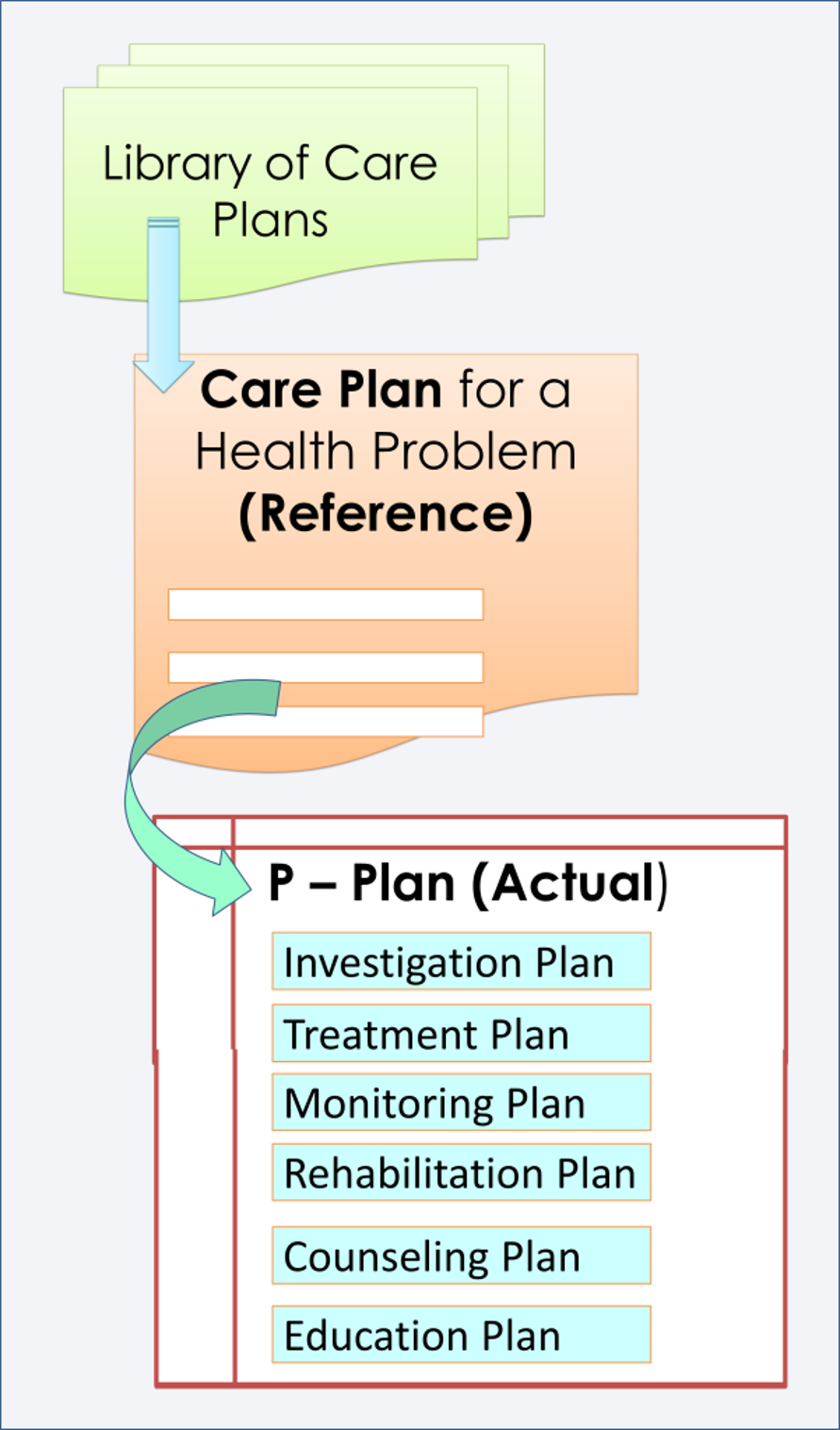
Appropriate Plans for Different Levels of Accuracy of the Working Diagnosis
From the perspective of developing SOP/Care Plans for service products, ailments must be categorized more objectively. This objectivity depends on the levels of accuracy of the working diagnosis.
It is often thought that SOP/Care Plans can only be designed for when a specific disease has been diagnosed. This is not true because care must be instituted even when the definite diagnosis has not been identified with certainty. The plan for the service to be offered to the patient must be made available as soon as the patient seeks care at the facility.
Levels of accuracy of the working diagnosis increases as the patient care process advances through its phases. The characteristics of the service product changes at the different levels of accuracy of the working diagnosis. Hence, SOP/Care Plans must be created for the care of patients diagnosed at these levels of certainty i.e.:
- When the diagnosis is general or uncertain
- When a specific disease has been identified
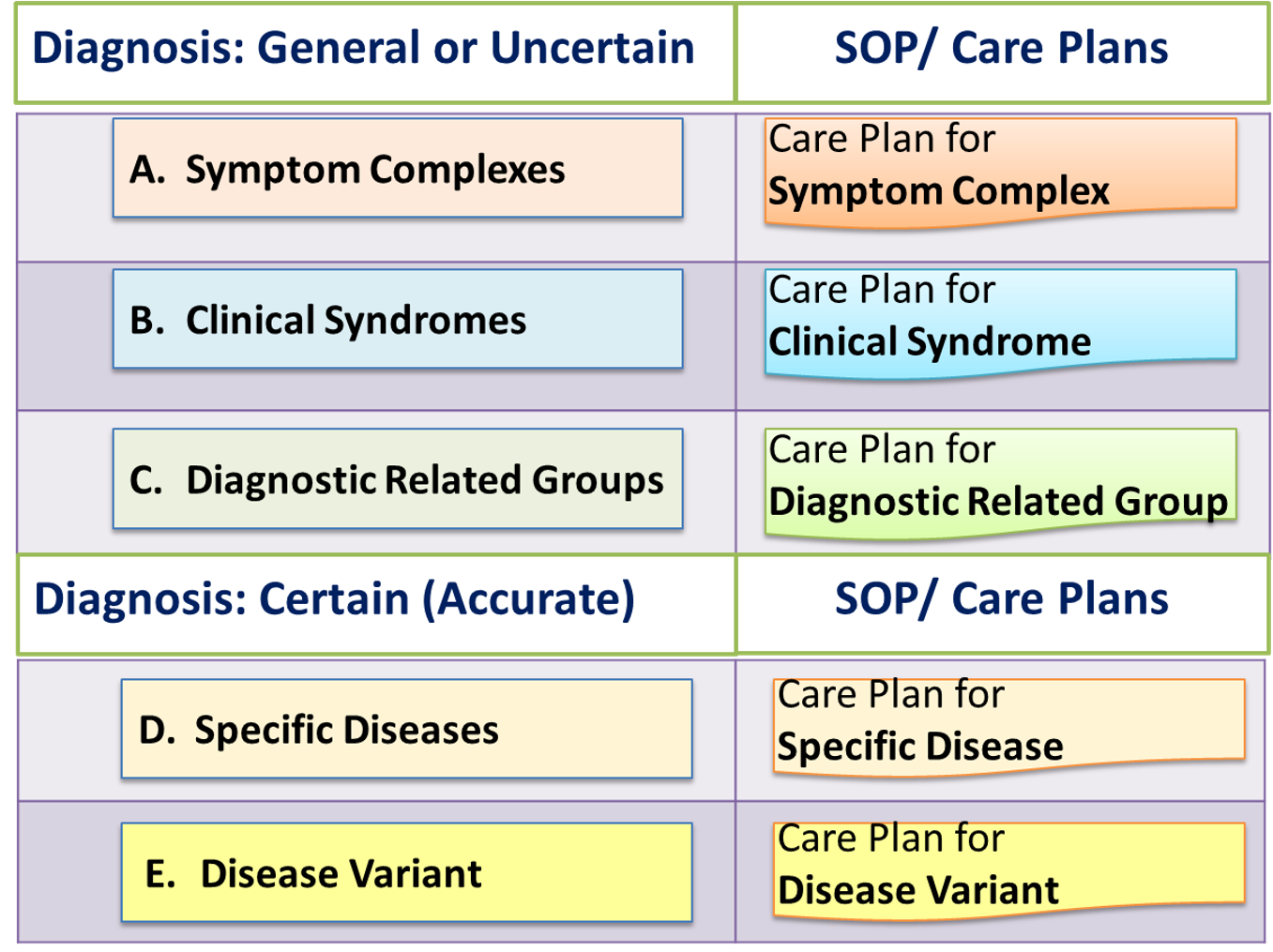
The primary care provider (usually the doctor in charge) is the person responsible for arriving at the diagnosis. Therefore, he/she is also the person to select and initiate the care plan and to change it as the care progresses.
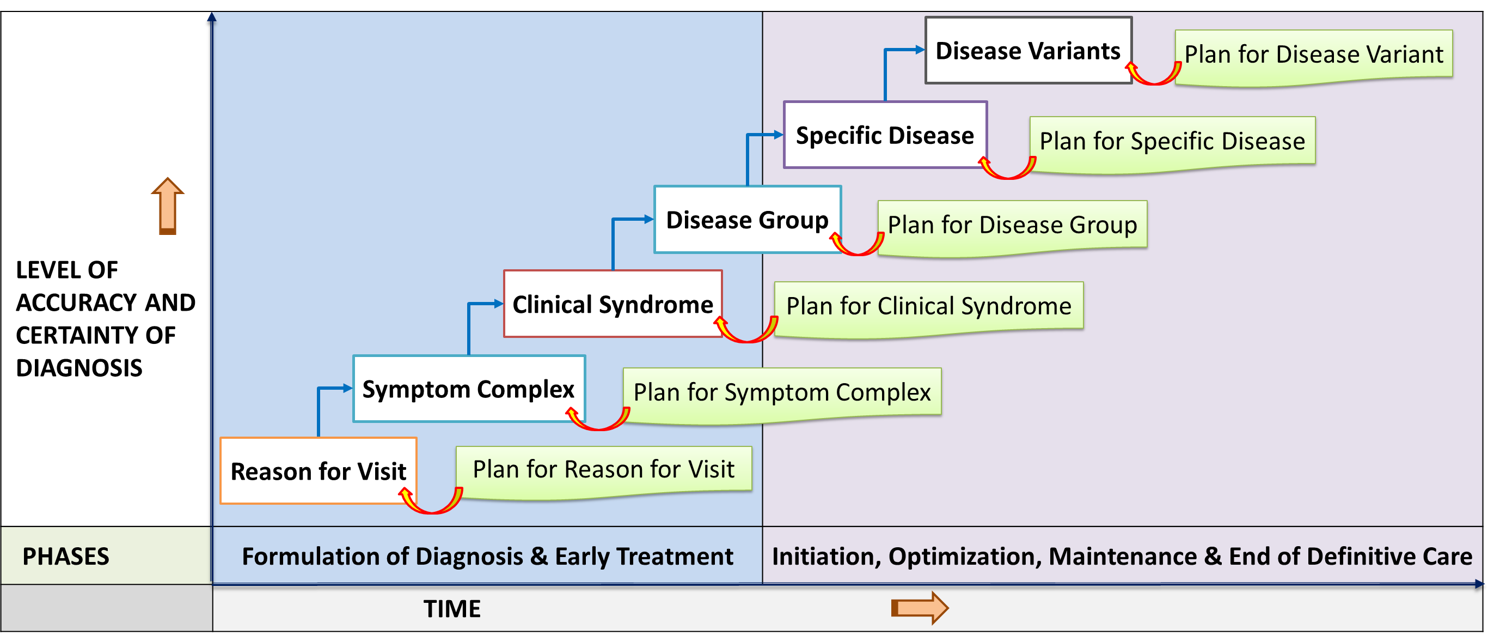
The service product can be named after entities corresponding to these wide range of diagnosis using accepted terminology e.g., derived from ICD-10 Classification of diseases or SNOMED. As the diagnosis changes different service products will be offered to the patient. The various types of service products will be discussed further below.
| Working Diagnosis | Objectives | Plan and Content |
|---|---|---|
| A. Symptom complex B. Clinical Syndrome C. Diagnostic Related Group D. Clinical Syndrome | a. Symptom relief b. Resuscitation c. Stabilization d. Obtaining sufficient data | Care plan to a. Determine Diagnosis — Gather Clinical data — Investigate b. Early Treatment — Relief symptom — Restore function — Stabilize |
SOP/Care Plans For Symptom Complexes, Syndromes And Diagnostic Related Groups
When the diagnosis is expressed as Symptom complexes, Clinical syndromes or Diagnostic Related Groups, the SOP/Care plan contains activities aimed at:
- clarifying the diagnosis further through diagnostic investigations
- providing treatment for symptom relief
- providing supportive therapy (resuscitation, stabilization)
- establishing monitoring and observation routines
introduction of preventive measures and rehabilitation
These activities occur at the early period (phase) in the of the care episode. They will be discussed in detail later.
The effort of clarifying the diagnosis may yield a diagnosis that is a group of diseases rather than a distinct disease. For example, Pneumonia refers to a group of diseases characterized by infection of the lung consisting of Lobar pneumonia, Bronchopneumonia, Atypical pneumonia and variants related to the causative microorganism. As such Pneumonia is a diagnostic related group (DRG) rather than a specific disease. A SOP/Care plan has to be written for this DRG because it is important to provide the initial care of Pneumonia even when the cause is uncertain. When its variants are identified later, a specific SOP/Care Plans (based on causation) are required.
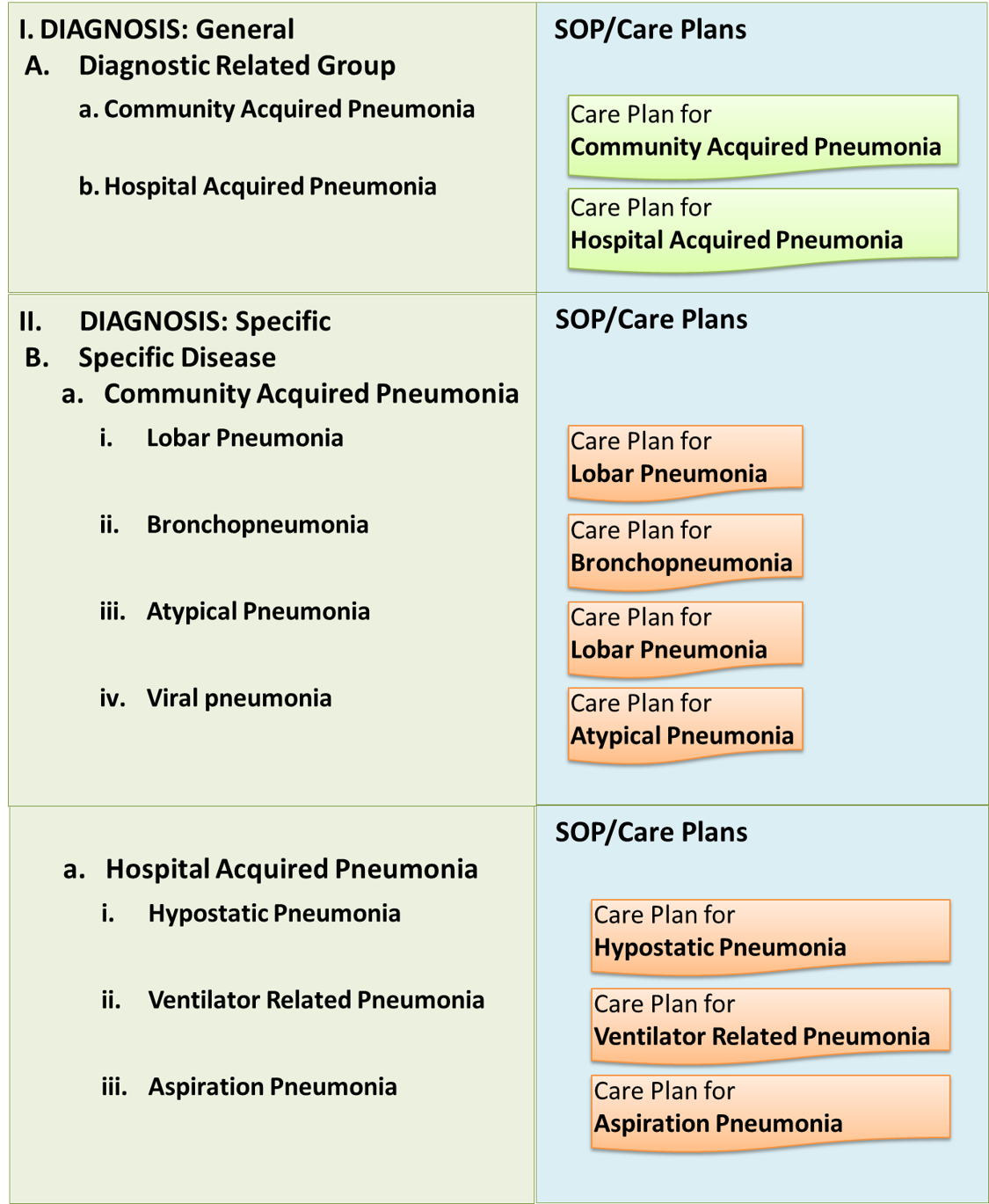
DESIGN FOR WHEN THE DIAGNOSIS IS CERTAIN
At the completion of the activities in the early phase of care, a definite diagnosis may be arrived at, and the patient profile is known. Then, an appropriate SOP/Care plan for the specific disease has to be developed.
The specific disease may be a typical disease or variants of it. It is necessary to make available SOP/Care plans for:
- main plan as applied to the typical disease
- sub-sets of plan for the category, stage, pathological grading, severity level, risk stratification and potential for remedy
- sub-sets of plan for alternatives, variations, options and contingencies
When the definite diagnosis of a specific disease is made with certainty, a SOP/Care Plan for the ‘care’ of this particular disease or health problem is used. The guidance given in it can be more certain, and specific. It will take a more didactic tone and be more regimented. The present illness is the primary consideration in formulating the service to be given to the patient (the service product).
| Working Diagnosis | Objectives | Care Plan |
|---|---|---|
| Specific Disease / Illness / Health Problem | Cure or Containment / Control or Palliation | Specific Care Plan – Initiate plan – Optimize care – Continue care |
CHANGE OF PLAN WITH FURTHER CHANGE IN DIAGNOSIS
Even if the definite diagnosis is considered to be certain , it may still change as the care process and the disease process proceeds because of additional information from developments that include:
- emergence of new symptoms and signs,
- physiologic changes evident by change in parameters monitored
- availability of investigation findings
- availability of data from better exposure e.g. findings at endoscopy or surgery
- observed changes in the response to treatment
As more clinical findings, investigations and monitoring data are available, a more specific diagnosis that is a refinement of the definite diagnosis or a complete change is possible. This warrants an alteration of the plan. If additional problems emerge, then there should be modifications to the plan.
If the change in diagnosis is minor then the same Reference plan is used but revised accordingly. If the diagnosis differs significantly, another more relevant Reference plan or sub-set of the previous plan must be chosen as a replacement. Hence, in designing the Reference Plan for a disease, besides making available a plan for a typical presentation of the disease, it is necessary also to build in advance appropriate plans for the variations of the disease.
Plans for Presumptive Working Diagnosis
There are instances when not all the criteria for a definite diagnosis are met, despite various efforts,. Then, either the provisional diagnosis or the closest diagnosis that can be reached (the Working diagnosis or Presumptive diagnosis) is used to select the SOP/Care Plan. The care provider must be aware constantly that this is the case and be ready to change the plan if further evidence points to a different diagnosis.
Retention of General Aspects and Refinement for Specific Diseases
The interventions within the SOP/Care Plans for Clinical syndromes and Diagnostic related groups are general. When the specific variety of disease is identified ultimately, the content interventions that are still pertinent are retained and further elaborated or can be discarded depending on their relevance. Hence, parts of the SOP/Care Plans that followed can be a continuation of the previous general plan but a significant portion will diversify along different paths.
Creation of a Comprehensive Set of SOP/Care Plans
Plans for various diagnosis should be made available for reference (by whatever means) as a properly indexed comprehensive library of documents. In a paper based system, these documents are placed in files and compiled into folders usually termed as the Work Procedure Manual. In a computerized system, the documents are kept in a file server. They are systematically indexed and can be retrieved via a search mechanism.
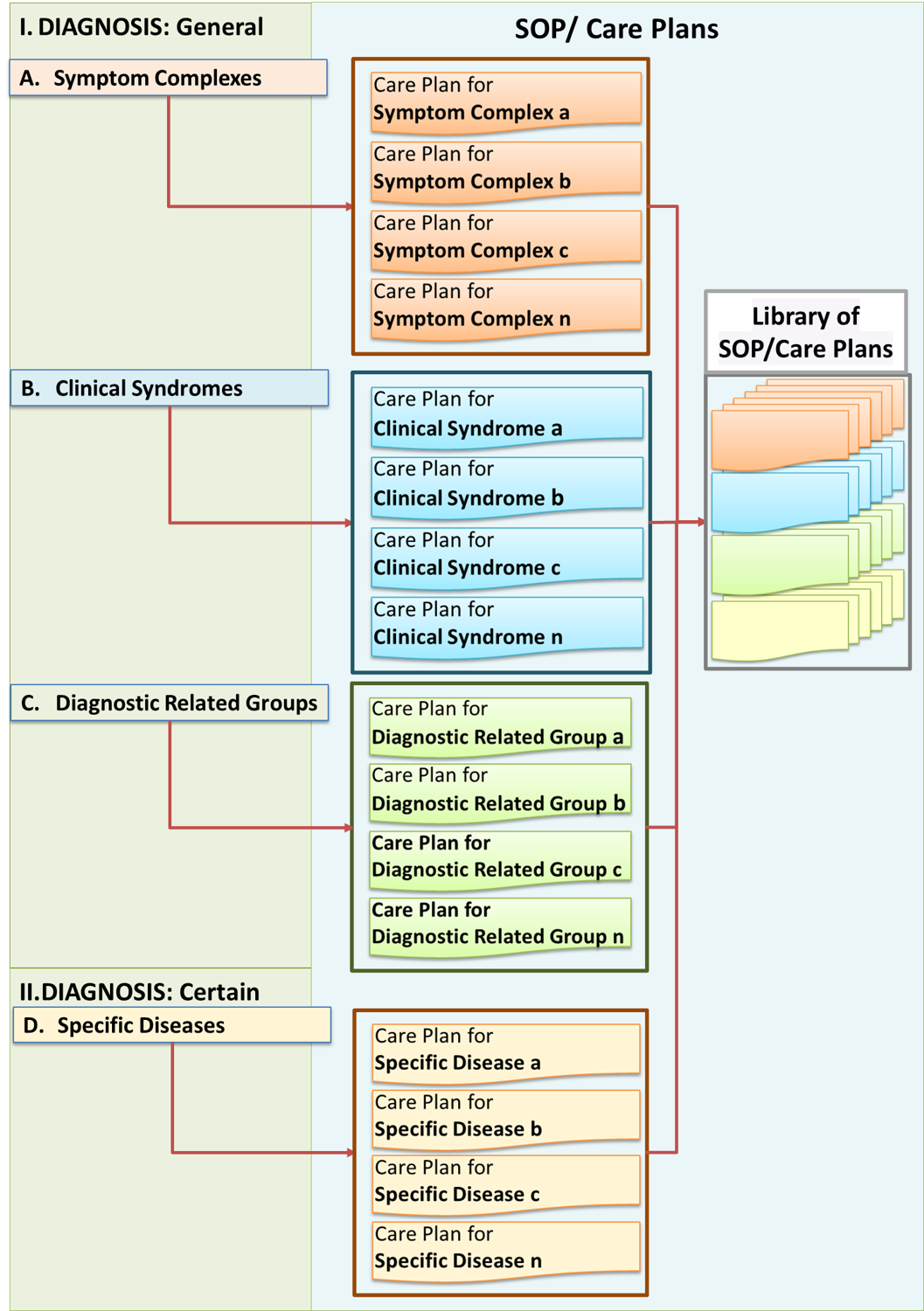
Further Refinement of Care for Variations of a Disease
Even when a diagnosis is deemed to be definite (all the criteria to support it are satisfied), the care provider must identify the variant (sub-type) of the disease and the stage in its natural history. SOP/Care plans must be designed not only for specific diseases but also their variants. Diseases can be stratified according to categorization, staging, pathological grading, severity level and risk stratification. These variations must be considered when SOP/Care plans are designed and chosen.
Types of variants of diseases include:
- Pathological variant
- Clinical variant
- the stage at time of presentation relative to its natural history (early, late, presence of complications)
- severity level (mild, moderate, severe)
- Patient profile / category
- age,
- gender,
- risk factors,
- confounding factors.
The above variations will impact on both the way the case is cared for and the expected or desired outcome. Where disease variants are known, plans for its care can be written as extensions or appendices to this SOP/Care Plan of the disease. Where the alternatives are subtle, variance to the SOP/Care Plan can be made by the clinician him/herself when devising the Actual care plan.
Where there are very distinct variations, the care of these sub-types can be considered as essentially different service products. A separate sub-set of the SOP/Care Plan should be created for each one of the sub-types.
Plans In Response To Variations, Options and Contingencies
At the start of care (usually at the first session) the primary provider chooses a care plan that matches the diagnosis. At subsequent sessions the same plan may be used if appropriate. There will be a need to design a sub-set of the plan depending on variations in the pathological grade of the disease, the stage of the disease, the level of severity or the emergence of complications.
Indeed, a Reference Care Plan for a different disease must be available for the clinician when there is a marked change in the diagnosis.
Plans are also modified or revised if various other emerging needs appear. If formally designed plans are not available, then the care provider needs to devise the actual plans him/herself without referring to a Reference plan. Hence, it is better to design and put together a comprehensive library of Reference Care Plans to cater for various scenarios in the care of a patient for each disease, illness or health problem. The primary provider selects the appropriate plan from a library of SOP/Care Plans made available to him/her.
STEP2: Setting the Standards for the Desired Outcome
Standards for the expected or desired outcome are condensed from the the objectives of the service. Broadly, the care objectives (expected outcome) are:
- Cure
- Containment (by 2O or 3O Prevention)
- Palliation
Which objective is suitable depends on the diagnosis and therefore the service product.
Note: Standards for input (facility, machines, human resource etc.) are mentioned as policies when the procedures are described.
Objectives of the Service and Standards of the Product
The primary objective of any service is satisfying the needs of the client and the product is said to be “fit for use”. In patient care, a good service is defined by a set of prominent features or characteristics i.e.:
- effectiveness
- safety
- acceptability
- appropriateness
However, besides these main features, attention must be given to secondary and tertiary needs of the patient including:
- accessibility,
- convenience,
- responsiveness,
- affordability,
- comfort
At the same time, attention should be paid to the viability of the service as a business venture. It is necessary to take into account efforts directed towards ensuring:
- feasibility
- productivity
- efficiency
- cost-effectiveness.
- lowering of risks.
Many of these characteristics are interdependent. Acceptability depends very much on affordability, convenience, comfort and timeliness besides conformance with cultural values. In turn both timeliness and affordability are the result of efficient service delivery. Feasibility depends substantially on capability (availability of resources) and cost-effectiveness.
The general objectives of the service are used to guide the development of and therefore built into every aspect of the service. In the SOP, it is not necessary to document them as a separate section except perhaps to mention them in the introduction.
Objectives and Standards of the Care of a Specific Case
The objectives or outcome goals of the service provided (i.e. care of the patient) should be known and stated at the outset in the SOP/Care Plan. Of course this depends on service product which in turn depends on the diagnosis. In fact, objectives are determined for every phase of patient care and for every intervention made.
At the early phase of the care episode when the diagnosis is yet uncertain the care objectives would be achieving adequacy in:
- relief of symptoms
- provision of support (physiological, psycho-social)
At the later phases when the diagnosis becomes more certain and more definitive treatment is given, the objectives can be more definite. The final objective or treatment end points need to be defined and measurements made to determine whether they have been achieved. Depending on the disease, the objective of treatment would be the combination of any of the following:
- cure the illness,
- contain it or control the progress and minimize complications
- mitigate the effects
The objectives of care influence the way it is planned. For a given illness, not all of the objectives mentioned can be achieved or are necessary. While many diseases are eminently curable, some can only be contained or their harmful effects reduced/mitigated/delayed. When there is potential for cure or complete resolution of the disease process, the plan is directed towards achieving it. In such illnesses achievement of the objectives is the marker for ending the care episode.
Even as attempts are made to achieve cure, efforts must be made to at relieve of symptoms, contain of the effects of the disease through physiological plus psycho-social support and rehabilitation. Therefore in a patient where cure is possible, the therapeutic (treatment) approaches or modalities will have the following intentions:
- Definitive
- Symptomatic
- Supportive
- Preventive
- Rehabilitative
- Promotive
For patients with diseases that are inherently incurable or are too far advanced, the plan offers beneficial therapeutic options aimed at symptom relief, restoring functions, and providing comfort. This mode of therapy is termed as Palliative care. Achievement of the objectives mark the point when the care is considered to have been optimized.
Whether the intermediate or final objectives are achieved is estimated and decided at the procedure of Progress Review. The progress of the patient is a measure of outcome. The criteria is the detection of deterioration or improvement and occurrence of complications of illness or of treatment.
Standards of the Outcome of Care
Standards are quantifiable characteristics that form the relevant criteria based on which the achievement of the objectives are determined. The criterion can be a measurable value or if subjective its value is being present or absent. Often the outcome is computed from a set of characteristics or parameters with each characteristic given a nominal value or score. The parameters can be clinical symptoms and signs, physiological status, biochemical measures etc. This method of measuring outcome is termed as a “scoring system”. The most important standard to be declared is that of the intended or expected outcome with respect to the illness.
Prognosis
The likelihood that the above outcomes can be can be achieved is termed as the “prognosis”. It is based on the analysis of results from a study of a population of similar cases. Since outcome is dependent on severity of illness, the presence of of factors contributing to the severity can be assessed at presentation and summated as a scoring system. Comparison of the final outcome of a case with prognosis (expected outcome) for similar cases similar in severity is a better measure of success.
STEP 3: Putting in Place the Service Delivery System
Standards for input (facility, machines, human resource etc.) are mentioned as policies when the procedures are described.
For any service to be offered, the organization/facility has to ensure that a proper service delivery system is in place. When a new facility is built the input required to deliver all of its service products must be built or procured. If a new service product is to be introduced in an existing organization, then whatever additional facility, equipment and personnel require must be made available.
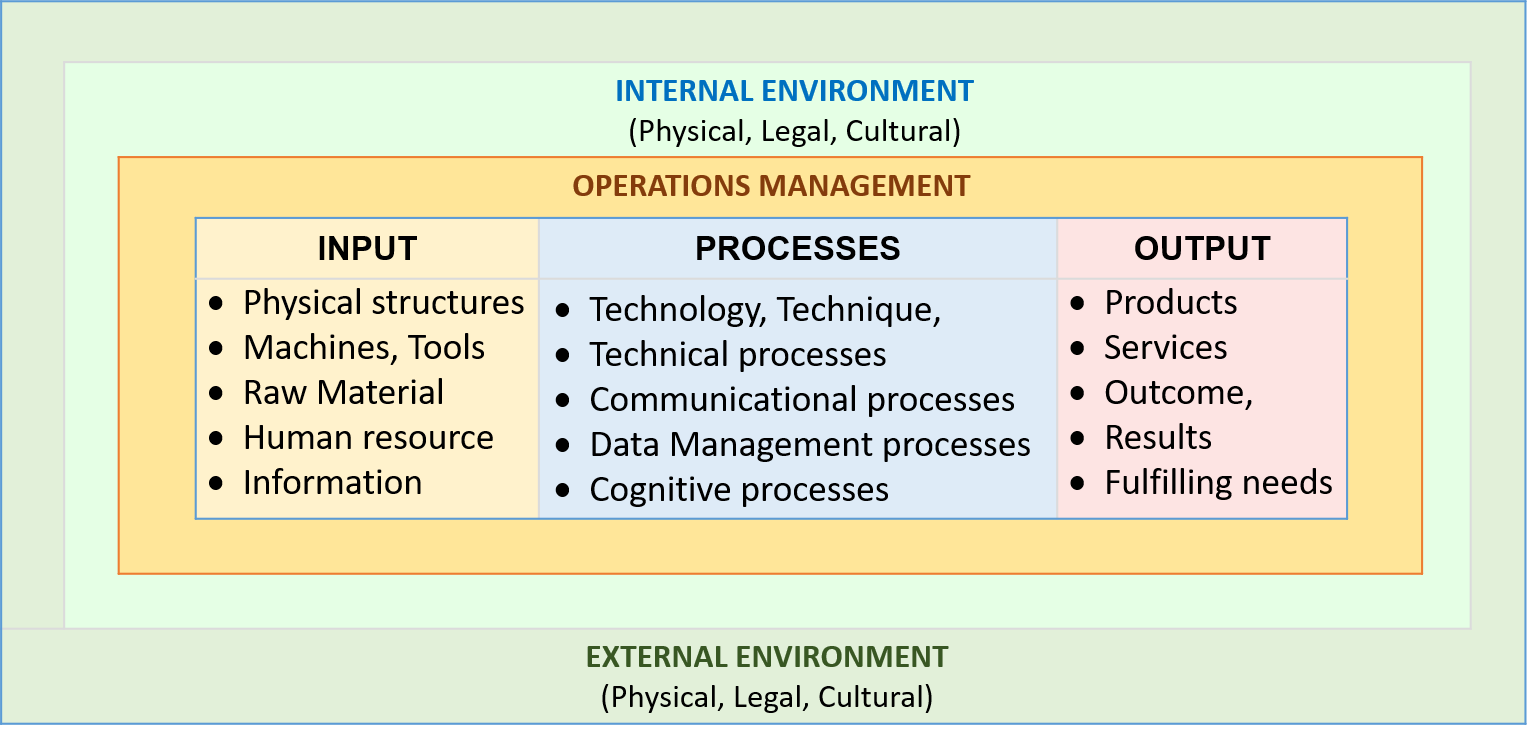
The factors that impact of the operations of a patient care service is illustrated below:

Location
Each service product must be delivered at appropriate locations. The choice of the location depends on the sessions to be conducted, types of procedures to be performed and the needs of the patient. Each location is a service delivery unit with specific settings i.e. the facility design (layout) and the resources made available and accessibility. The types of service delivery systems include:
- Outpatient clinic
- Emergency complex
- Inpatient ward
- Day Care complex
- Procedure rooms (for surgery, endoscopy, tests etc.)
- Home
- Teleconsultation facility
The complexes or units have general requirements of and follow certain systems. These are known and can be assumed to be in place. However, if specific requirements and specifications are required this should be stated in the SOP/Care Plan at the beginning or mentioned as and when the procedures are described.
The choice of service delivery systems in relation to sessions (visit, events) can be proposed as a general rule but often can be made at the actual implementation of the plan. This will be discussed later in the appropriate sections.
Staffing
Standards of Input
Lists given as attachments. Standards for input (facility, machines, human resource etc.) are mentioned as policies when the procedures are described.
STEP 4: Design and Composition of the Method of Delivery of the Service Product
Just as various methods are used to manufacture tangible products, suitable methods are devised to deliver service products.
Delineating the sequence and layout of the workflow (the Care Pathway, the phases of care))
Providing clear instructions on the policies and procedures to follow (legal, professional and ethical considerations)
Identifying the most appropriate technology or modalities to be used
Assignment of responsibilities to various service providers
Identifying the monitoring and control measures (Monitoring, Review and Evaluation, Quality Control)
Providing reference documents (work instructions, standards)
Providing the means for data documentation (Clinical documentation, Forms, Charts, Information systems)
Anticipating possible errors of omission or commission, their prevention and damage control (Quality control).
providing alternative actions to cater for variations, exceptions and contingencies.
The Delivery of Clinical Patient Care Service
Work and Services
Work is the expenditure of energy to produce a useful outcome. It is made up of a series of activities performed by workers. Each activity consists of a series of procedures or tasks. Therefore, patient care service delivery is the performance of various activities to improve the condition of a person affected by an illness, disease or health problem.
Policies and Procedures
The principal purpose of the SOP/Care Plan is to indicate the set of procedures required to conduct the care of a patient. Policies provide the limits or constraints within which procedures are performed. Hence, the development of effective SOP/Care Plans requires a thorough understanding of the clinical work processes and the policies that govern it.
In healthcare, the word procedure is often used differently to mean some intervention done directly on the patient like a surgical operation, endoscopy, taking blood and so on. In this discussion, the term procedure is taken to mean, just as in other industries, a group of processes performed together to produce a certain output or outcome. To avoid ambiguity, the term task is taken to be equivalent to this meaning of procedure and is preferred in this discussion.
General Policies
General policies are rules that take into consideration the values held by the facility or organization where the service is provided. They may include:
- philosophy, aspirations, goals and principles of the facility or organization
- adherence to legal requirements
- conformance to professional standards
- ethical considerations
General policies of the facility/organization should be indicated in in its business plan. However general policies must also be written for every service product.
Legal and Ethical Considerations
Patient care is a highly regulated service. The design of the SOP must take into account legal and ethical requirements including:
- ensuring privacy
- maintaining confidentiality
- showing respect for human dignity
- obtaining consent
- use of accepted methods and technology
- performance of tasks only by qualified persons
- use of properly functioning and safe equipment
- providing the service in a safe environment
Legal requirements vary from country to country. Ethical norms are advocated by professional bodies (councils and associations). These requirements must be stated as general and operational policies in the SOP/Care Plan.
Operational Policies
Operational policies are guides on how to perform procedures and achieve the expected results. They are molded by the general policies and then constructed around the procedures used to deliver the service product. They define limits and constraints on what must be done, what conditions must be satisfied before it can be done and what to avoid. They are embedded within the procedures.
Policies Aimed at Achieving the Objectives Of Care
Striving to achieve the objectives of care is itself a policy. It is often termed as the Quality policy. Hence, the care provider must be aware of the desired outcome at every step of the care process and use it as a guide.
Procedures (Tasks)
In other industries, the term procedure is taken to mean, a group of processes performed together to produce a certain output or outcome. In healthcare, the word procedure is often used differently to mean some intervention done directly on the patient like a surgical operation, endoscopy, taking blood and so on. To avoid ambiguity, the term task is taken to be equivalent to this meaning of procedure and is preferred in this discussion.
| Term | Meaning |
|---|---|
| work | the expenditure of energy to realize a useful outcome |
| workflow | the sequence and direction of how work is done |
| processes | the most elementary unit of work |
| procedure | a series of processes |
| tasks | the alternative term in healthcare for procedures |
| product | the useful outcome (object or benefit) achieved through work |
| service | an instance of providing a benefit to a customer |
| care | alternative term for service provision in healthcare |
| healthcare | the service of promoting, preventing, maintaining and restoring health |
| delivery | provision of services, an alternative term for operations |
Carrying Out Tasks
In patient care, tasks are performed by workers delivering services who are called care providers. A service is made up of a series of planned tasks and their delivery. The instructions or requests to perform tasks are called orders. Work can be done in many ways including:
- manually by the care provider or a team of care providers
- by the care provider with the help of machines.
- by a machine based on instructions given by a worker and under his/her supervision
- entirely (automatically) by a machine prompted by instructions built in computer applications
As part of the service, items such as drugs, blood products, fluid and nourishment are given or supplied to patients. These tasks must be done in an accepted way. They are often called dispensing or administration.
Procedures as a Series of Processes
Tasks are made up of processes. In caring for a patient, healthcare professionals act as a team. They are dependent on the contributions provided by each another.
In patient care services, tasks are performed in many ways, using various input. Many are technical i.e. performed manually or with the help of machines which can be automated. Some take the form thinking (cognitive) processes but most are a mix of both types of processes. Some of the most common processes is that of data management.
Because functions are performed by persons with the ability to perform them, tasks are allocated to a particular professional or teams of professional. Many procedures can be accomplished only by a team of personnel.

A task should be performed only by a worker with the skill and knowledge to perform it. Even then, he/she must do so using the right input and within a suitable environment. Input includes items such as raw material, instruments, assistance and information. In fact, the ability to proceed from one task to the next depends on whether the results of the transformation made by the previous task is immediately available and sufficient. If so, he/she may continue to the next task without pause. Therefore, an essential input is data (results) generated by the previous task.
The environment suitable for a task takes into consideration situations such as the adequacy of space, cleanliness, air quality, safety, lighting, noise level, presence of essential equipment and proximity to other facilities.
Output and Objective of Procedures / Tasks
Clinical care is made up of procedures each of which produces outcomes that contribute to the fulfillment of the objectives of care. Procedures are considered successful if satisfactory results are obtained. Otherwise they be repeated or replaced by another method. The whole care episode is divided into phases and sessions within which sets of procedures are planned with the aim of achieving various objectives which when added up will lead to the desired overall or final outcome.
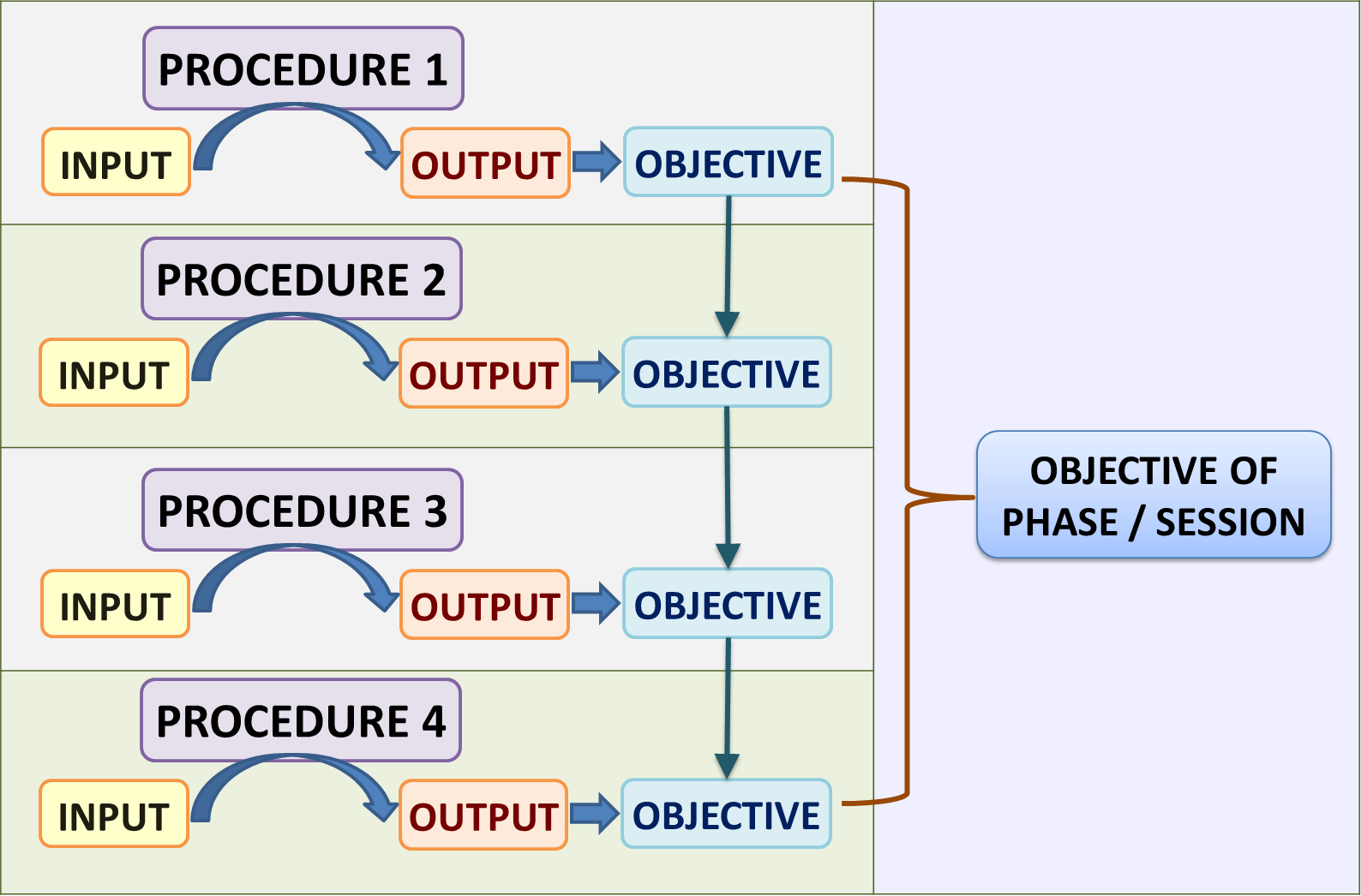
Sequence and Direction of Processes: The Workflow
The predicted or planned sequence and direction and layout of what, when and how work processes are to be done is termed as the ‘workflow’. It is the practical application of the sequence and paths thought out through algorithms. In manufacturing and most service industries the techniques used are capable of producing precise results. Therefore, procedures are performed in fairly fixed sequential steps.
In patient care, the sequence is less rigid or predictable. Actions at subsequent steps are often dependent on the outcome of the previous steps. Hence, procedures are often cyclical or iterative.
There is a universally accepted way by which clinical care providers deliver patient care. The services consist of two categories:
- Administrative tasks
- Clinical tasks
Administrative tasks are those tasks that facilitate the management of the patient as a client which include giving appointments, registration, admission, resource allocation,referrals, transfer and discharge, and follow up. They contain processes different from clinical care processes and require separate SOPs. They occur at the beginning or end of the service and sometimes interspersed between the clinical tasks. In the clinical care process, they should be mentioned but need not be described in detail.
The path/flow/sequence/layout of processes is thought out and later presented in two ways i.e.:
Outline of the Workflow
A general outline of the workflow is often called the high level workflow or ‘critical’ pathway. It contains only the critical (important, required) steps) with the obvious or mundane steps left out in the documentation (but not in practice). When the processes are complex it is beneficial for better understanding to demonstrate the flow initially in the form of an outline and details are elaborated subsequently. The outline of the generic flow of clinical care is as shown below:
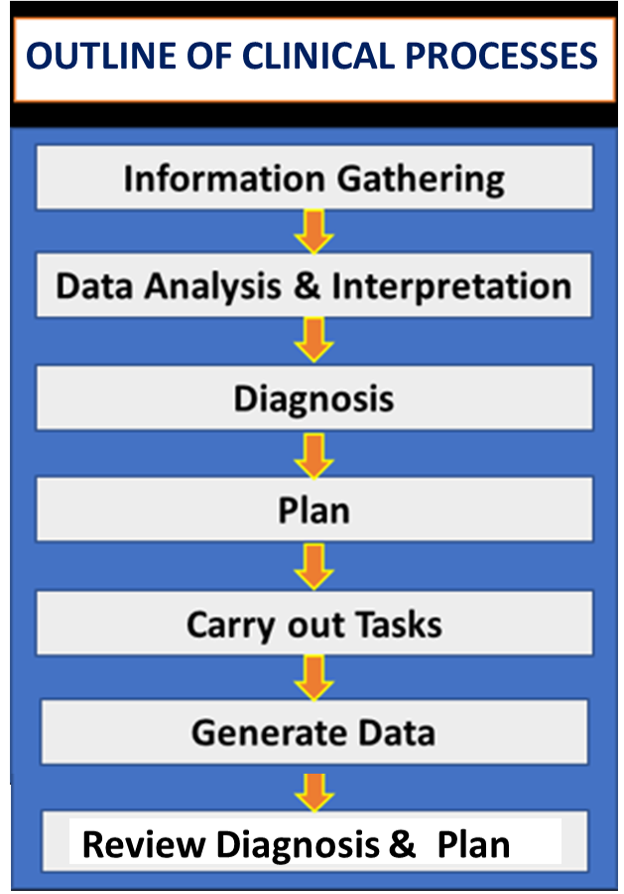
This general workflow is applicable to most cases. However the sequence of the processes does not necessarily follow this strictly but will depend very much on the type, severity, urgency, speed of progress and effects of the illness. In an urgent case, emergency treatment is given first before a full interview, examination and tests are done. Some cases may have obvious diagnosis based on routine tests or chance findings from investigations already done during other instances of care. As such, it would not be necessary to repeat the diagnostic investigations. For some types of cases, it may be more practical to perform certain processes first as a routine for example performing urine tests at a antenatal visit or visual acuity measurements for every case with a problem of vision.
In some instances the following scenarios that affect workflow can occur:
- results of tasks are available or become evident only after an interval,
- the next transformation must be performed performed by another worker.
For the first scenario, the care provider has to stop, wait for the results and resume his/her work when they are ready. For the second scenario he/she has to pass on the next task to another worker. He/she may resume his/her part of the work when the transformation has occurred or the results are ready.
The workflow has decision making steps i.e. points when care providers have to choose the appropriate path when alternative directions exist. The decision is guided by criteria such as:
- policies,
- judgement,
- patient preference,
- availability of resources.
Working Out a Detailed Workflow
The path/flow/sequence/layout of processes is thought out and later presented in two ways i.e.:
- written as a narrative,
- depicted graphically as a chart
The workflow is first thought of as a series of steps consisting of the arrangement of the tasks for the delivery of a service in terms of content, layout, sequence and direction. The operational policies are embedded within it. The set of procedures and their sequence is outlined below:
- Generation, gathering and collection of data about the patient’s illness and the effect on his/her health through interview, examination, observation, measurement, tests and investigations by various techniques,
- Documentation of data regarding tasks done and their results plus reporting incidents that happen and the actions taken (using specific forms and charts).
- Analysis and interpretation of data to determine the diagnosis, status, profile and needs of patients,
- Planning the case management including response to anticipated side effects,
- Therapeutic tasks (treatment, providing support, rehabilitation, preventive actions, damage control) using various modalities.
- Monitoring and Progress review
- Continuation or discontinuation of the care depending on the outcome.
Graphical Depiction of the Flow Of The Clinical Process
In the SOP/Care Plan, the understanding of the flow, sequence and layout of clinical processes is much enhanced if depicted graphically as a workflow chart. However, it must always be preceded or followed by a narrative description. The workflow that can be applied generically for patient care is as depicted below:
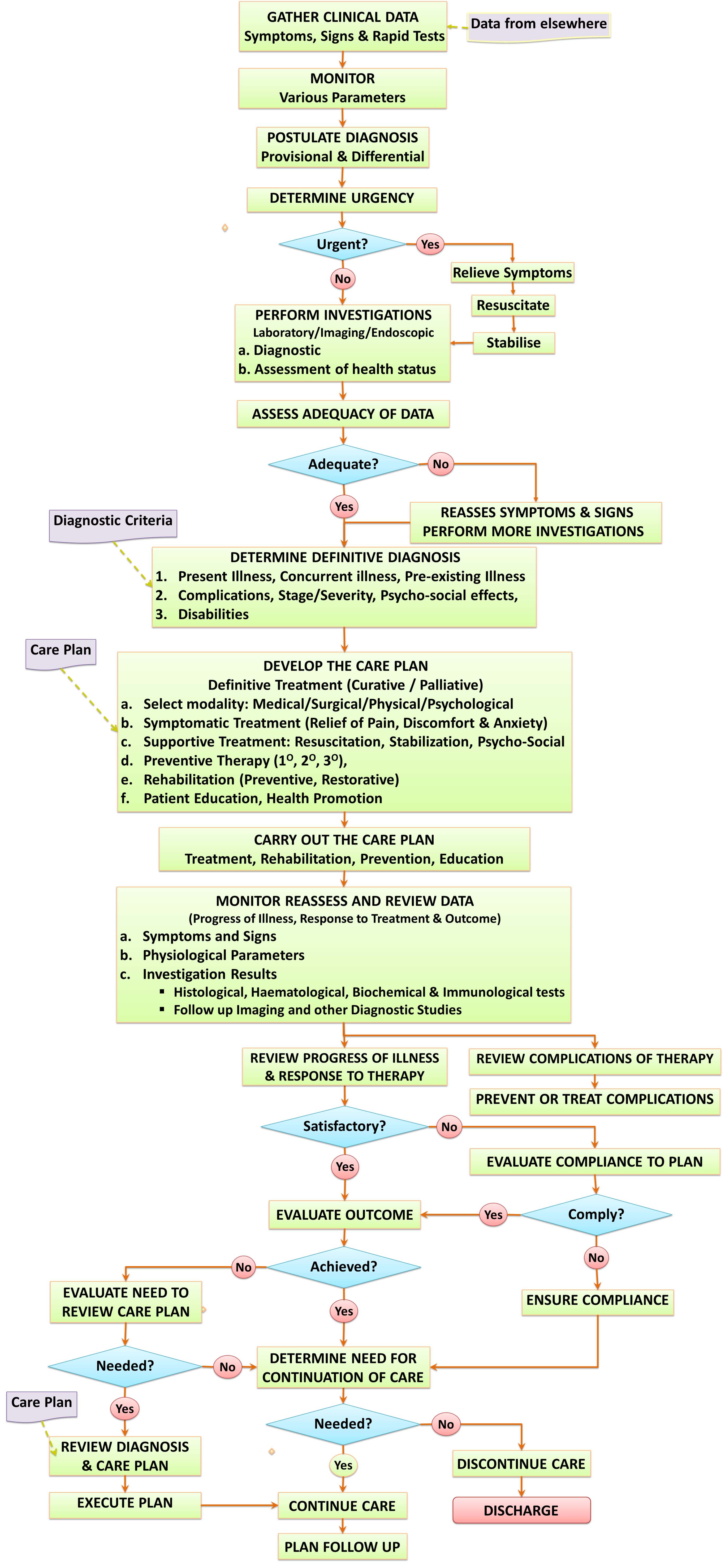
Decision Making Steps an Essential Component of the Workflow
Decision making steps is an essential component of the workflow because its determine the direction of the steps of the care process.
In clinical care, the plan is very much dependent on diagnosis. After selecting a plan based on the initial diagnosis, the care provider may decide to alter or revise the plan based on the criteria listed below:
- Changes in the understanding of the illness affecting the patient (the certainty and comprehensiveness of the diagnosis )
- Evolution of the disease along its natural history,
- Advancement of the flow of clinical processes,
- Occurrence of other emerging issues (incidents, contingencies)
There are instances when the workflow cannot progress according to the initial plan due to various impediments or circumstances. At times, the processes e.g. information gathering, investigations or tasks have to be repeated or abandoned. In those cases or if the prescribed treatment plan is ineffective, unacceptable or unsafe for the patient, an alternative approach or modality is used. Non-compliance by care providers or patients is also a factor that affects the progress of the workflow as well as the success in achieving the desired outcome.
Decision-Making and the Resultant Change in Plan
- Guide to making decisions
- Indications,
- Contraindications,
- Precautions (preventive measures, risk control)
Decisions are made when there are choices or options to be selected. In clinical care, decisions are made based on conclusions arrived after appraising the situation based on accumulated information. The conclusion may be determined by appraisal of:
- the updated working diagnosis
- the latest understanding of the disease/problem,
- the evolving objectives of care,
- the progress of the disease,
- the response to treatment.
The choices or options that a care provider can make are:
- to retain the current plan without alteration,
- to make modifications to the current plan,
- to change the plan completely to a new plan.
The involvement of clinicians are often through direct interaction with the patient. When the tasks requires the patient to cooperate by physical or verbal means, care providers have to take turns to perform them. This is because a patient can only be at one place or interact with one care provider at one time. Only when the patient is free another clinician may use the opportunity to have direct contact whether to gather information or provide direct care. For example, after the doctor has done his /her round, nurses do their own to observe, monitor and chart various parameters .
There are exceptions to this rule like when active input from the patient is not required, tasks can be done simultaneously by different care providers. For example, a nurse may observe the patient while the doctor is talking with or examining him/her. There are instances e.g. in emergency situations and in complex procedures (e.g. surgical operations) when more than one care provider may be attending to the patient at the same time. Often, when the patient is unconscious (comatose or under anesthesia) different interventions are done on him/her.
Tasks that does not require the presence of the patient can be done simultaneously or concurrently. Hence, tasks such as making a diagnosis and planning can be done while another care provider is attending to the patient. These are thinking tasks that uses data from memory or from records. Sometimes, the ability to perform it requires the presence of the medical record. In computerized systems data can be presented as views or displays.
Procedures performed in the presence of the patient must be performed sequentially.. These include those performed by Radiologists, radiographers, echocardiogram technicians, endoscopists, optometrists, and audiologists.
Pathologists and microbiologists usually work on specimens obtained from the patient and therefore their tasks can be performed concurrently in parallel with that of clinicians.
REPETITION AND ITERATION
In the manufacturing industry, tasks are usually done only once. Repetition is called rework and seen as a failure. The same is true for most clinical tasks. The dictum “do it right the first time and every time” is also applicable to clinical patient care
However, cycles of events and tasks are often repeated not because they fail but intentionally. for various reasons. This repetition of cycles of events and tasks is termed as iterations
Meaning of Iteration: repetition of a sequence of operations that yields results successively closer to a desired result.
Repetition of Procedures
During the entire episode of the care of a patient, the procedures of interview, examination, tests, diagnosis, plan and evaluation often forms a repeating cycle.
Therefore, care is fashioned in blocks within which there are iterations of various events and tasks. This is because the objectives of a care episode is achieved through the summation of objectives of the various phases. For each phase, the objectives are rarely achieved by one cycle of processes. In most cases, the objectives can be met only through a series of purposeful repetitions. Only by the achievement of objectives of a phase would care be able to move on from that phase to the next culminating in the final outcome.
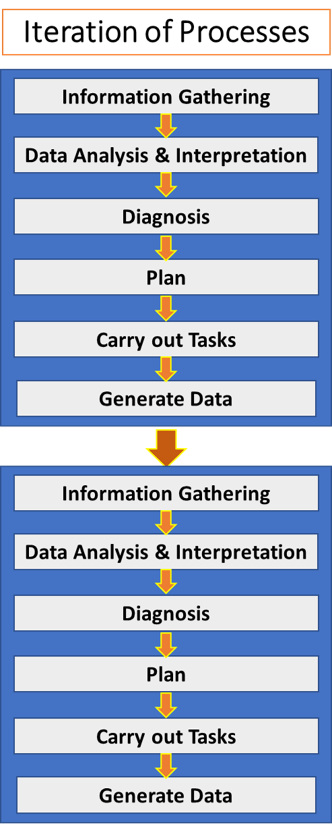
The repetition of the clinical care processes makes the work cyclical. Each cycle is termed as an iteration and clinical care is said to be iterative in nature.
Purpose of Iterations
Iterations are necessary because clinical patient care mirrors the steps of data management which is made up of:
- the work is effective only if it is repeated intentionally for a certain number of times
- failure to obtained satisfactory result by a single instance
- the work has not been carried out properly
- the patient’s condition changes as the disease progresses naturally or because of treatment. Repetition of monitoring of parameters, tests, progress review and measurement of outcome will provide data that will show the trend,
The Necessisty of Iterations
Benefits of Iterations
Iterations are beneficial because it enables the clinician to:
- obtain more data of increasing range (granularity) and accuracy and complete the data management cycle
- reach a more certain and comprehensive diagnosis
- demonstrate the status of progress of the disease and patient’s condition
- ascertain the effectiveness of treatment
Iteration As the Means to Improve
Iteration of the processes of data gathering, collation, analysis, and interpretation is necessary to make data more accurate, and sufficient. Interview and physical examination is repeated to determine progress of existing symptoms and signs or the emergence of new ones. Investigations are redone if there are problems with the sample or the test itself. They are repeated to see trends in the results.
Because data acts as input for the formulation of diagnosis, the increasing amount and quality of data obtained from each cycle will facilitate the derivation of increasingly more accurate and comprehensive diagnosis as care progresses. Monitoring and review are necessarily iterative tasks.
The recommended treatment regimen should be provided in the reference SOP/Care Plan. However, often when implementing the actual plan, to achieve the optimal result, therapeutic measures such as medication, irradiation, or physical manipulation must be improved by altering the dose, intensity, technique, or frequency.
While surgical procedures that causes permanent change cannot be repeated others that result in temporary benefits (such as dilatation, debridement) may be repeated. As a rule, treatment as an event undergoes first iteration of the tasks of plan, initiate, review (iteration), followed by subsequent iterations consisting of modify, plan, implement and review again.
he increasing clarity and validity of data, diagnosis, and plan means that the service is constantly undergoing quality improvement. This feature is quite unique to clinical patient care.
Accumulating Data As the Main Reason for Iteration
From the above discussion, it can be seen that an important reason why iteration is necessary is the need for increasing quantity and quality of information. In that respect, iteration can be seen as the repetition of the data management cycle as shown below:
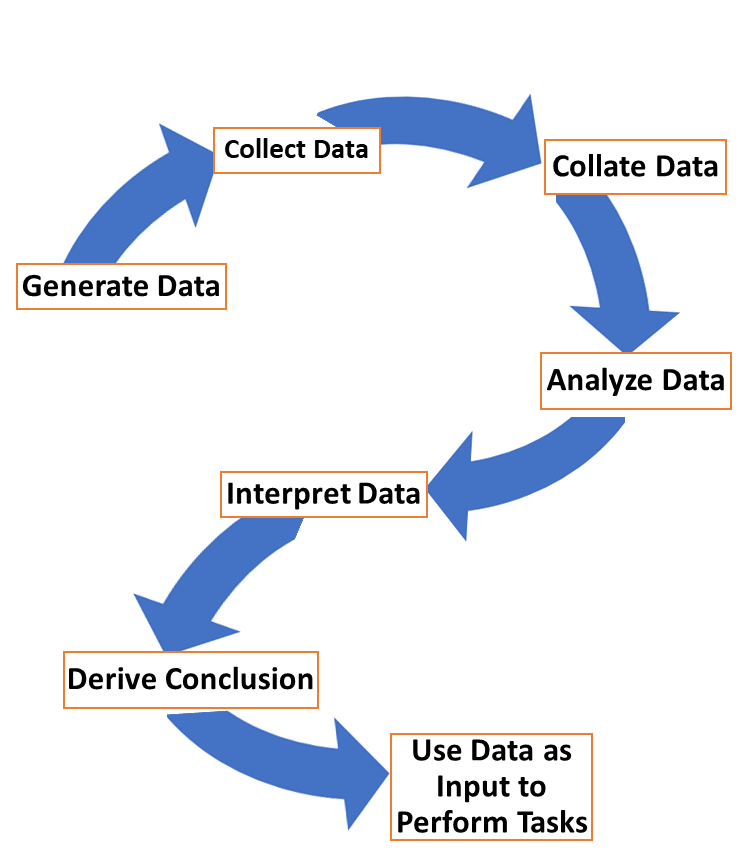
Data made available after an iteration of a data management cycle becomes an essential input for all clinical events and therefore drives the clinical workflow.
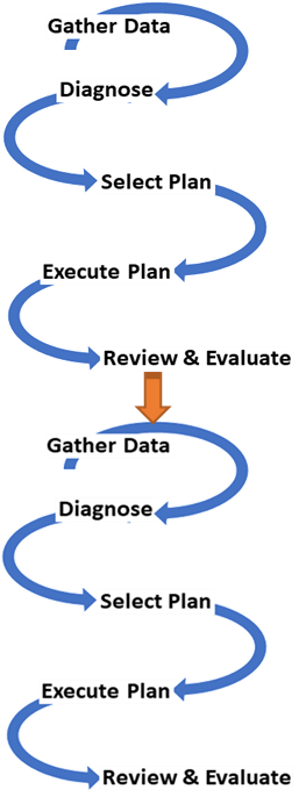
Steps in Fabricating a Product or Realizing the Outcome
In any manufacturing industry, producing the output is achieved through many separate activities. that usually include processing of the raw material, fabrication of parts, assembly, testing and distribution. The activities are usually in sequence but parts may be built separately before being assembled. For some of the activities, the processes are strictly continuous e.g. in an assembly line, but in others these c an performed with intervals in between and done at different facilities.
Services in healthcare are delivered in a similar way. The entire Care Episode is considered as as a package of services provided in stages. Each stage consists of sets or blocks of activities.
The Care Episode
In a patient’s lifetime, he or she may experience multiple illnesses, diseases or health problems. The entire period during which care is delivered for one of them is termed as the Care episode, It mirrors the disease episode. It begins at the time of first contact with a health care practitioner and ends, in most cases, with the resolution of the illness/problem or death of the patient. It is necessary to view the care episode from separate angles:
- the period during which the service product is delivered
- the scope and content of the SOP/Care Plan for the service product
Besides what is delivered to the patient, what he/she experiences during the care episode is also the service product. The SOP/Care Plan confines itself only on how the service is delivered.
Dividing the Care Episode into Phases
The care episode advances in sequential major steps over time. These steps can be termed as phases. Each phase is made up of blocks of procedures carried out to attain an intermediate objective. The final outcome of care is achieved through the fulfillment of objectives of each phase. The phases have variable number of procedures and take variable duration to complete.
The phases of care of both acute and also chronic diseases are categorized and sequenced based on their functions as listed below:
- establishing diagnosis, stabilization and immediate care
- initiation and optimization of care
- maintenance of care, re-evaluation and modification
- discontinuation of care in the event of resolution of illness
Converting/Dividing a Phase into Blocks of Activities
The activities within each phase of care are iterations of the processes of care. Hence the plan for each phase consists of procedures sequenced according to the flow of the clinical care processes. The differences between the phases are in the
- aim i.e. what should be achieved at that particular point
- focus i.e. what measures should be emphasized on.

In the SOP/Care plan document, this complexity can be clarified by dividing the description of care into different sections and paragraphs differentiated by headings.
Progressing through the Phases
The plan of care moves from one phase to the next depending on the increasing certainty and accuracy of the diagnosis. The care given does not wait for when a definite diagnosis is available.
Therefore, plans must be available for care when the diagnosis is uncertain (symptom complex, clinical syndrome) as well as when the diagnosis is certain (disease group, specific group and variants of the disease). The clinician need to select and use the care plan appropriate for the working diagnosis as the care progresses through the phases. How Reference plans are combined to form the Actual Plan of care will be discussed in detail later.
Activities within a Phase
Within a phase, the ability to perform each task is dependent on the outcome of the previous task. Therefore as a rule, it is important to perform the set of tasks in sequence.
However, this sequence may not be strictly followed because there are times when:
- an opportunity to perform the task may not occur again,
- it is more convenient to perform an activity earlier or later,
- one activity may be given priority over another because of certain needs.
When designing the SOP/Care Plan, it is necessary to think out and list down the whole series of tasks within the care episode. It may be appropriate to depict them as a single list of tasks in the Reference Plan but as will be discussed later, in the Actual Plan the tasks have to be divided into sets or blocks of tasks so that they can be allocated time slots and assigned to particular care providers. At the time of designing the Reference SOP/Care Plan, the separation into discrete blocks is not possible because of the following reasons:
- in patient care, an activity need not be carried out at the same location or facility,
- alternative equipment may be used to perform certain tasks,
- the ability to perform a task is not necessarily confined to a particular care provider category,
- often there is a need to repeat the tasks before the desired outcome is achieved, The frequency of this repetition is not predictable.
- clinical tasks of data gathering, diagnose, plan, treat, monit
- or and reevaluate take a variable amount of time to complete.
- the advancement of the care process is related to how the disease progresses which is not always the same,
- the response to treatment is not uniformly predictable.
Dividing Care into Sequential Phases
As discussed earlier the planning of care occurs continuously throughout the entire episode of care. The care episode is divided into sequential phases during which groups of procedures are performed aimed at achieving distinct purposes or objectives. So, a phase starts with the setting up of one or more objectives and ends when all the objectives have been met. This occurs when all the tasks designed to achieve the objective are performed successfully. Completing all the phases will then result in the final outcome. Hence, the phases and the care episode are not limited by time or number of sessions (will be discussed in detail later).
The Plan for Each Phase
The care episode can be roughly divided into two periods i.e., the phase when the diagnosis is being formulated and the period consisting of the phases after a definitive diagnosis is made. Actions taken at the earliest phase is concerned mainly with establishing the diagnosis, stabilization of physiological functions and immediate care. At the end of this phase the definitive diagnosis should be obtained. In the next phase, attention is given to starting the definitive care and optimizing its outcome. This is followed by efforts at continuation or maintenance of treatment, monitoring and reassessment. Subsequent actions depend on whether the illness resolves such that care can be terminated or remain unresolved hence requiring continued care.
The phases of care of both acute and also chronic diseases are categorized and sequenced based on their functions. They can be given different names but the following division is typical:
- Phase of determining the diagnosis and immediate care / early treatment
- Phase of initiation of definitive care
- Phase of optimization of care
- Phase of maintenance of care
- Phase of resolution (continuation or discontinuation of care)
Procedures within Each Phase
Despite this division the activities within them are contiguous. However, because of the iterative nature of clinical care, similar processes are repeated with some given more emphasis than others. For the purposes of documentation, each phase can be thought of as being divided into segments corresponding to the the processes involved in clinical patient care as tabulated below:
| No. | PHASE | SEGMENTS |
|---|---|---|
| 1 | Phase of determining the diagnosis and immediate care | – initial data gathering – determination of diagnosis – immediate or early treatment – start monitoring |
| 2 | Phase of initiation of definitive care | – select and modify care plan – initiate definitive care plan – continue monitoring |
| 3 | Phase of optimization of care | – review progress and response – review compliance – review complications – modify plan, improve care |
| 4 | Phase of maintenance of care | – continue care as planned – continue monitoring – review progress |
| 5 | Phase of resolution | – measure outcome – determine if problem resolved – continue care if unresolved – discontinue care if resolved |
How the clinical care processes are segmented into phases is depicted below:

The decision to proceed from one phase to the next depends on whether the objectives of the former have been achieved. In an emergency case, the initial phases are compressed such that tasks within them such as resuscitation and stabilization are accomplished within a short period. In non-urgent cases the phases are stretched over a longer period.
Even though tasks are performed to achieve the objectives of a phase, it does not mean they are confined to thatphase. Many tasks must be continued to maintain the gain achieved. For example, the initial data gathering is followed intermittently by progress assessment. Symptom relief may be necessary even at later phases or even permanently. Monitoring is done continuously until the parameters are stable and is unlikely to change. Stabilization and optimization must continue and the patients condition must not be allowed to slide.
How the care episode is divided into phases is depicted below:

In the in-patient setting some of the procedures may be performed continuously where necessary or intermittently. In the outpatient setting, most procedures will be performed intermittently with continuity being facilitated by self-care, home care and may be teleconsultation.
Constructing SOP/Care Plan into Blocks of Procedures Corresponding to Phases of Care
Cases can be categorized into acute or chronic categories. Each categories can be divide further into sub-types based on severity, grading, stage at presentation, and response to treatment. The differences of their care is mainly in the mode of treatment and intensity of monitoring. As such, the care of the disease sub-types are designed as as separate alternative blocks or modules.
When the SOP/Care Plan is documented, the narrative differentiation into alternatives take the form of separate segments designated by sections and paragraphs with appropriate headings as shown below:
In the Reference SOP/Care Plan each phase can be thought of as groups of tasks to be performed to achieve a particular objective.
- Care episode
- Phases
Selection of / Content of Each Phase of the SOP/Care Plan
Since moving on from one phase to the next depends on whether all tasks has been performed and the objectives have been met, the content of each phase need to be determined with this consideration in mind. There may be occasions when tasks of one phase is carried over to the next. Some tasks like monitoring persists through out the phases. Adoption of the division into phases is critical in determining the structure, content and implementation of the SOP/Care plan.
- Care episode
- Phases
- Clinical Care Procedures
PHASE 1: Phase of Determining the Diagnosis and Early Treatment
This is the phase of initial contact with a health care provider. The procedures are grouped to serve two functions with both running concurrently.
- formulation of diagnosis
- immediate or early treatment (resuscitation, support, symptom relief)
The phase start with the procedures of establishing the reason for visit. A triage procedure is included in the plan when necessary. Guidance to the front-end staff at reception or triage regarding the criteria to differentiate disease conditions requiring urgent (emergency) care as opposed to diseases that can be cared for at a more comfortable pace (non-urgent or elective cases). Based on it care providers should be able to:
- determine whether to direct the patient to immediate care or give an appointment the appropriate
- determine the appropriate clinical unit to accept the case
- choose the appropriate setting (emergency, outpatient, in-patient) for the care to be given.
Clinical data Gathering
The encounter with a clinical care provider can be with a nurse of a doctor depending on the type of case. The information to be gathered is aimed at making a preliminary diagnosis (symptom complex, clinical syndrome, diagnostic related group) and assessment of the condition of the patient.
The latter depends on whether the disease process is at an early or later stage of its natural history, depending on whether the patient seeks treatment early or late. Early treatment is given based on the working diagnosis (symptom complex, clinical syndrome, diagnostic related group) even as efforts at determining the definite diagnosis are being made.
Formulation of Diagnosis
The main objective of this phase is to determine the diagnosis as accurately and comprehensively as possible. For a new case where the diagnosis is not known, steps are taken to identify it. This process can be termed as the formulation of the diagnosis. Hence, the steps for this purpose are:
- clinical data gathering (interview and examination)
- performing simple tests
- initiation of observations and monitoring
- determining the working diagnosis
- Care episode
- Phases
- Clinical Care Processes
- Data gathering
- Determination of Diagnosis
- Planning
- Execution of plan (treatment, monitoring)
- Review of outcome, treatment, diagnosis and plan
- Continuation or discontinuation
- Phases
At the beginning, a clinician takes charge of the case and is said to be the primary provider. Usually this person is the doctor to whom the case is assigned. However, depending on the scope of care, he/she can be a nurse, nurse practitioner, therapist, or clinical psychologist (or other practitioners). The primary provider is responsible for formulating the diagnosis. The working diagnosis at this stage is usually provisional and may take the form of a symptom complex, clinical syndrome or a disease related group. Plans must be devised for them so that they can be referred to with the change in diagnosis as the care progresses.
Process of Determining the Definitive Diagnosis
The provisional diagnosis will provide a guide to the next step which consists of:
- taking a more elaborate history
- finding out more about specific symptoms
- closer examination of regions or organs involved
- performing more specific and elaborate diagnostic investigations
- analysis and interpretation of all data available to formulate the definitive diagnosis
The clinician in charge uses the data from tests, observation and the monitoring to arrive at the definite diagnosis. The diagnosis need to be further refined to clarify the variant of disease, severity grade, stage of illness, risk stratification and prognosis.
Investigations are aimed also at determining the patient’s general physiological status and functions of various systems besides focusing on determining the system or site involved or the likely pathology and in the end, the definitive diagnosis. Providers of clinical support services become involved when diagnostic investigations are ordered.
The definite diagnosis is one that is both specific and certain. Often, the effort to determine it takes time. This phase may be completed over a few sessions with intervals between the sessions. This is necessary because tests have to be scheduled. The results of pertinent tests or observations are not immediately available but are obtained at different times and have to be accumulated. analyzed and interpreted before the conclusion is made regarding the diagnosis. Depending on results additional tests may have to be done.
However, every effort must be made to obtain a definitive diagnosis because it indicates the cause of the disease or at least the pathological processes that are affecting the patient. This information is necessary before the plan for specific treatment can be made. In fact this phase ends only when a reliable working diagnosis is arrived at.
Immediate Care and Early Treatment
Therapy must not wait for want of an accurate diagnosis. The plan for immediate care and early treatment is based on the working diagnosis which at this point of care is provisional in nature and are likely to be:
- a symptom complex
- a clinical syndrome
- a disease identified to belong to a diagnostic related group
SOP/Care plans are prepared for these levels of diagnoses. Only occasionally, the specific diagnosis is obvious from the start.
Procedures to be Performed
Generally in both acute and chronic illness, procedures at the immediate phase should include:
- nursing care
- immediate and continued relief of symptoms
- monitoring of relevant parameters
- maintaining normal physiology through resuscitation and stabilization
- providing nutrition or at least fluids and electrolytes,
- giving support (physiological, psychological, social and spiritual)
- taking preventive actions
- avoiding and reducing emergence of disability
- treatment of ongoing problem as they arise
The outline of the workflow for this phase is depicted below:

The difference in approach between acute and chronic illness is a matter of intensity and priority. In an acute illness resuscitation, stabilization of physiological parameters and support of their functions must be done quickly., In a chronic illness these can be done in a more measured manner.
PHASE 2: Phase For Initiation Of Definitive Treatment
This phase is a direct continuation of the previous phase. Only when the diagnosis is definite can the direction of care be set clearly. Plans are designed according to the needs posed by the specific disease, illness or health problem. As such, the guidance given can be more definite (certain and specific). It has to take a more didactic tone and be more regimented. From this point the care for the rest of episode is concerned with the initiation, optimization and maintenance of definitive care.
Care Plan based on Definite Diagnosis
The plan for definitive care should allow allow the care provider to know the objectives of care (expected outcome, therapeutic end points). A more definite SOP/Care Plan appropriate to the diagnosis must be constructed for various diseases and their variants. The plan should include continuing efforts to refine the diagnosis and further clarify the variant of disease, severity, grade, stage of illness, risk and expected or desired outcome. Plans for the these variants need to be prepared.
Plans should cater for unexpected developments, eventualities and contingencies that may occur. Some of these can be anticipated such that the care provider must be guided on on decisions to make when they occur. However, it quite likely that the care provider need to address them at his/her own discretion.
In this phase, the care provider should be reminded to continue tasks like nursing care, symptom relief, monitoring, support and others initiated earlier. Regular observations and monitoring should be a regular activity.
Setting the Objectives of Definitive Treatment
Treatment end points need to be defined and measurements made to determine whether these end-points have been achieved. Depending on the disease, the objective of treatment would be the combination of any of the following:
- cure the illness,
- contain it or control the progress and minimize complications
- mitigate the effects
SOP/Care Plan is designed to be consistent with the care objectives consistent with the disease encountered. The care plan helps the care provider define the treatment end points, and choose the most suitable treatment approaches or modalities. In this phase and in later phases. the care plan should indicate the measurements to be made to determine whether the end-points have been achieved. Advice should be given on the parameters to be used to review the progress of the patient. It should include efforts to detect deterioration or improvement and occurrence of complications of illness or treatment. The frequency ( regularity) of measurements should also be indicated.
Depending on the illness, this phase may spread over a considerable period and at different service delivery settings. In the case of an acute illness, efforts should be made to complete this phase as early as possible. But for elective cases, it may be possible or necessary to have the patient discharged at the end of the visit (e.g. in-patient care) and to complete it in the next visit (e.g. at an outpatient setting). For less acute cases this phase may be carried out entirely at outpatient settings and over a few visits.
Procedures Within this Phase
In this phase almost all care providers are involved directly or indirectly in the care. Therefore procedures would be allocated accordingly and listed in their Task lists. These tasks include:
- review of data
- ascertain diagnosis
- choose and execute appropriate plan
- start definitive treatment
- monitor and observe
- initiate preventive measures
- initiate rehabilitation
- provide education and counseling
The tasks involved and their sequence is as shown below:
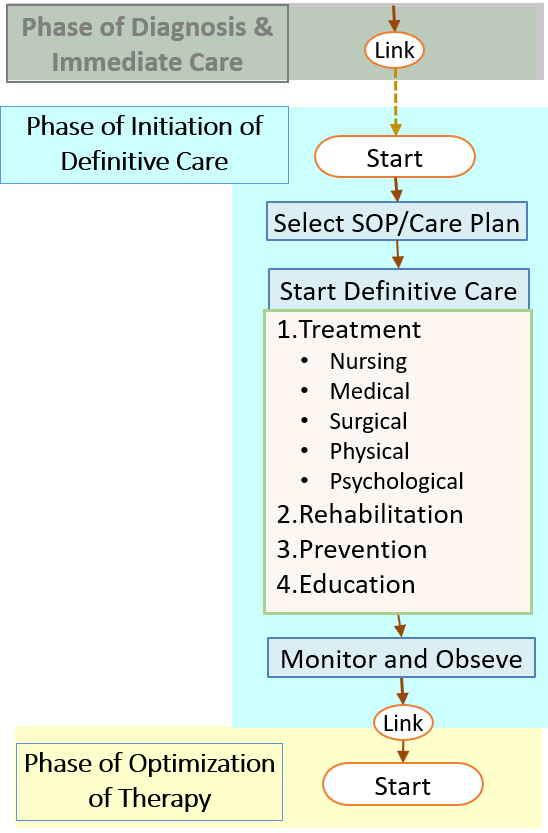
PHASE 3: Phase of Optimization of Care
The main aim of this phase is to optimize the benefit of care given. The care provider need to be made aware of the desired treatment end points and provided with the means to achieve them.
Progress is assessed through:
- review of symptoms and signs,
- observations,
- monitoring,
- repeated investigations
Assessment are designed to address both the progress of the disease and effect of treatment. The way results are presented for the various parameters is proposed. The plan should help the care provider to analyze and interpret the results and determine the behavior of the disease and improvement or otherwise of the health of the patient. The care provider must be given the criteria to be used to determine whether care has been optimized. In general, optimization is considered achieved when the care regimen produces the best possible level of benefit. If optimization is not achieved the care provider is advised on how to make adjustments and modifications to the care plan.
Conformance of the care providers to the plan must be assured through quality control measures. Compliance of patients to instructions must also be assessed and enforced.
The phase may extend beyond one session. If the the patient is at first managed as an inpatient he/she may be discharged and the care continues in the outpatient setting. The progress of acute illness is often dramatic and easily discernible. The progress of chronic diseases vary in many ways including:
- slower speed of deterioration or improvement ,
- active vs inactive periods (remission, reactivation),
- emergence of complications of the disease
Measurement of outcome and comparison with planned targets is an integral activity of care at this stage. Scoring systems and check lists can be mandated or suggested. If the progress is satisfactory, the plan is continued with further improvement if necessary. However, if it appears to be ineffective, guides on how to make minor or major modifications must be provided. If there is doubt regarding the diagnosis further investigations must be done, If the diagnosis is different, a new care plan need to be initiated and optimized.
Optimization is considered achieved when the care regimen produces the best possible level of benefit. The plan is then continued.
Procedures Within This Phase
w
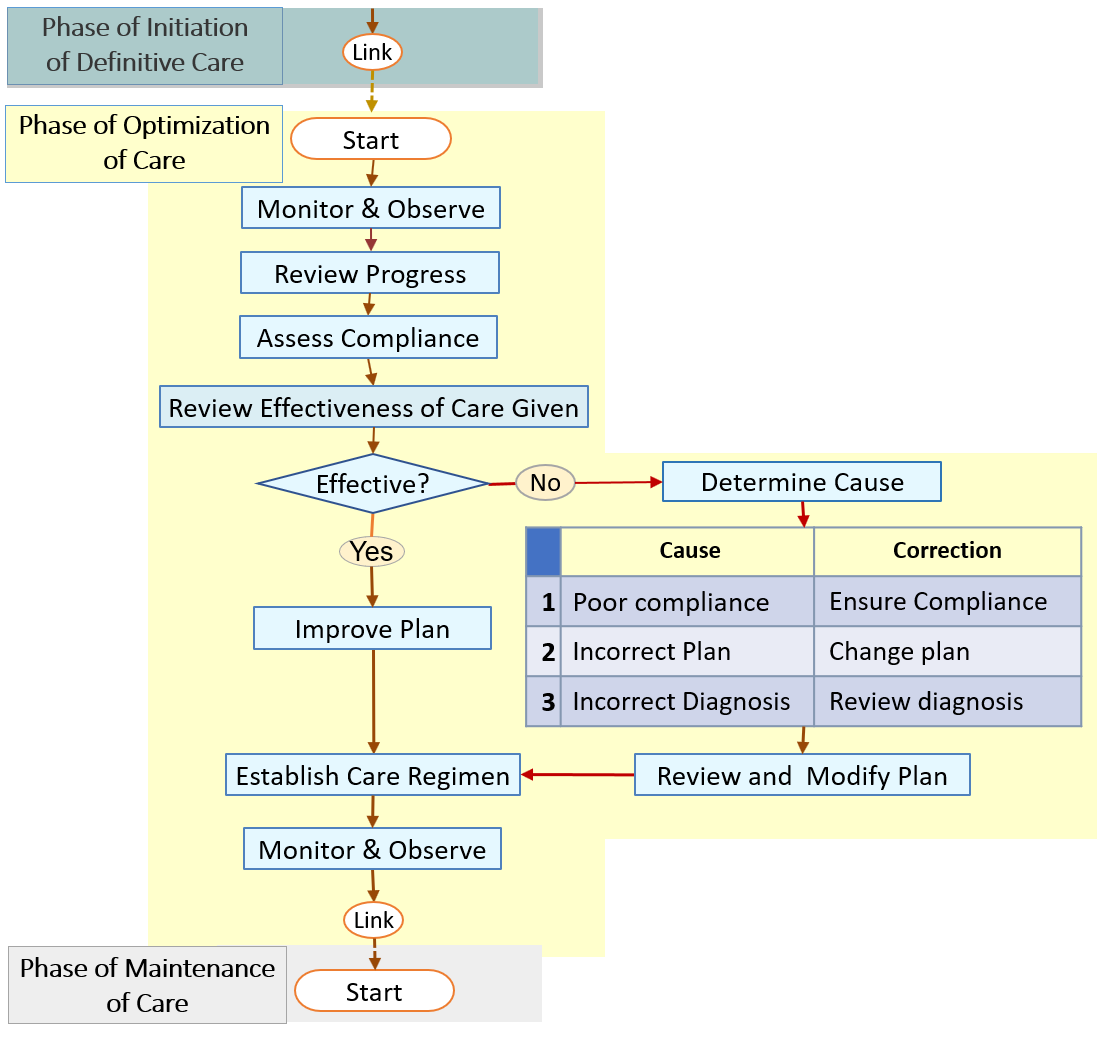
PHASE 4: Phase of Maintenance of Treatment
Moving from initiation and stabilization of definitive care to the maintenance phase depends very much on the effectiveness of the care given or improvement in the disease condition. Otherwise, the care persists in that phase. It must be noted that a phase may need more than one visit to complete.
The care provider must maintain the plan of care that led to the optimal level of outcome. Depending on the illness, this phase may extend over a considerable period. Usually, it is conveniently carried out at outpatient settings (clinics, day, care, home care, teleconsultation. self care).
The care provider is expected to follow the established care regimen as closely as is possible. At the same time, an important aspect of the plan is the continued evaluation of response to and effects of therapy. The following factors are assessed:
- conformance to the plan by care providers
- patient compliance
- detrimental effects of therapy
Procedures Within This Phase
nm
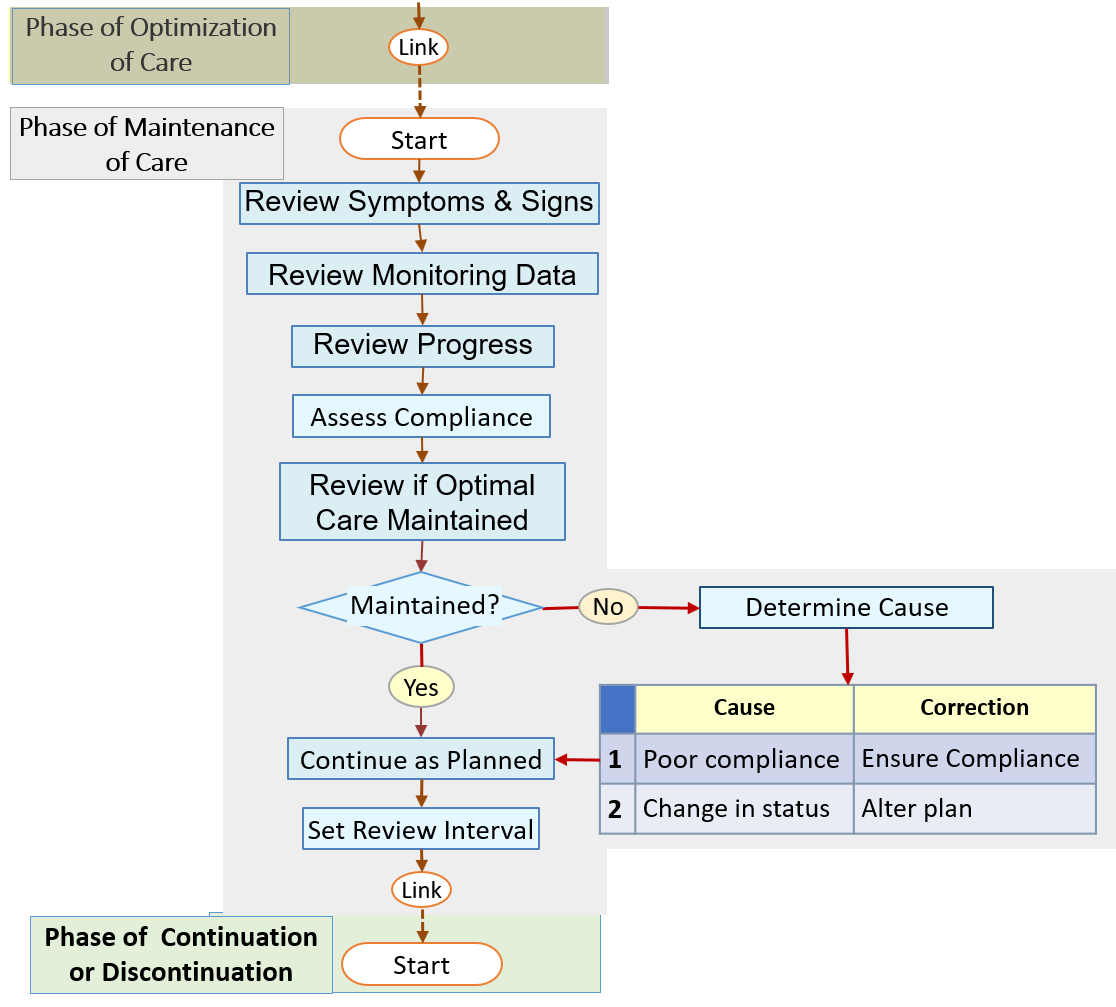
PHASE 5: Phase of Resolution (Continuation or Discontinuation of Care)
The plan should indicate to the care provider at what point decision should be made on whether the patient requires further care. The criteria used are based on the resolution of the illness or the achievement of the optimal outcome. In practice, this means the decision to continue follow up visits. There is no advantage in putting the patient on regular follow up when it is unnecessary. However, access to the service can still be offered on a needs (prn) basis.
Depending on the nature of the illness and the response to care, the service may reach a stage where it can be discontinued. This is so with curable diseases.
On the other hand, chronic illnesses are characterized usually by continuous progression or persistence. The duration of care is therefore long term and usually extend throughout the life of the individual. Some diseases may resolve, go into remission and be dormant only to appear again later. Temporary cessation of therapy with planned follow up reviews at longer intervals (quarterly, half yearly, or yearly) may be necessary.
Some diseases may not require care at health care facilities but sufficiently managed by self care. Rarely some chronic diseases runs through its course and dissipates. The care can then be phased out.
For illnesses that has been brought under control the care provider must be on the look out for recurrence.
Procedures Within This Phase
nm
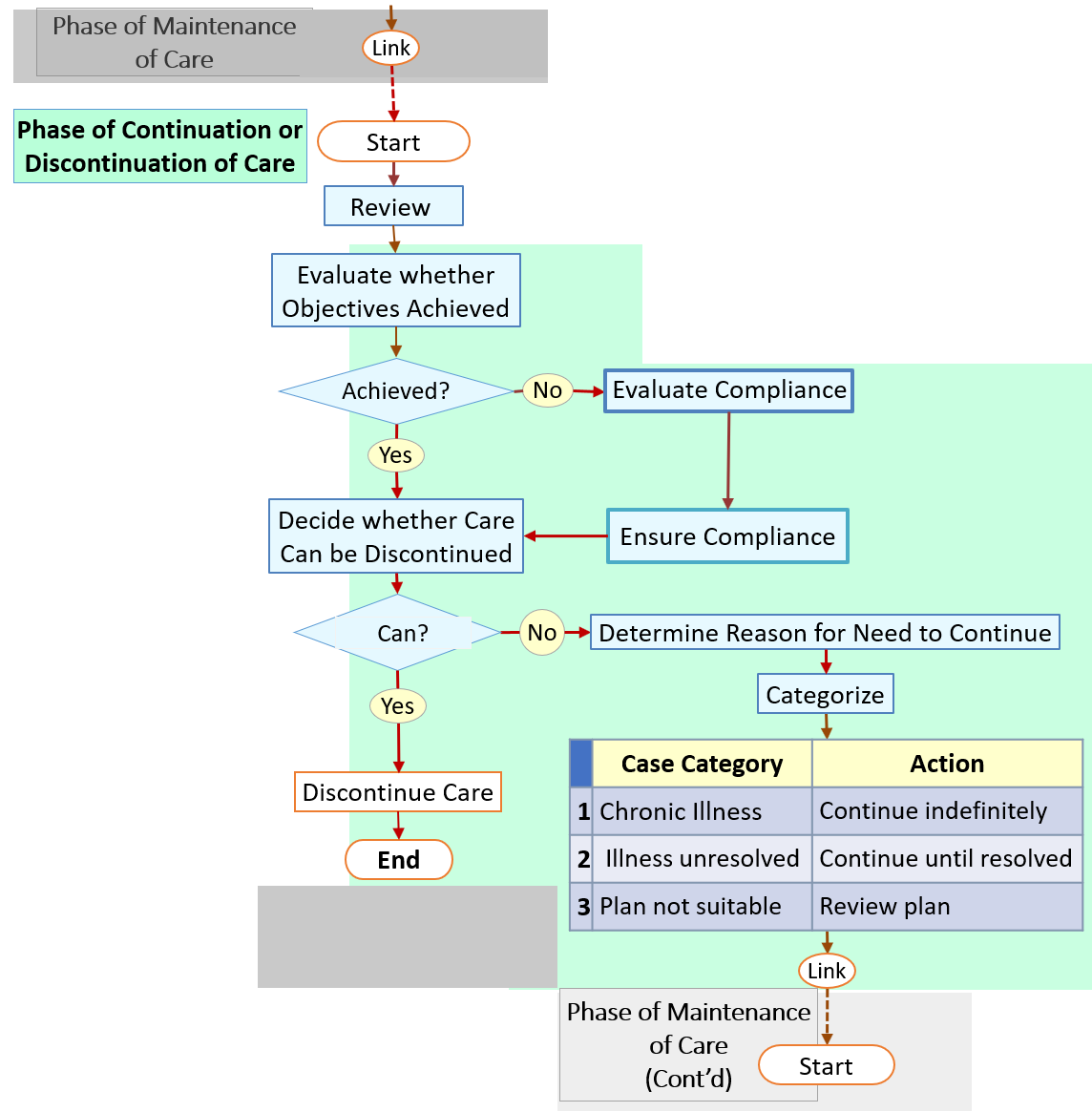
The circumstances that allow care to advance to the next phase often become evident when actual care is given and the care provider has reviewed whether all efforts planned has been performed and after the outcome of tasks are known. Hence it will be discussed in the discussion on the Actual OP/Care Plan.
Documenting Phases as Segments of the Reference SOP/Care Plan
The Reference plan document should be divided into segments consistent with phases with each segment indicating the sets of clinical care processes to be performed. The care provider must be aware of the phase of care that he/she is currently in. If the Reference SOP/Care Plan is written on paper, each segment need to be marked out clearly as paragraphs with clear headings. In a computerized system, it is possible for the relevant segment to be called for (via a menu) or be automatically presented to the care provider at the appropriate time.
How the structure and content of the SOP/Care Plan is segmented in accordance with phases is shown below:
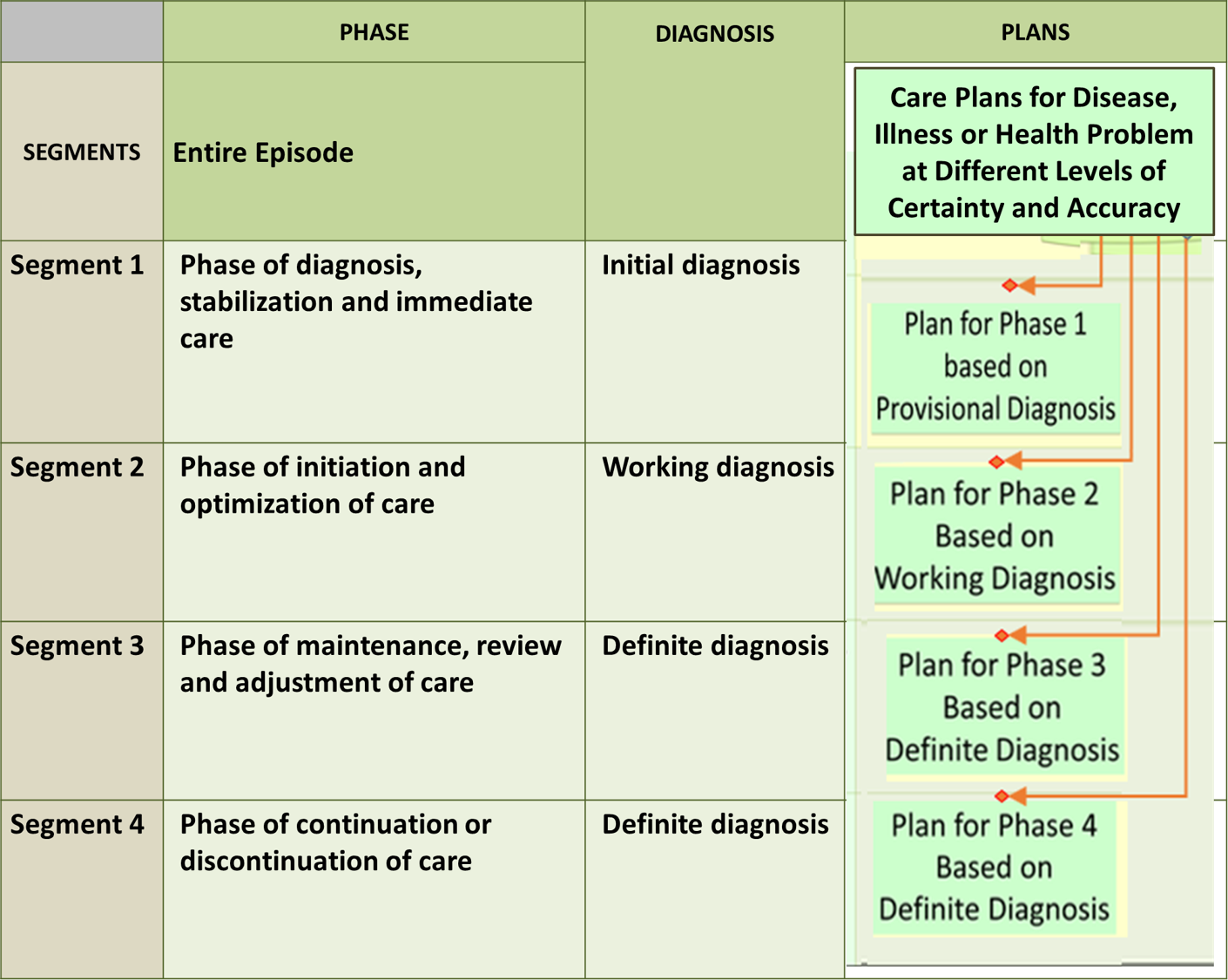
It must be noted that, because plans change with the change in diagnosis, the Actual plan is a composite plan built incrementally by adding on segments derived from plans for the symptom complex, clinical syndrome, disease group and specific disease. The plan is therefore dynamic. As new plans are adopted, new items will be added, some items in the previous plan are retained while some others are discarded. The plan is only completed at the phase of definitive care when the definite diagnosis is ascertained.
The decision to progress from one phase to the next is a decision-making process requiring much thought, In a computerized system, the criteria to indicate the right moment to move on is the fulfillment of the objectives based on data regarding progress and outcome. Even then, the decision remains the responsibility of the care provider. Completion of a phase may require a variable number of sessions and hence cannot be scheduled in advance.
Actual Plans
The Actual Care Plan is a statement of intent listing out the intended sets of tasks to be performed and their objectives (expected results or outcome). Planning is regarded as an essential clinical process and the plan is recorded as a separate item in the medical record. The record of events, tasks performed and outcome reached should not be put together with the plan because these occur after the planning process following a different time sequence i.e. when transactions actually happen. Instead, the execution of the plan (the treatment given), and the results obtained are documented, as and when the processes are performed, in the form of progress review notes, monitoring charts, procedure records, findings, outcome documentation and etc.
In a completely computerized system, the issue of the need to replicate data entry does not arise because the plan (both reference and actual) can be accessed from a central repository or a section within the application as and when needed. Computer software can be used to convert prescribed plans into actual plans and then into orders/tasks to be executed (task lists). Data regarding task performance and results can be entered and stored in a database. The information can be retrieved, analyzed and displayed as a report on conformance to plans and the outcome of care.
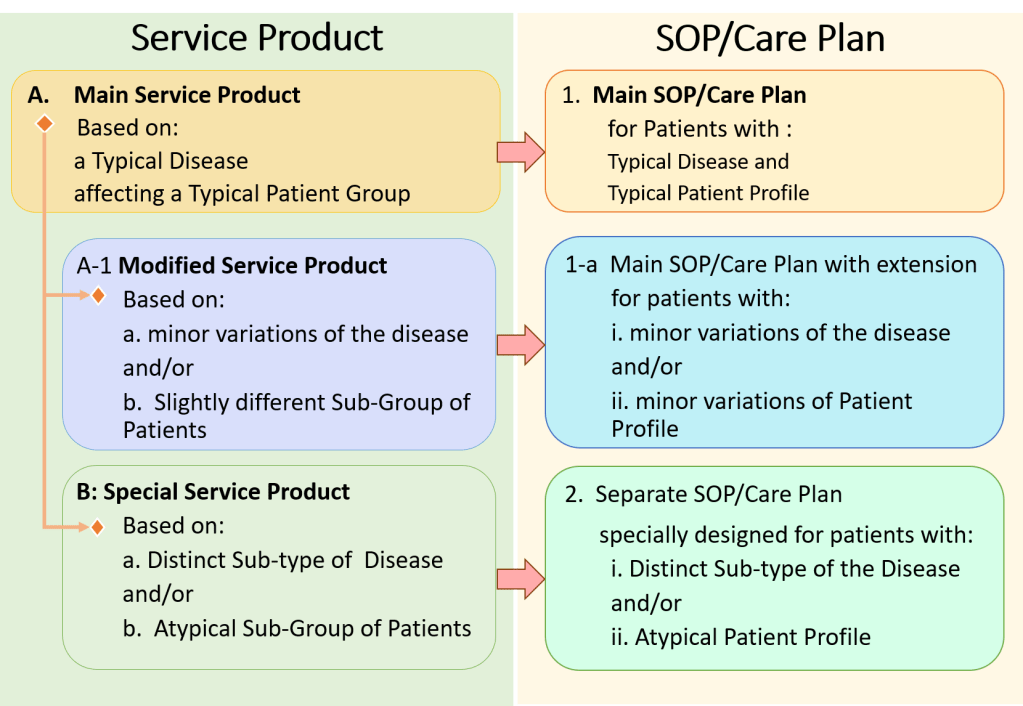
Plans are also modified or revised if various other emerging needs appear. If pre-designed plans are not available, then the care provider needs to devise the various plans him/herself. Therefore, to minimize this need, it would be helpful if a comprehensive range of SOP/Care Plans that cater for particular scenarios in the care of a patient are already designed and made available.
The actual plan is then communicated to other care providers by documenting it in the medical record or the Clinical Information System (under the section for Plan). The details of the plan for the entire care episode is described in the SOP/Care Plan which should be referred to rather than copied. In the medical record, a statement as to which SOP/Care Plan has been chosen is indicated e.g. “to treat patient as case of Acute Coronary Syndrome”.
Since the care of a patient is a multidisciplinary effort, each care provider has the opportunity to put into effect (operationalize) the part of the actual plan in their area of expertise during their encounter with the patient. They may modify their portion of the Actual plans when needs arise. Yet, there should be consultation with other members of the care team. The patient also needs to be aware of the plan, be allowed to make queries and be involved in it. Changes to plans (variance) must be documented.
Factors to be Considered in Developing SOP/Care Plans
The following factors need to be considered in the development of SOP/Care Plans:
The structure and content of the SOP/Care Plan document is written in accordance with the factors listed above.
- Identification of the Needs of the PatientIdentification of the Needs of the Patient
- Identifying the case type (Primary Diagnosis) Disease complexity (type, pathological grade)
- Severity Level
- Stage of the disease
- Effects and complications of the disease
- Other needs arising from other Health Problems (preexisting disease, pre-morbid health status)
- Care Objectives
- Cure
- Containment (by 2O or 3O Prevention)
- Palliation
- Identifying the case type (Primary Diagnosis) Disease complexity (type, pathological grade)
- Policies and Procedures Clinical Care Processes
- Information gathering
- Deriving conclusions
- Planning
- Execution
- Review/Evaluation (of diagnosis, objectives and plan)
- Legal, professional and ethical considerations
- Phases of Care Changes in the certainty and comprehensiveness of the diagnosis
- Progress of the disease along its natural history
- Stage of the workflow
- Other emerging issues
- Guide to Making Decisions
- References as aid to performing tasks or making decisions
- Quality Control Methods Methods to Ensure Conformance
- Preventive measures
- Quality Measurement
- Comparison with Standards
- Detection of non-Conformance
- Rectification and Damage control

IDENTIFICATION OF PRIMARY NEEDS OF THE CLIENT
Patients do not usually present to care-providers with readily identifiable health problems. Therefore, before a service is provided, care providers need to gather information about the patient, analyze them and identify his/her problems. Proper planning of care requires an understanding of the needs of the patient (defined as a person who is sick). The primary needs is identified through an accurate and comprehensive diagnosis. Besides the main illness the patient often has secondary needs arising from concurrent illness, preexisting illnesses, disabilities and other health problems. These should also be addressed.
In other industries the product of manufacturing or outcome of service delivery are well defined and so also are the input (human resource, material, machines) and the processes used. This is not so in healthcare. While care can be made uniform based on the patient’s disease, the needs of patient varies quite significantly depending on many factors. Even if it would seem that there as many service products as there are diseases, these would have to be broken further into more specific sub-types.
DESIGN BASED ON DIAGNOSIS OF PRESENT ILLNESS
The present illness is the primary consideration in formulating the service to be given to the patient (the service product). However, the nature of the Present Illness is not immediately apparent at the beginning of patient care. During the course of care, the amount and clarity of information available to the care provider increases and the diagnosis of the present illness becomes clearer or additional problems emerge. If these changes are significant, another more relevant plan is chosen. If the change is minor then the plan is revised or amended accordingly.
The Working Diagnosis as the Basis for Selecting a Plan
Clinicians used the term Working diagnosis to denote the diagnosis based on which the care is planned at the current time. At any point during care, the SOP/Care Plan must be based on this Working Diagnosis. In some cases, the diagnosis is obvious from the symptoms, signs and results of point of care tests alone. In such cases the entire care plan can be instituted right away.
In most cases, the diagnosis is at first unclear but becomes more accurate as the amount and quality of data available to the clinician. It can be a broad or general diagnosis, a presumptive diagnosis or a definite diagnosis. However, some aspects of care must be instituted even when the definite diagnosis has not been identified with certainty. Therefore, plans for care of a particular patient need to change according to the changing levels of accuracy of the diagnosis as more information is available. Only when the definite diagnosis of a specific disease or disease variant is made can the specific definitive care for the patient be planned and carried out.
Appropriate Plans for Different Levels of Accuracy of the Working Diagnosis
From the perspective of developing SOP/Care Plans for service products, ailments must be categorized more objectively. This objectivity depends on the levels of accuracy of the working diagnosis.
It is often thought that SOP/Care Plans can only be designed for when a specific disease has been diagnosed. This is not true because care must be instituted even when the definite diagnosis has not been identified with certainty. The plan for the service to be offered to the patient must be made available as soon as the patient seeks care at the facility.
Levels of accuracy of the working diagnosis increases as the patient care process advances through its phases. The characteristics of the service product changes at the different levels of accuracy of the working diagnosis. Hence, SOP/Care Plans must be created for the care of patients diagnosed at these levels of certainty i.e.:
- When the diagnosis is general or uncertain
- When a specific disease has been identified
The primary care provider (usually the doctor in charge) is the person responsible for arriving at the diagnosis. Therefore, he/she is also the person to select and initiate the care plan and to change it as the care progresses.
The service product can be named after entities corresponding to these wide range of diagnosis using accepted terminology e.g., derived from ICD-10 Classification of diseases or SNOMED. As the diagnosis changes different service products will be offered to the patient. The various types of service products will be discussed further below.
Planning When the Diagnosis Is Uncertain
In most cases, at the initial phase when only data gathered through interview, examination and simple tests are available, a broad or general diagnosis may be made. This makes it necessary to build SOP/Care Plans for diagnosis expressed as:
- symptom complex,
- a clinical syndrome or
- a diagnostic related group.
The nature of the illness affecting the patient is not immediately apparent at the beginning of patient care. The diagnosis evolves with accumulation of data gathered through interview, examination and simple tests. This happens at the early part or phase of care where the focus of care is on gathering data to determine the diagnosis and to provide the pertinent immediate treatment
At the beginning or early phase of care, the illness as expressed by the patient can be identified as a group of symptoms termed as a symptom complex. The pattern of symptoms provides a pointer as to the scope and direction of further information gathering for the purpose of clarifying the diagnosis and gauging the general status of the patient.
At this point, the main concern of the service is relief of symptoms and provision of support. Subsequently, when signs are elicited and results of simple tests are obtained, the patient can be placed into a group termed as a clinical syndrome, or a diagnostic related group, Clinical syndromes are characteristic of certain categories of diseases. From the the mix of information, the care provider can infer the possible underlying disease (the differential diagnosis). At this point, care addresses various problems common to the group and care is given corresponding to it.
Therefore, it is necessary to build SOP/Care Plans for these broad diagnosis expressed as:
- symptom complex,
- a clinical syndrome or
- a diagnostic related group.
These SOP/Care Plans contain actions required to address the general needs of the patient no matter what the definite diagnosis would be. They would be applicable at the early stage or phase of care. The care processes at this phase of care is shown in the table below:
| Working Diagnosis | Objectives | Plan and Content |
|---|---|---|
| A. Symptom complex B. Clinical Syndrome C. Diagnostic Related Group D. Clinical Syndrome | a. Symptom relief b. Resuscitation c. Stabilization d. Obtaining sufficient data | Care plan to a. Determine Diagnosis — Gather Clinical data — Investigate b. Early Treatment — Relief symptom — Restore function — Stabilize |
Definitive care will be given only when the definitive diagnosis is arrived at. How these would be used at the early phase of care will be discussed later.
As more investigations and monitoring data are made available a more specific diagnosis is possible. There are instances when not all the criteria for a definite diagnosis are available. The care provider may decide to use the most likely diagnosis as the basis for a SOP/Care Plan. The diagnosis is then called the Presumptive diagnosis. The care provider must be aware constantly that this is the scenario and be ready to change the plan if further evidence points to a different diagnosis. Even when a diagnosis is deemed to be definite (all the criteria to support it are satisfied), the care provider needs to identify the variant (sub-type) of the disease and the stage in its natural history. SOP/Care plans must be designed not only for specific diseases but also their variants.
Hence, categorization, staging, pathological grading, severity level and risk stratification are important prerequisites before objectives of care are determined and the right SOP/Care plan is chosen. Interpreting the nature of the health problem inappropriately and therefore choosing an inappropriate plan would lead to dire consequences. Work flows, algorithms or care pathways are tools that can assist health care providers to make the right decisions and provide guidance towards accepted processes of care. A discussion on Diagnosis is available in another article.
Care Plan for Symptom Complexes, Syndromes and Diagnostic Related Groups
The SOP/Care plan for symptom complexes, syndromes and diagnostic related groups has the following purposes:
- clarifying the diagnosis through diagnostic investigations,
- providing treatment for symptom relief
- providing supportive therapy
- establishing monitoring and observation routines
These activities occur at the early period (phase) in the of the care episode. They will be discussed in detail later.
At the completion of these activities, a more definite diagnosis is made and the patient profile is known. Then, an appropriate SOP/Care plan for a specific disease can be chosen.
The effort of clarifying the diagnosis may yield a diagnosis that is a group of diseases rather than a distinct disease. For example, Pneumonia refers to a group of diseases characterized by infection of the lung consisting of Lobar pneumonia, Bronchopneumonia, Atypical pneumonia and variants related to the causative microorganism. As such Pneumonia is a diagnostic related group (DRG) rather than a specific disease. A SOP/Care plan has to be written for this DRG because it is important to provide the initial care of Pneumonia even when the cause is uncertain. When its variants are identified later, a specific SOP/Care Plans (based on causation) are required.
Care Plans for an Identified Disease
A SOP/Care Plan is designed and written for a specific service product. While the description of a disease (as in a textbook) can be in general terms encompassing all presentations of it, the service product must have clear specifications and limits as to its application. SOP/Care Plans are written for the main disease only if has very minor variations in its presentation. Otherwise, as a rule, they would be written for a disease sub-type or variant.
At the completion of the activities in the early phase of care, a definite diagnosis may be arrived at, and the patient profile is known. Then, an appropriate SOP/Care plan for the specific disease has to be developed.
The specific disease may be a typical disease or variants of it. It is necessary to make available SOP/Care plans for:
- main plan as applied to the typical disease
- sub-sets of plan for the category, stage, pathological grading, severity level, risk stratification and potential for remedy
- sub-sets of plan for alternatives, variations, options and contingencies
When the definite diagnosis of a specific disease is made with certainty, a SOP/Care Plan for the ‘care’ of this particular disease or health problem is used. The guidance given in it can be more certain, and specific. It will take a more didactic tone and be more regimented. The present illness is the primary consideration in formulating the service to be given to the patient (the service product).
| Working Diagnosis | Objectives | Care Plan |
|---|---|---|
| Specific Disease / Illness / Health Problem | Cure or Containment / Control or Palliation | Specific Care Plan – Initiate plan – Optimize care – Continue care |
For example, Type 1 (Juvenile onset) Diabetes and Type 2 (Adult onset) Diabetes has dissimilar characteristics requiring two separate SOP/Care Plans. It is not appropriate to write one for ‘Diabetes’.
Quite often the diagnosis made refers to an entity that is a group of diseases rather than a distinct disease. For example, Pneumoniae refers to a group of diseases of infection of the lung consisting of Lobar pneumonia, Brochopneumonia, Atypical pneumonia and variants related to the causative microorganism. As such Pneumonia is a diagnostic related group (DRG) rather than a specific disease. A SOP/Care plan has to be written for this DRG i.e. initial care of Pneumonia in general but specific SOP/Care Plans is required for its variants when identified later.
Sometimes, despite various efforts, the definite diagnosis cannot be ascertained. Then, either the provisional diagnosis or the closest diagnosis that can be reached (the Working diagnosis or Presumptive diagnosis) is used to select the SOP/Care Plan. Later as care proceeds, further developments in the disease process (symptoms, signs, physiological changes) or findings after treatment (e.g. surgery) will lead to a Definite diagnosis warranting a change in the plan.
Disease Sub-types and Corresponding Subset of SOP/Care Plans
When the patient’s diagnosis is identified as a specific disease entity or a variant of it, the care that is provided for it would be the service product. For better understanding of the relationship variants and the SOP/Care Plan associated wit it, the following terms are used in this discussion:
- the variants of the disease are equivalent to the sub-types of it
- the different plans for the care of patients with these variants can be called the subsets of the SOP/Care Plan.
CHANGE OF PLAN WITH FURTHER CHANGE IN DIAGNOSIS
Even if the definite diagnosis is considered to be certain , it may still change as the care process and the disease process proceeds because of additional information from developments that include:
- emergence of new symptoms and signs,
- physiologic changes evident by change in parameters monitored
- availability of investigation findings
- availability of data from better exposure e.g. findings at endoscopy or surgery
- observed changes in the response to treatment
As more clinical findings, investigations and monitoring data are available, a more specific diagnosis that is a refinement of the definite diagnosis or a complete change is possible. This warrants an alteration of the plan. If additional problems emerge, then there should be modifications to the plan.
If the change in diagnosis is minor then the same Reference plan is used but revised accordingly. If the diagnosis differs significantly, another more relevant Reference plan or sub-set of the previous plan must be chosen as a replacement. Hence, in designing the Reference Plan for a disease, besides making available a plan for a typical presentation of the disease, it is necessary also to build in advance appropriate plans for the variations of the disease.
Plans for Presumptive Working Diagnosis
There are instances when not all the criteria for a definite diagnosis are met, despite various efforts,. Then, either the provisional diagnosis or the closest diagnosis that can be reached (the Working diagnosis or Presumptive diagnosis) is used to select the SOP/Care Plan. The care provider must be aware constantly that this is the case and be ready to change the plan if further evidence points to a different diagnosis.
Retention of General Aspects and Refinement for Specific Diseases
The interventions within the SOP/Care Plans for Clinical syndromes and Diagnostic related groups are general. When the specific variety of disease is identified ultimately, the content interventions that are still pertinent are retained and further elaborated or can be discarded depending on their relevance. Hence, parts of the SOP/Care Plans that followed can be a continuation of the previous general plan but a significant portion will diversify along different paths.
Categorization of the Disease
The clinician categorizes the patient according to possible risks, severity of illness, stage of development and therefore prognosis. Categorization in turn allows the clinician to choose the right pathway and start an appropriate care plan. As such, grading and scoring systems for various diseases should be adopted for each disease and the care plan should have variations for different severity levels, stages and grades.
Variants of the disease are determined by:
- the pathological grade (virulence of causative organisms, tumour cell type, degree of differentiation of neoplasms)
- clinical onset (acute, sub-acute, chronic)
- the stage at presentation relative to its natural history (early, late)
- severity grading (mild, moderate, severe or extent of spread)
- patient profile or category (age, gender, risk factors, confounding factors)
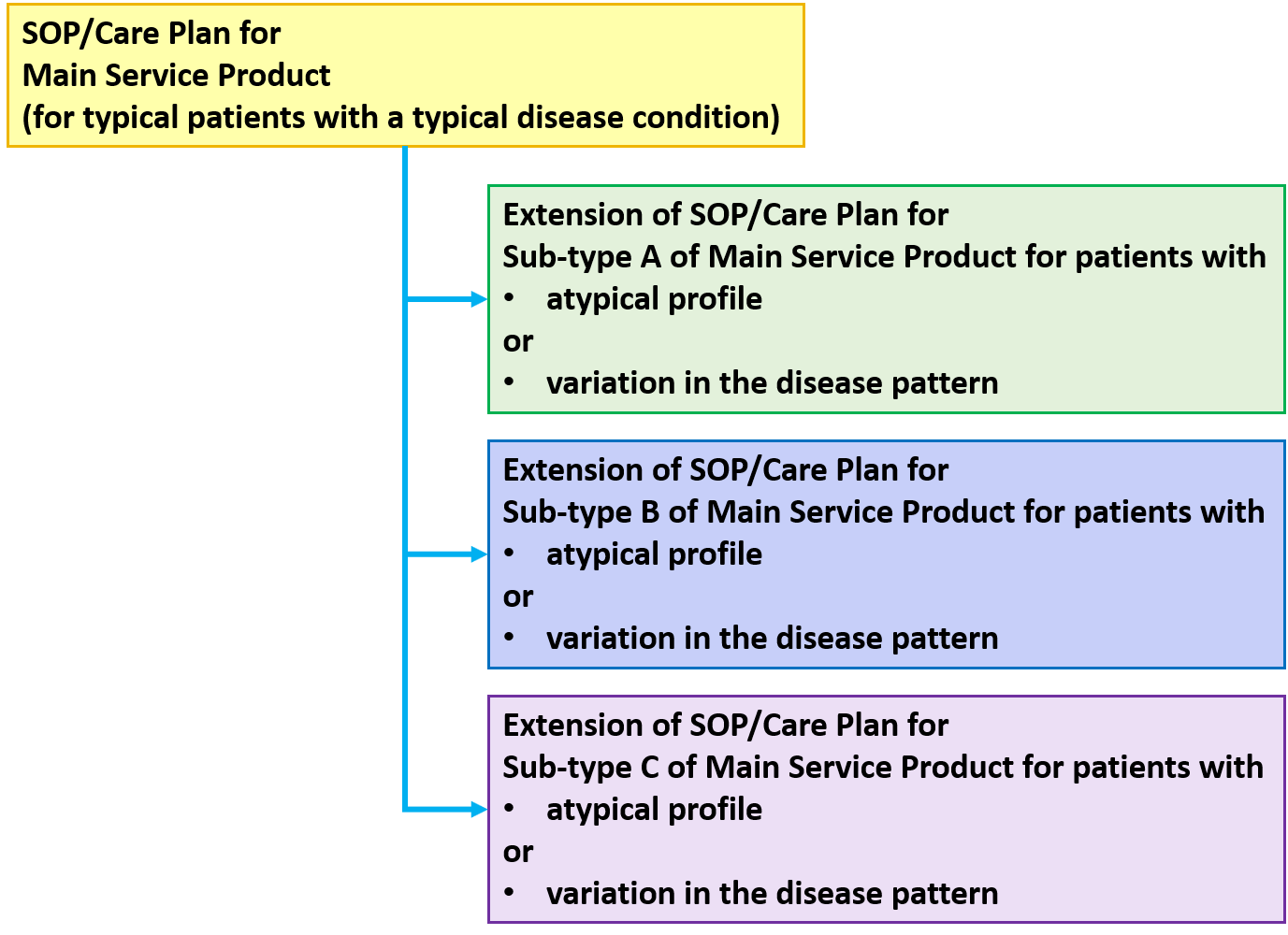
Designing and Documenting SOP/Care Plans for Variants of the Disease
SOPs are often criticized for being rigid and didactic. In fact, by offering different directions and paths, the SOP/Care Plans offer alternatives in managing a patient based on various valid criteria. SOPs / Care plans are designed to suit different anticipated scenarios (see below). Where there is a choice of methods or material without major difference in effectiveness or safety, the care provider is given an option to choose one based on being the best suited or available. Indeed, the care provider may choose to modify procedures and plans as long as these do not deviate from core policies and the variance in the approach or method (intentional or otherwise) should be noted.
Creating alternative subsets of a SOP/Care Plan catering for variants or sub-types of the disease is a challenge. They can be designed and documented in two ways:
- as alternative segments to the main plan where the variation of the care of the various sub-types is slight
- as a separate SOP/Care Plan, if there is a distinct difference in the care for the each sub-type of the disease
The concept of sub-types of the disease and corresponding sub-sets of SOP/Care Plans is depicted below.

Expressing Variations in Care either as Alternative Segments in the SOP/Care Plan or as Separate Documents
Multilevel numbering of the SOP/Care Plans is a good way of indexing the documents.
When the variation in case type and their care is slight there is no necessity to write separate SOP/Care Plans. Instead the difference in the care is expressed as alternatives in identified segments in the document. For example, Bronchial Asthma is categorized based on variation in acuity of onset into Acute and Chronic types. The two categories have very different presentations and approach to treatment. As such, there is no value in having a SOP/Care Plan for Bronchial Asthma per se. However, separate SOP/Care Plans have to be designed and written for its two categories. Separate SOP/Care Plan are also needed for care of Bronchial Asthma in children.
Each of the categories (acute or chronic) has further sub-types based on severity. The differences of their care is mainly in the treatment. As such this variation in care of the disease sub-types is written as alternative segments/paragraphs (with headings) as shown below:
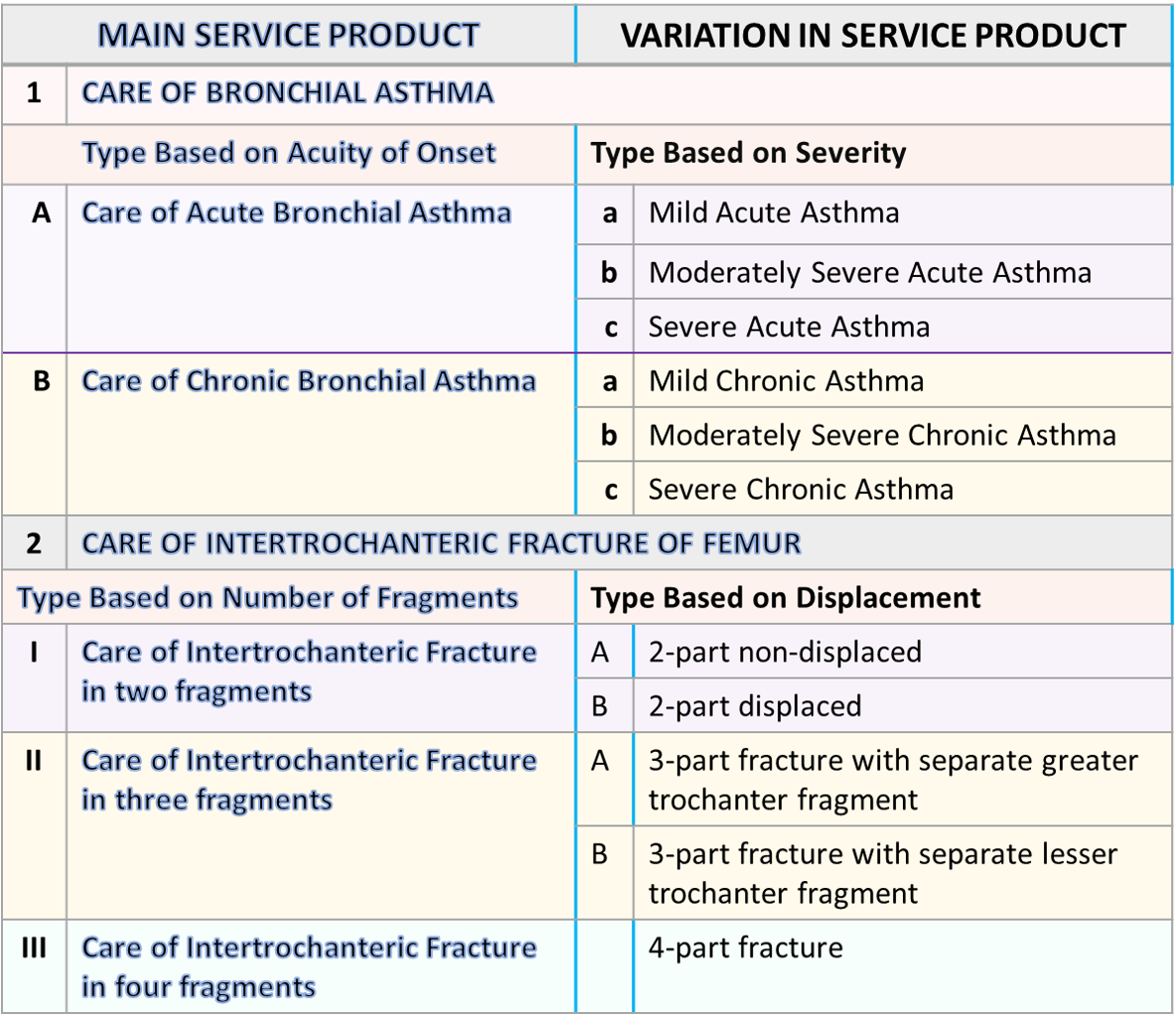
Taking the Patient Biological Profile into Consideration
For many diseases, the presentation and the management is different for the paediatric vs the adult age group. Separate SOP/Care Plan must be designed for them. The same may be true if there is major variation in the disease and its treatment due to gender (e.g. Urinary Incontinence). Variation in the care when it happens in the elderly would probably require an addendum rather than a separate plan.</
Taking the Patients Underlying Health Status into Consideration
If complete care is to be given, consideration should be given not only to the current illness but also health status before the illness began. It would be uncommon for separate Reference plans to be necessary for these circumstances but certainly the Actual Plan needs modification taking the following factors into consideration:
- The general health in terms of nutrition, physical ability, physiological functions and psycho-social status
- The existence of Concurrent, Preexisting and Unresolved Previous illnesses
- The existence of disabilities, handicaps, deformities (congenital or acquired, temporary or permanent)
The plan must therefore incorporate considerations of the Total Patient Care Concept mentioned previously.
INFLUENCE OF CARE OBJECTIVES AND STANDARDS
The objectives of the service provided (care of the patient) should be determined and stated at the outset in the SOP/Care Plan. In some instances the objectives are also determined for every phase of patient care. Indeed the objective for any intervention need to be known.
At the start of the care episode the diagnosis is often uncertain. Yet in the interim, care with appropriate objectives is offered to the patient. As the disease and the care progresses, the diagnosis becomes more certain, more definitive treatment is given and the objectives can be stated more clearly
There are three main categories of treatment goals depending on the potential for altering the progress of the disease i.e.:
- Cure of the disease,
- Containment (by 2O or 3O Prevention), Support and Relief,
- Palliation of symptoms and of disturbed function.
The objectives of care influence the way it is planned. For a given illness, not all of the objectives mentioned can be achieved or are necessary. While many diseases are eminently curable, some can only be contained or their harmful effects mitigated. When there is potential for cure or complete resolution of the disease process, the plan is directed towards achieving it. Yet, others are inherently incurable or are too far advanced. However, when there is no possibility for cure, the plan offers other beneficial therapeutic options aimed at restoring functions, symptom relief and providing comfort. These three goals can be achieved using the strategies that may contain all or some of the following types of therapeutic (treatment) approaches or modalities i.e.:
- Definitive
- Symptomatic
- Supportive
- Preventive
- Rehabilitative
- Promotive
Depending on the potential for altering the progress of the disease, the main treatment strategies or actions to be taken will include:
- Remove or lessen effects of illness (relief symptoms, provide comfort)
- Maintain, restore, or improve health status and physiological function (provide support)
- Avoid or minimize complications of treatment
- Induce remission
- Cure the disease (if possible)
- Prevent deterioration or recurrence
Each mode of therapy needs to be planned so that the optimal quality features of the outcome are achieved. These features include:
- Effectiveness
- Safety (including avoidance of unwanted effects)
- Appropriateness
- Efficiency (especially timeliness)
- Sustainability
- Acceptability
- Cost-effectiveness
Therefore, in the SOP/Care Plan, setting objectives includes specifying standards of the final and also the intermediate outcomes of care based on the desired quality features. By considering patients as clients, due attention is also given to the restoration or amelioration of the disrupted quality of life (ability to work, enjoy leisure, attend school and perform daily life activities) as the objectives of care.
Different treatment modalities pose different requisites. Plans need to take into consideration:
- the conditions required to ensure its success
- the prevention of adverse effects
- the steps to be taken when complications occur
DESIGN BASED ON CLINICAL WORK PROCESSES
The greater part of the SOP/Care Plan addresses policies and procedures. Hence, the development of effective SOP/Care Plans requires a thorough understanding of the clinical work processes and the design is fashioned according to the sequence and conduct of it.
All clinical care providers, including doctors, nurses, allied health personnel and others, follow a common generic set of processes, their layout and direction. A comprehensive outline of clinical care processes applicable to all cases is shown below as a workflow chart:
The Generic Clinical Process Algorithm

Sequence of Processes (Workflow)
The priority and flow of the processes does not necessarily follow strictly the sequence shown above. The workflow will depend very much on the type, severity, urgency, progress and effects of the illness. In an urgent case, emergency treatment is given first before a full interview, examination and tests are done. Some cases may have obvious diagnosis based on routine tests or chance findings from investigations already done during other instances of care. As such, it would not be necessary to repeat the diagnostic investigation. For some types of cases, it may be more practical to perform certain processes first as a routine for example performing urine tests at a antenatal visit or visual acuity measurements for every case with a problem of vision.
Concept of Triage
Triage (determining priority of care and dispersion of cases) as a concept as used in managing mass casualties and emergency situations can be applied at the beginning of care for all situations, even for elective cases.
Triage is done just after the patient has been registered. It should preferably be performed by a care provider with clinical experience. A SOP/Care Plan should be available even at this stage. The outcome will be the identification of a diagnosis in the form of a symptom complex or a syndrome unless the patient is a referred case from some other care facility where the diagnosis has already been worked out. The triage procedure will help in:
- directing patients to appropriate care
- speeding up the flow of the care process
Iterative Nature of Clinical Workflow
Clinical processes are iterative (cyclical, repetitive) in nature. Certain processes need to be repeated if:
- the process is effective only if it is repeated intentionally for a certain number of times,
- the objectives are not met, or desired results are not obtained by a single instance,
- the results of processes (such as monitoring, review and measurement of outcome) are expected to vary (improve) as the care progresses.
f processes are repeated as the care proceeds, without any change in plan, then it is sufficient to document the decision as “repeat as planned” or “continue monitoring” or “continue medication as prescribed”. Since processes are done based on orders, new orders have to be made if the duration of the initial order has ended.
CHANGE IN PLAN WITH THE PHASE OF CARE
A SOP/Care Plans is written as a narrative made up of segments or sections consisting of the clinical care processes required to be performed at various phases of the episode of care, as elaborated below.
When the diagnosis is uncertain the plan for the whole care episode cannot be very definite. The care provider can put up an Actual plan only for the initial stage. When the diagnosis is clearer, the broad overall plan of care can be determined. Even then, because the workflow may take variable paths, only an outline of the latter stages can be stated. Once a definitive diagnosis is made and the appropriate treatment regimen is known, then the care for the rest of episode may be planned, initiated, optimized and maintained.
When the diagnosis is certain, definitive treatment is initiated. Even so, this cannot be accomplished in one sitting. Unless it is the treatment of an emergency case, the effects of treatment will take time to manifest. So, treatment is followed by monitoring of the patient which includes checking on the progress of the illness as well as monitoring of side effects. Rehabilitation would be added to the plan, in earnest. Progress review is done regularly to determine the effectiveness of the therapy. failure due to non-compliance to the plan by care providers and patients need to be excluded. Once an optimal regime is established, it should be continued until desired objectives are achieved.
If the plan itself comes into question, the reliability of the diagnosis and the appropriateness in the choice of the plan or the way it is customized need to be reviewed.
The Care Episode
The period within which the entire care of a patient with a particular disease or health problem (a case) takes place is considered as a care episode. It begins at the time of first contact with a health care practitioner and ends with the resolution of the illness/problem or death of the patient. In that episode, the patient may make several visits and during each visit, he/she may have encounters with many health care providers. He/she may be subjected to processes/interventions or experience incidents, all which are considered as events. Encounters and events usually occur in sequence. However, there are instances e.g. in emergency situations and in complex procedures (e.g. surgical operations) when more than one care provider may be attending to the patient at the same time.
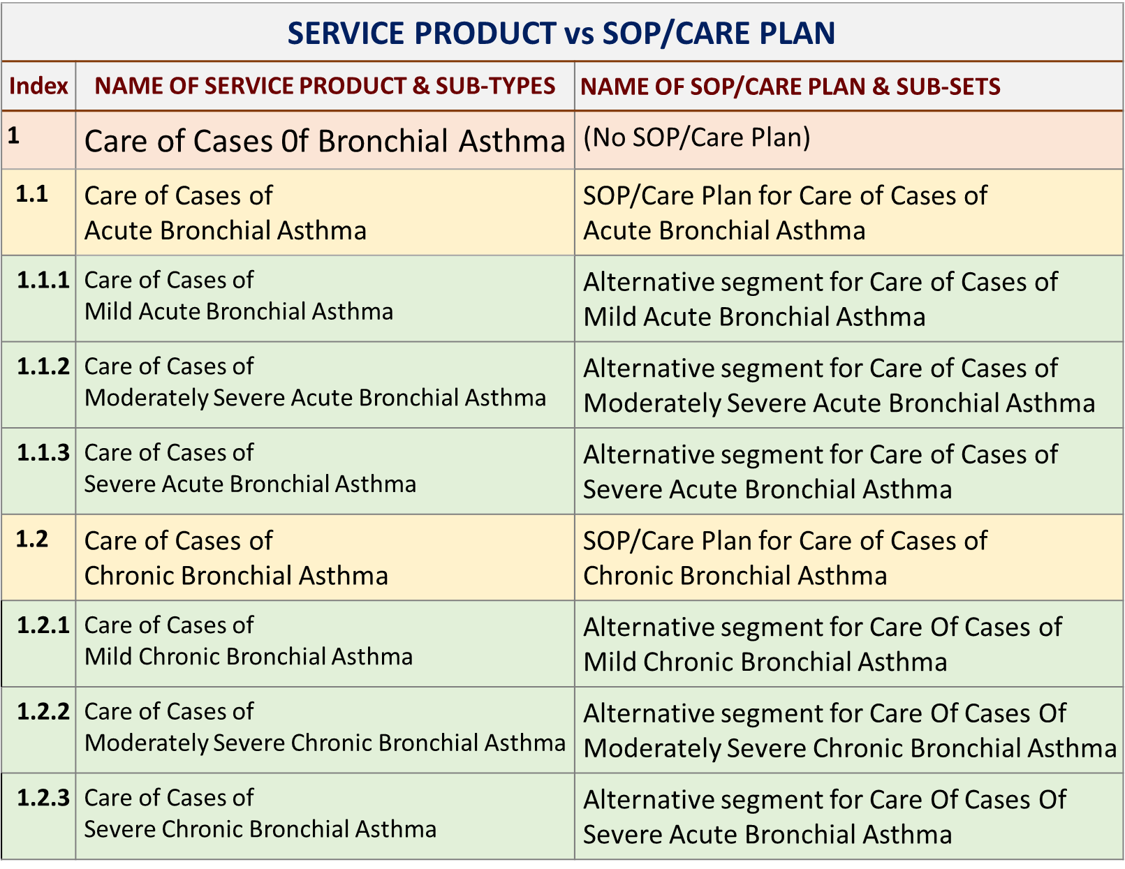
Dividing the Care Episode into Phases
Although the process of care is continuous, it is convenient in practice to divide the care into sequential periods or phases. Each of the phases is distinguished by the objectives that can be achieved during the period. For simplicity, the division can be into early, middle and later segments. Indeed, phases can be divided in different ways and be given different names (see below).
Actions taken at the earliest phase is often concerned with establishing the diagnosis, stabilization of physiological functions and immediate care. In the next phase, attention is given to starting the definitive care and optimizing it. This is followed by continuation/maintenance of care (treatment, monitoring and reassessment). Subsequent actions depend on whether the illness resolves such that care can be terminated or remain unresolved hence requiring long term care
Variation of the Plan Based on Changes in the Characteristics and Behaviour of the Illness
The characteristics and behaviour of a disease varies with each occurrence. Its progress may be typical or atypical and may become better or worse. Complications of treatment may occur. The care provider modifies the existing Actual plan or if necessary selects a different Reference plan in response to these variations. Usually, the work flow advances as and when all tasks planned for the phase are completed and the objectives met. The phases of care of both acute and also chronic diseases are categorized into:
- Phase for establishing diagnosis, stabilization and immediate care
- Phase for initiation and optimization of care
- Phase for maintenance of care, re-evaluation and modification
- Phase for discontinuation of care in the event of resolution of illness
Designing SOP/Care Plans with Consideration to Phases of Care
In manufacturing, the processes in an assembly line occurs continuously without stopping. However, if we look at the entire manufacturing activity, there are separate lines for fabricating of parts, assembly and testing. Similarly, while the SOP/Care Plan describes the processes from the beginning to the end, it does not mean that it is performed continuously. The processes cannot be listed then as a long lists of process but have to be segmented into blocks. These blocks can correspond with phases and coincide with visits. The phases and the processes that make up the content of each phase is as shown below:

Hence the SOP/Care Plans is designed as segments with phases of care in mind.
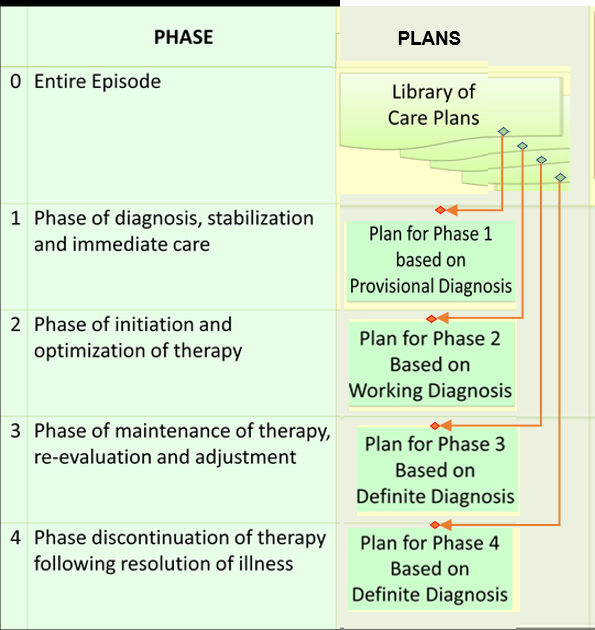
The Flow of the Clinical Process
Clinical pathway is another term for work flow and algorithms when it is used in patient-care activities. These terms can be used interchangeably. They are the predicted or planned series of sequential work processes guided by policies in managing a clinical problem. They provide the mechanism to incorporate alternatives and variations. A ‘critical’ pathway contains only the critical (important, required) steps or processes with the obvious (mundane) steps left out in the documentation (but not in practice). The term pathway has been incorrectly used to describe care plans. If the term care pathway is to be used at all it should be synonymous with workflow as used in SOPs. The workflow/care pathway is an essential component of a documented SOP/Ca re Plan.
After selecting a plan based on the initial diagnosis, the care provider may alter or revise the plan based on:
- Changes in the understanding of the illness affecting the patient (the certainty and comprehensiveness of the diagnosis )
- Evolution of the disease along its natural history
- Advancement of the clinical process workflow
- Other emerging issues
There are instances when the workflow cannot progress according to the initial plan due to various impediments or circumstances. At times the process e.g. information gathering, investigations or procedures have to be repeated or abandoned. In those cases or if the prescribed treatment plan is ineffective, unacceptable or unsafe for the patient, an alternative approach or modality is used. Non-compliance by care providers or patients is also a factor that affects the progress of the workflow as well as the success in achieving the desired outcome.
The decision-making process that guides the necessity to change the Care Plan is depicted below:
Changing to Alternative Reference Care Plan in Response to Variations, Options and Contingencies
At the start of care (usually at the first visit) the primary provider chooses a care plan that matches the diagnosis. At subsequent visits the same the same plan may be used if appropriate. There may be a need to follow a sub-set of the plan depending on variations in the pathological grade of the disease, the stage of the disease, the level of severity or the emergence of complications.
Indeed a Reference Care Plan for a different disease must be chosen in response to a marked change in the diagnosis.
Plans are also modified or revised if various other emerging needs appear. If previously designed plans are not available then the care provider needs to devise the required plans him/herself. Hence, it is necessary to design and put together a comprehensive library of Care Plans to cater for certain periods/phases or scenarios in the care of a patient for each illness or health problem. The primary provider selects the appropriate plan from a library of SOP/Care Plans made available to him/her. practice, the health care provider delivers care at encounters / consultations with the patient, usually during a visit i.e. when the patient comes to the health care facility or are visited by health care provider or via Teleconsultation. Moving on from one phase to the next depends on whether the objectives of the former have been met. This depends very much on whether results of actions (assessment, tests and treatment) are immediately available or takes some time to be available. Many results would only be available after a time interval, it is necessary to have a break between the encounters or visits. Hence, only some part of the work process can be done at one encounter or visit. Therefor, for practical purposes the entire list of processes need to be broken up into segments or blocks.
Initiation and Continuation of Phases of Care to Coincide with Visits and Encounters
The division of care into phases is conceptual rather than practical. Dividing care into sequential phases is still insufficient.
In an inpatient setting, processes are performed during encounters with intervals in between. The exception is for the processes of continuous monitoring or observation (manually or by machine).
In an outpatient setting, more often than not, processes are performed in blocks at visits. There are of course instances when a care provider would attend to a case more that once (e.g. at the ordering of a test and after the results are available).
The the service setting (i.e. where the visit take place) deemed suitable for the process depends on the part of the workflow to be accomplished.
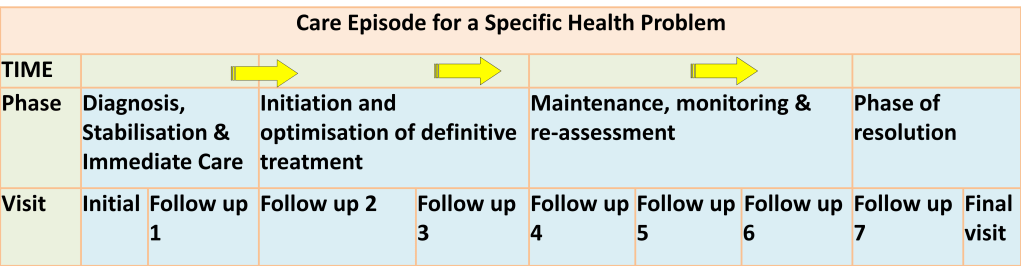
MATCHING PLANS WITH VISITS AND SERVICE DELIVERY SETTINGS
Service delivery may be provided in various settings including:
- Outpatient visit
- Emergency visit
- Inpatient visit
- Day Care visit
- Home Care visit
- Teleconsultation visit
- Self-care
Matching Care with the Appropriate Service Delivery Setting
Different types of disease and different phases of care has to be matched with the appropriate health care service delivery setting. Diseases that are sudden in onset with severe symptoms and physiological derangement need to be cared for in the Emergency Unit or an Inpatient facility. The of care of a patient with certain chronic illness at the initial phase involves intense care and therefore better carried out in an outpatient setting. Otherwise the care of patients with most diseases can be cared for on an outpatient or daycare basis. Telehealth as a service delivery system augments inpatient and outpatient services. It is better to start the first encounter with direct interaction where the care provider can use all his senses and instruments to examine the patient. Later when the care regimen is firmly established, interaction via remote audio-visual mechanisms and telemetry is more convenient for patients in lieu of visits to clinics.
Scheduling Care Activities
For practical reasons and convenience, service managers schedule visits to coincide with the anticipated change-over of the clinical care process from one phase to the next. If the workflow for the care of the case type or sub-type is studied the number of visits or encounters to complete a phase can be anticipated and scheduled as a feature of the SOP/Care Plan. For example, a patient who is on an outpatient follow-up may have to be admitted for in-patient care if certain complications occur. Inpatients should be discharged as early as possible so that nosocomial side effects can be minimized.
At the visit or encounter, tasks to be performed and other events that the patient will experience or incidents that is likely to happen to them can be anticipated by the care providers. Similarly, the patient should be aware of what to expect. What is planned for the visit may be continuation of the current SOP/Care Plan or a change in plan. However, the decision to execute the plan is made only if the patient’s status when reviewed allows for or warrants the change-over. This is especially true, for example, in ante-natal care where plans are made for phases coinciding with trimesters of pregnancy. While pregnancy inevitably progresses, certain processes or interventions that have not been successfully completed need to be repeated or continued.
In actual practice, the opportunity to decide on advancing to the next phase occurs during the visit and encounter itself rather than before it. Usually, it is then that the care provider reviews the patient’s condition and the accumulated data.
The most appropriate service delivery setting for a particular visit can can also be decided in advance. The difference in settings do not significantly change the clinical content of the SOP/Care Plans but affects mainly the administrative processes, workflow and use of resources.
Differences in Arrangement of Processes According to the Care Setting
When the patient is managed in an in-patient setting for either acute illness or the initial care of chronic illness, the care provider may review the plan for the case as often as daily or more frequently and decide on advancing through the phases.
For cases managed in the outpatient or daycare setting, the patient is reviewed at a follow up visit such that the decision to move on to the next phase is usually made then.
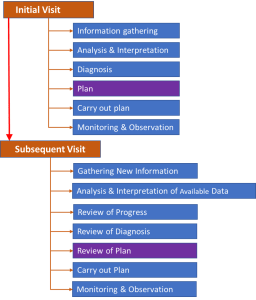
Differences in the Care of Acute vs Chronic Illness
In acute illness the disease progresses at a rapid pace. Hence, processes are also performed rapidly through encounters at short intervals or continuously. This means that the appropriate service delivery setting is ether the Emergency Unit or the Inpatient facility. at the immediate phase, Efforts are directed towards symptomatic relief, resuscitation, stabilization and support (physiological, psychological, social and spiritual).
The care of a patient with chronic illness can be carried out a slower phase. Except at the very beginning of care for some diseases, chronic diseases are suitably managed as outpatients. Care occurs at visits spaced by intervals. The appropriate interval between visits is determined by the expectation on the speed of progress of the illness, the readiness of results of tests, and the effect of treatment on the disease will become apparent. and the This gives time for the care provider to obtain a diagnosis with a high degree of certainty and the choice of the most appropriate definitive care plan. Except at the very beginning of care for some diseases, chronic diseases are suitably managed as outpatients. Phases of care move along visits rather then encounters. Involvement of the patient in care of his/her own at home is essential. For incapacitated patients, their wards will take that role. The same is true for parents in the care of their children.
Dividing Processes into Blocks to Coincide with Visits and Encounters
It is obvious that in the SOP/Care Plan processes must be grouped together, taking into consideration when and where they are supposed to take place. However, it must be emphasized that phases do not coincide necessarily with visits or encounters.
The processes planned for the First visit is quite different from that for the Follow-up visit because at the very first visit the diagnosis is usually uncertain, while at subsequent visits, the diagnosis is more definite. So, processes for the initial phase of care is assigned to the first visit. The later phase of care is initiated at the next visit depending on whether all objectives of the first phase has been met. Otherwise, the processes of the initial phase has to be repeated over more than one visit or encounter. If, at later visits some part of the care process has been completed they can be adopted and continued. Then, plans need to be made only for the remainder. At each visit or encounter the care provider has to make decisions on whether to:
- proceed to the next phase on the current plan
- change the current plan altogether or in part to another plan
The phase of clarifying the diagnosis, ends when a definite diagnosis is identified with some certainty. If, for example, the result of a test is pending it has to be waited for. If findings are equivocal, more tests may have to be done. In that situation, the phase is delayed. Moving from initiation and stabilization of definitive care to the maintenance phase depends very much on the effectiveness of the care given or improvement in the disease condition. Otherwise, the care persists in that phase. At some point, the care provider has to decide whether the patient requires further care (follow up visits) based on the resolution of the illness or the achievement of the optimal outcome. There is no advantage in putting the patient on regular follow up when it is unnecessary. However, access to the service can still be offered on a needs (prn) basis. It must be noted that a phase may need more than one visit to complete.
The term ‘care’ is preferred because many other elements/aspects besides treatment or therapy contribute to improving the patient’s status. The grouping of processes into blocks corresponding to particular visits and phases of care is depicted below:
Phase for Determining the Diagnosis and Immediate Care / Early Treatment
This is the phase of initial contact with a health care provider. The disease process itself may be at an early or later stage of its natural history, depending on whether the patient seeks treatment early or late. In this phase, the main objective is to determine the diagnosis as accurately and comprehensively as possible. The main tasks are clinical data gathering and diagnostic investigations. At the beginning of this phase, the data available may allow the clinician to determine the diagnosis in terms of symptom complexes, clinical syndromes or as a disease belonging to a diagnostic related group. Care would then be directed towards symptomatic relief, resuscitation if necessary, stabilization and support (physiological, psychological, social and spiritual). Besides the diagnostic investigations, data accumulated through observing and monitoring the patient will help in arriving at a definitive diagnosis. The diagnosis need to be further refined to clarify the variant of disease, severity grade, stage of illness, risk stratification and prognosis.
In acute illness at the immediate phase, efforts are directed towards symptomatic relief, resuscitation, stabilization and support (physiological, psychological, social and spiritual). At the outset, observation and monitoring are initiated. Investigations is aimed at determining the patients general physiological status and functions of various systems. The priority for Diagnostic investigations is to determine the system or site involved or the like pathology. Therapy must not wait for want of an accurate diagnosis.
Yet every effort must be made to obtain a definitive diagnosis so that the plan for specific treatment can be started as early as possible. The diagnosis need to be further refined to clarify the variant of disease, severity grade, stage of illness, risk and expected or desired outcome.
The care of a patient with chronic illness begins with the initial contact with a health care provider. The disease process itself may be at an early or later stage of the natural history of the disease, depending on whether the patient seeks treatment early or late. In this phase, the main objective is to determine the diagnosis as accurately and comprehensively as possible. The main tasks are clinical data gathering and diagnostic investigations. At the beginning of this phase, the data available may allow the clinician to determine the diagnosis in terms of symptom complexes or syndromes.
t is essential that the care provider plans for the continuity of care well and ensure that it happens. He/she may delegate the responsibility to others for the convenience of the patient. The primary care doctor, family doctor or school/factory nurse are the most appropriate care providers to take on this responsibility. If it is a disability or handicap, depending on the type, then therapists, counselors, optometrists, audiologists or social workers may be more appropriate. Self-care, home care and care by voluntary bodies may be adequate or may supplement those given by health care professionals.
Periodic review by the provider who initiated the plan may be necessary.
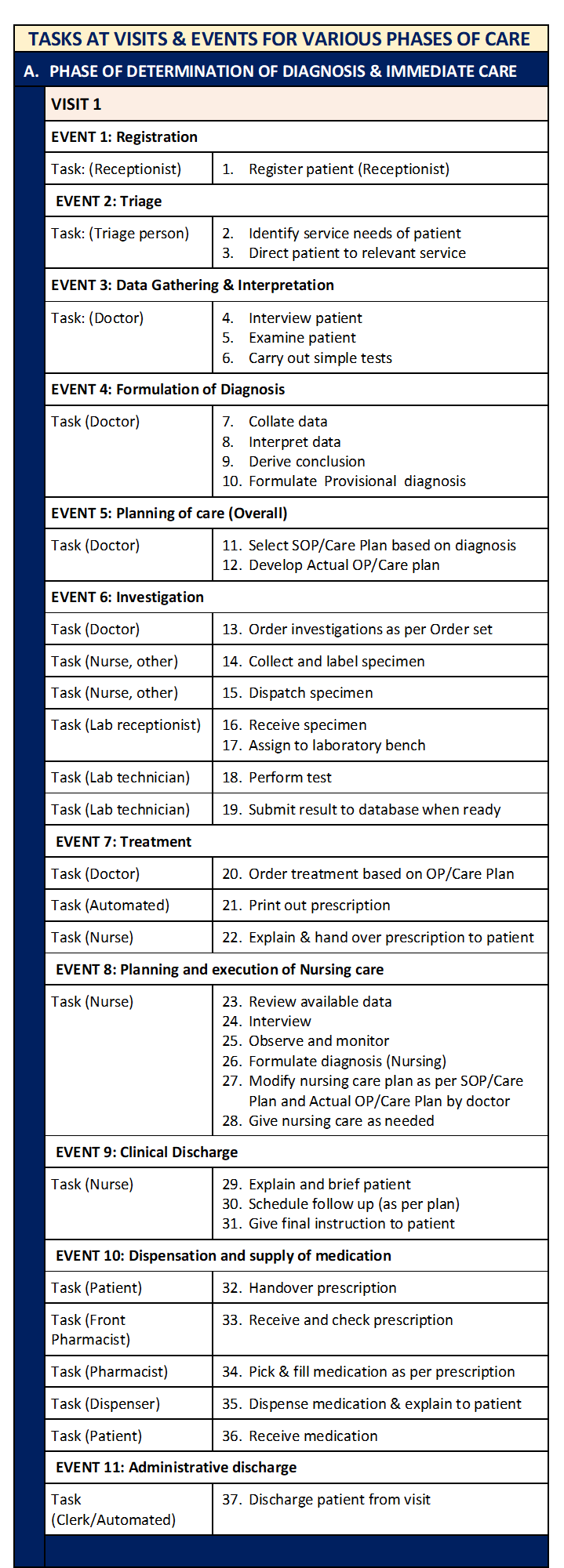
Phase for Initiation of Definitive Care
Once the diagnosis is ascertained the care provider needs to clarify the objectives of care (expected outcome, therapeutic end points). A more definite Care Plan is then chosen and customized.
In this phase, the disease entity/entities and accompanying health problems affecting the patient are already established with some certainty. An appropriate definitive management plan (curative, palliative / supportive, rehabilitative) is adopted and implemented. contain it or control it.
In this phase, the disease entity/entities and accompanying health problems affecting the patient are already established with some certainty. As such, treatment end points need to be defined and measurements made to determine whether these end-points have been achieved. Depending on the disease, the objective of treatment would be to be the combination of any of the following:
- cure the illness,
- contain it or control the progress
- mitigate the effects
An appropriate definitive management plan influenced by the care objectives is adopted and implemented.
The progress of the patient is reviewed regularly to detect deterioration or improvement, occurrence of complications of illness or treatment. The care provider reviews the diagnosis and the effectiveness of therapy. He/she then, may have to revise the Care plan and modify the treatment.
Depending on the illness, this phase may spread over a considerable period. The patient may be discharged from in-patient care and the care continues in the outpatient setting or at home.
As such, the care provider defines the treatment end points, chooses the plan offering the most suitable treatment approaches or modalities. As such, treatment end points need to be defined and measurements made to determine whether these end-points have been achieved.
Phase of Optimization of Care
In this phase, the care provider need to be constantly aware of the desired treatment end points and evaluate them through feed back from patients, observations, monitoring and repeated investigations to determine whether these have been arrived at. Optimization is considered achieved when the care regimen produces the best possible level of benefit. To this end, the care provider need to make adjustments and modifications to the care plan.
Measurement of outcome and comparison with planned targets is an integral activity of care at this stage. Scoring systems and check lists can be used. . The plan is then continued with minimal change.
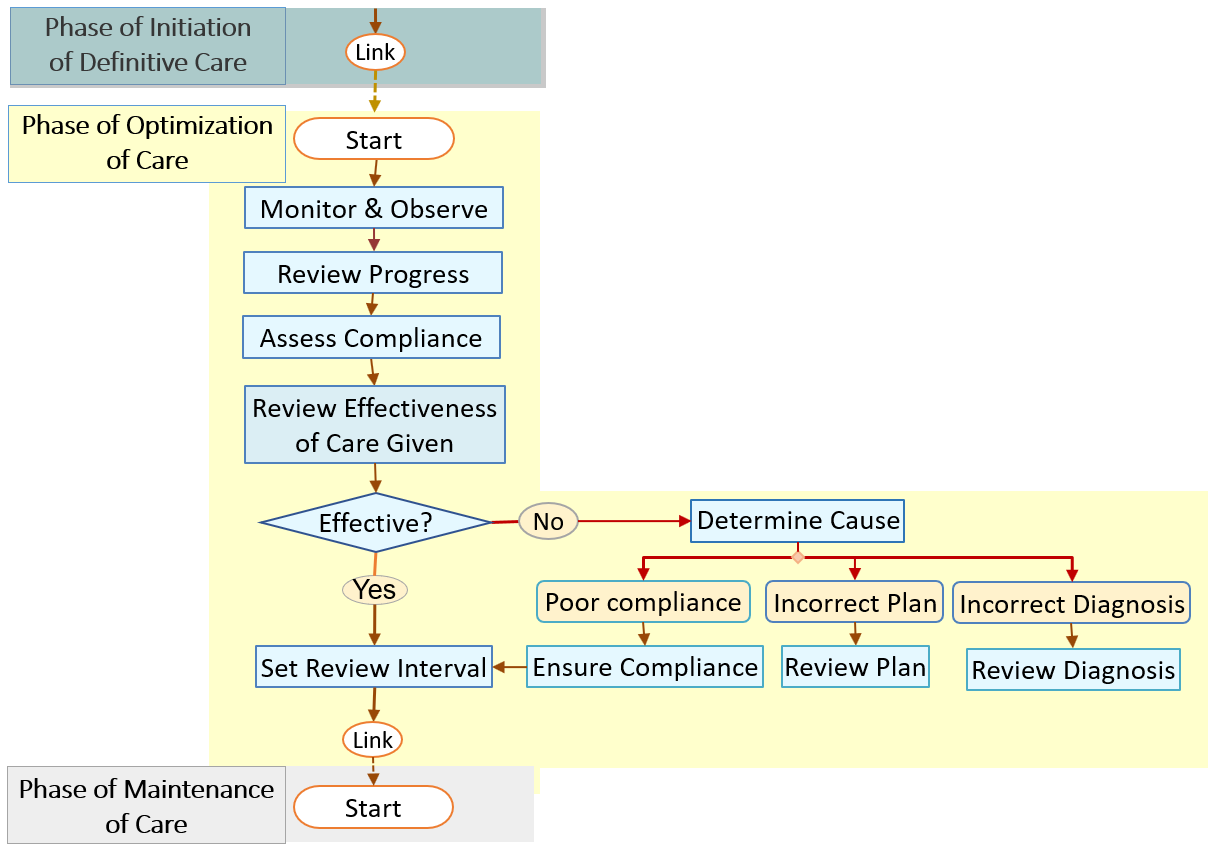
Phase of Maintenance of Care
The progress of the patient is reviewed regularly to detect deterioration or improvement, occurrence of complications of illness or treatment. The care provider reviews the diagnosis and the effectiveness of the care given. He/she then, may have to revise the SOP/Care Plan and modify the treatment.
Depending on the illness, this phase may spread over a considerable period. The patient may be discharged from in-patient care and the care continues in the outpatient setting or at home.
The main aim of this phase is to optimize the benefit of care given. The main tasks in this phase is monitoring, reassessment and progress review addressing both the disease and also the treatment. The results will reveal the behaviour of the illness and various developments. The progress of chronic diseases vary in many ways including:
- speed of deterioration
- active vs inactive periods
- emergence of complications
Another important aspect is the evaluation of response to and effects of therapy. These factors are assessed:
- conformance to the plan
- patient compliance
- detrimental effects of therapy
Measurement of outcome and comparison with planned targets is an integral activity of care at this stage. Scoring systems and check lists can be used. Optimization is considered achieved when the treatment regimen produces the best possible level of benefit. The plan is then continued with minimal change.
Once the patient has been stabilized, attention is paid to:
- relief of symptoms
- monitoring various parameters
- maintaining normal physiology,
- providing nutrition,
- giving psychological support
- taking preventive actions
- treatment of ongoing problem
Phase of Continuation or Discontinuation of Care
Depending on the nature of the illness and the response to care, the service may reach a stage where it can be discontinued.
Chronic illnesses are usually characterized by continuous progression or persistence. The care is therefore long term and usually extend throughout the life of the individual. Some may resolve, go into remission and be dormant only to appear again later. Temporary cessation of therapy with planned follow up reviews may be necessary.
Rarely some diseases runs through its course and dissipates. The care can then be phased out.
If the illness appears to have resolved, discontinuation may be abrupt or phased out. The plan conveys the manner in which care is to be stopped including how medication or other treatment is to be tapered and what evaluation criteria need to be met to declare it safe for the care to be terminated.
On the other hand, the acute illness/health problem may be a manifestation of an underlying chronic disease justifying further observations, monitoring and investigations. The acute illness may also give rise to permanent or semi-permanent disability, deficiency or handicap. In both instances, long term care will then be planned and provided.
Revision or Complete Change of the SOP/Care Plan
For every case, the actual SOP/Care Plans are revised frequently based on the ever-changing changing needs (brought about by changes in diagnosis or condition of the patient or occurrence of events). The revision is documented as part of the plan in Progress Notes.
Decisions to start, continue or abandon plans are dependent on the data available. In inpatient care, the data available are results of clinical reassessment, monitoring data and routine investigations. For outpatient care, these data can be made available by asking patients to come for a preliminary visit when investigations and other assessment are performed. As part of self-care, patients may also submit records of symptom characteristics and measurements they make themselves (Body weight, Blood pressure, Temperature, Blood sugar level, etc.).
PLANNING THE FREQUENCY, INTERVAL AND DURATION OF VISITS
The extent of each phase, is a variable period. It can span a duration of mere minutes or can stretch across many encounters and visits. Case managers or the primary provider set the frequency of encounters and visits based on the patient’s expected response. The number of visits per episode is by nature variable but may be intentionally fixed in a service delivered as a package.
However, there are situations where the transition in the plan is predictable such that a change-over of the plan can be initiated as and when the visit takes place. A good example is the care plan for the care of a patient with normal pregnancy or a patient undergoing Knee replacement surgery. The interval between one visit or encounter to the next is dependent on two factors:
- the expected behaviour of the disease according to its natural history
- the expected duration for the treatment or intervention to take effect
A visit requires one or more identified physical resources such as room/bed within a clinic complex or ward. During the visit, the patient may have one or more encounters with different care providers using the same or different resource. The duration of each encounter is defined as time slots. All these need to be planned. In a computerized HIS, this planning is done using the scheduling and resource allocation application.
COMPONENTS OF THE REFERENCE SOP/Care Plan
Standard Operating Procedures are descriptions of how work is to be carried out for a specific category of patients defined mainly by the diagnosis. Each comprises many specific components. Reference SOP/Care Plans should contain the following components:
- A title defining the service product that the plan is designed for.
- Description of the Service product.
- Care objectives including the quality features of the service and outcome standards (equivalent to quality objectives in ISO quality management system)
- Description of the policies and processes involved
- Textual (narrative) description of the various work processes detailing layout, the input, technology to be used, assignment of responsibility and expected intermediate outcome.
- Operational policies defining constraints within which procedures are to be carried out
- Work Flow Charts or Care Pathways (the ‘flow’ of the procedure depicted graphically)
- Specific Work Instructions or Protocols
- The Work schedule and Task lists
- Guide to use of charts or forms to be used as part of the work process
- Reference tables or lists (normal values, regimens, drug dosages etc)
- Quality Control Methods (Standards, Check-lists etc. i.e. equivalent to quality procedures in quality a management system)
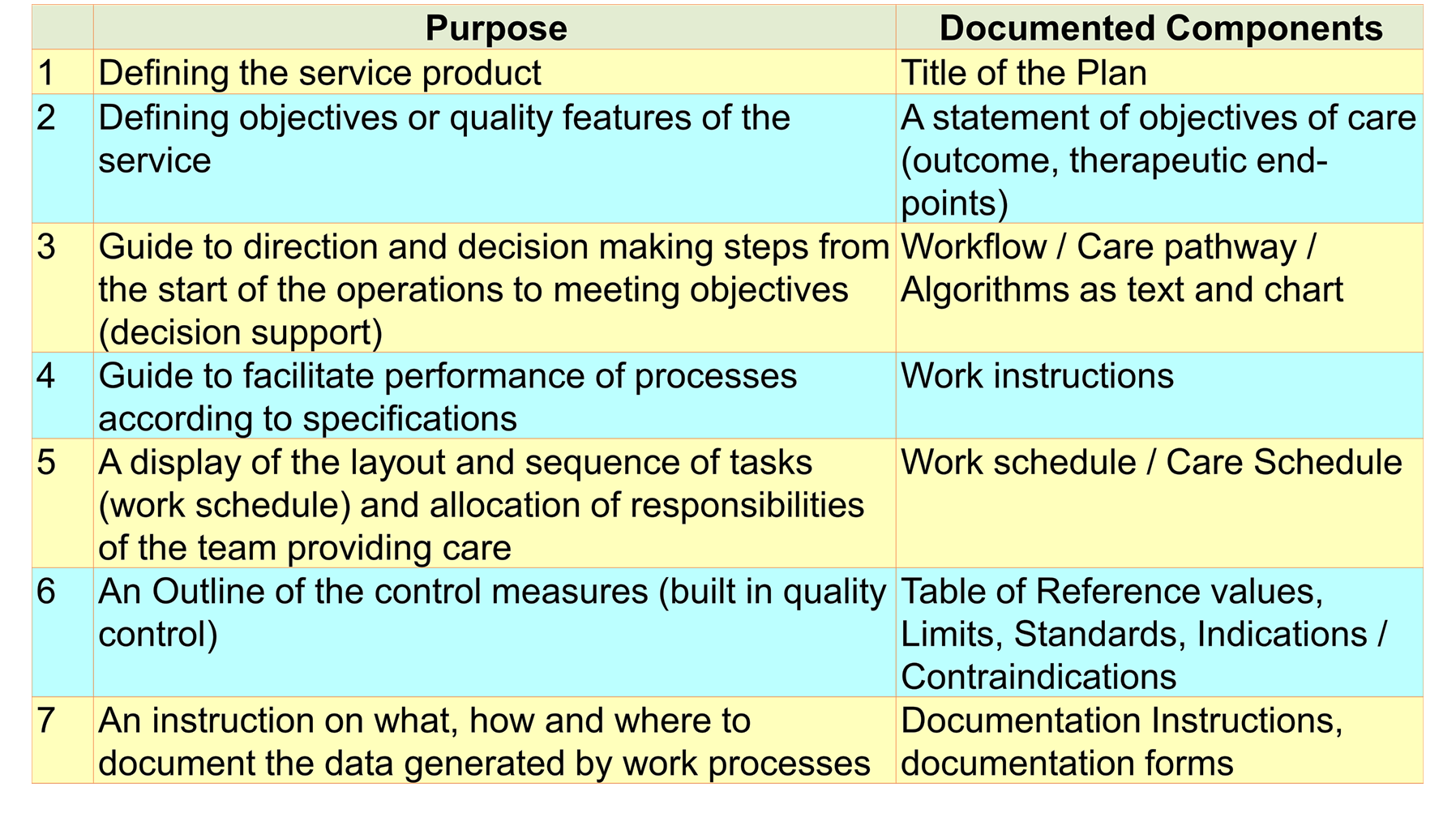
| – | SECTION | CONTENT |
|---|---|---|
| 1 | Title | Name of the Service Product for which the SOP/Care Plan is Applied |
| 2 | Service Product | Description of the Service Product i.e. the services to be given A. The typical patient group for whom the SOP/Care Plan is applicable B. The Needs of the Patient to be served a. Primary Diagnosis b. Disease Complexity (type, grade) c. Severity Level d. Stage of the Disease e. Effects and complications of the disease C. The location where and the care providers who provides the service |
| 3 | Objectives | The Desired Outcome of the care given with regards to: A. Productivity and Efficiency B. Effectiveness (Cure / Containment / Support / Relief / Comfort) C Safety (Risk assessment, Prevention) D. Quality |
| 4 | Policies and Procedures | Description of Policies and Procedures to be followed including: A. Operational policies (rules and regulations) B. Methods, modalities and Processes C. Input required (expertise, material, machines, equipment) D. Workflow, and links to related SOP/Care Plans E. Phases of Care (Episode, Visits, Encounters, Tasks and Events) F. Work Schedule (Orders, Tasks, Task , Time table) G. Guide to decision making I. Guide to documentation F. Reference documents i. Work instructions ii. Specifications and Standards iii. Forms and Charts |
| 5 | Quality Control | Quality Control Methods a. Methods to Ensure Conformance b. Preventive measures c. Quality Measurement d. Comparison with Standards (Detection of non-Conformance) d. Rectification and Damage control |
TITLE: THE SERVICE PRODUCT
To clinicians, the ‘care’ or ‘the management of a patient’ is the provision of the entire service or care for a certain patient according to his/her needs which are determined largely on the identified diagnosis or health problem. The title of the reference SOP/Care Plan should show that it is designed for the ‘care’ of this specific disease or health problem. As such, the Service product consists of a well-defined set of services to be provided for a typical patient (case) who has an episode of a specific illness. Yet it is, to a certain extent, still generic and would need customization, by additions or omissions, when it is used as the Actual SOP/Care Plan in the actual care of an individual patient.
The title is a very concise statement indicating the patient type, the diagnosis or indication and the context such as the phase of care, the service delivery setting where the service is to be given (inpatient, outpatient and day care) and the type visit or encounter.
The title of the Care Plan indicates that it is designed for the specific disease or health problem and for a particular phase. The model plan is generic in application. Conversion of such plans is done when the actual care of an individual patient is provided.
Description of the Service Product
Following the title, what the service is for and what is contains is described briefly.
The examples below, illustrates two main service products Care of a Patient with Bronchial Asthma and Care of a Patient with Intertrochanteric Fracture of the Femur. How the service is further refined is as shown below:

In the case of Bronchial Asthma, the service can be differentiated into more refined products based on acuity of onset/urgency and then further into types based on severity levels. The care for Acute vs Chronic Asthma follow quite different approaches. Some of drugs are used for all types but a few will be used only in certain types.
In the case of Intertrochanteric Fracture of the Femur, variations the service products being offered will have different characteristics to suit the different requirements necessitated by degree of fragmentation and displacement. While the main service will contain the service elements of managing a fracture the main difference for the various types will be in the surgical treatment.
OBJECTIVES OF CARE
The intended objective and expected outcome is precisely indicated. These may be the expected outcome, treatment end points, the degree of restoration or amelioration of the disrupted quality of life (ability to work, enjoy leisure, attend school and perform daily life activities) and avoidance of side effects. Details such as targets, limits and standards are understood by reference to the SOP.
A statement defining the objectives of care is essential for every SOP. These may include:
- expected outcome,
- treatment end points
- the intended degree of restoration or amelioration of the disrupted quality of life (ability to: work, enjoy leisure, attend school and do daily life activities)
- avoidance of side effects or complications of treatment
It should declare the quality policy about the service being offered i.e. a statement of targets, limits and standards with regard to quality.
Description of Policies and Processes
In an SOP, the policies and processes are presented in two forms i.e.
- A textual description (narrative)
- A work-flow chart
When designing the SOP/Care Plan, starting with the narrative description is the bet way to go. However, when presenting it as the final document it may be better to show the graphical workflow first.
Detailed Textual Description of the Policies and Processes
The whole work procedure needs to be described in text format. In general, the description takes the form of a sequential list of instructions on how to perform processes and the policies that guide it. At the same time the direction, input, technology to be used, persons assigned to perform the task and the expected intermediate outcome are specified. The operational policies that guide and constraint these processes, such as indications and contra-indications, alternatives, allowable variations and contingency plans, rules and criteria, are embedded in the description of the processes.
The sequence, direction and layout of processes or tasks that makes up a procedure must be described clearly and in detail. It is best written before or at the same time as the flow chart is being drawn. In a general sense, the textual description explains each workflow symbol (boxes, arrows etc.) but more importantly, it states the specifications and standards of the care process as well as the operational policies that govern them. Therefore, it is the principal component of the SOP/Care Plan.
The main tasks listed below need to be elaborated.
- Acquisition and documentation of clinical data (Initial Assessment, Progress Notes)
- Acquisition and documentation of data obtained from various investigations
- Analysis and interpretation of available clinical data
- Deriving conclusions regarding the patient’s health problems (the diagnosis) and documenting it (including severity grading, staging)
- Monitoring and charting of clinical parameters (Observations, serial measurements )
- Planning the management and documenting it (with decision support)
- Implementation of plans: Placing orders and carrying out tasks (Performing Investigations, treatment, administering drugs)
- Documentation of results, procedures performed, findings, and outcome
- Review of (monitoring and test) results and interpretation
- Quality Control Procedures (e.g. check lists)
- Progress review, assessment of outcomes
- Communications (Referral Notes, Replies), requests and orders
- Summaries
OPERATIONAL POLICIES
At the operations level (i.e. when work is performed), the general policies of the institution or service unit are translated into operational policies which define goals or objectives as well as the limits within which tasks or processes are performed. These limits (rules, regulations, targets and standards) may relate to efficiency, quality, costs, responsibilities, preferences and exceptions. Operational policies are embedded within the work procedure (see above).
Example of Textual Description of the Work Processes and Operational Policies
- Take history of frequency of exacerbation, limitation of activity & night-time symptoms
- Examine patient
- Perform PEFR
- Assess response according to these criteria:
- frequency of exacerbation,
- limitation of activity,
- night-time symptoms and
- PEFR
- If response is not satisfactory; review patient’s compliance to medication & advice. If the poor response is due to poor compliance then, continue the previous treatment and more effort is made to educate patient on the disease, treatment methods and need for compliance.
- If compliance is not deemed as a problem then, consider the possibility of the need to re-assign patient to a higher severity class. The medication need to be stepped up accordingly (refer treatment chart)
- Give explanation regarding the new added medication and further education on use of bronchodilator, use of PEFR meter and self-monitoring chart
- End the visit and give the patient an appointment date for a follow-up visit in one month.
WORK FLOW/CLINICAL CARE PATHWAY
Besides describing the path/flow of how the service is given as a narrative, it is also depicted graphically as a chart using the generic clinical work flow, described earlier, as the basis. It may be better to present the workflow before the text description but the idea is for the user to switch from one view to the other regularly. An example is shown below:
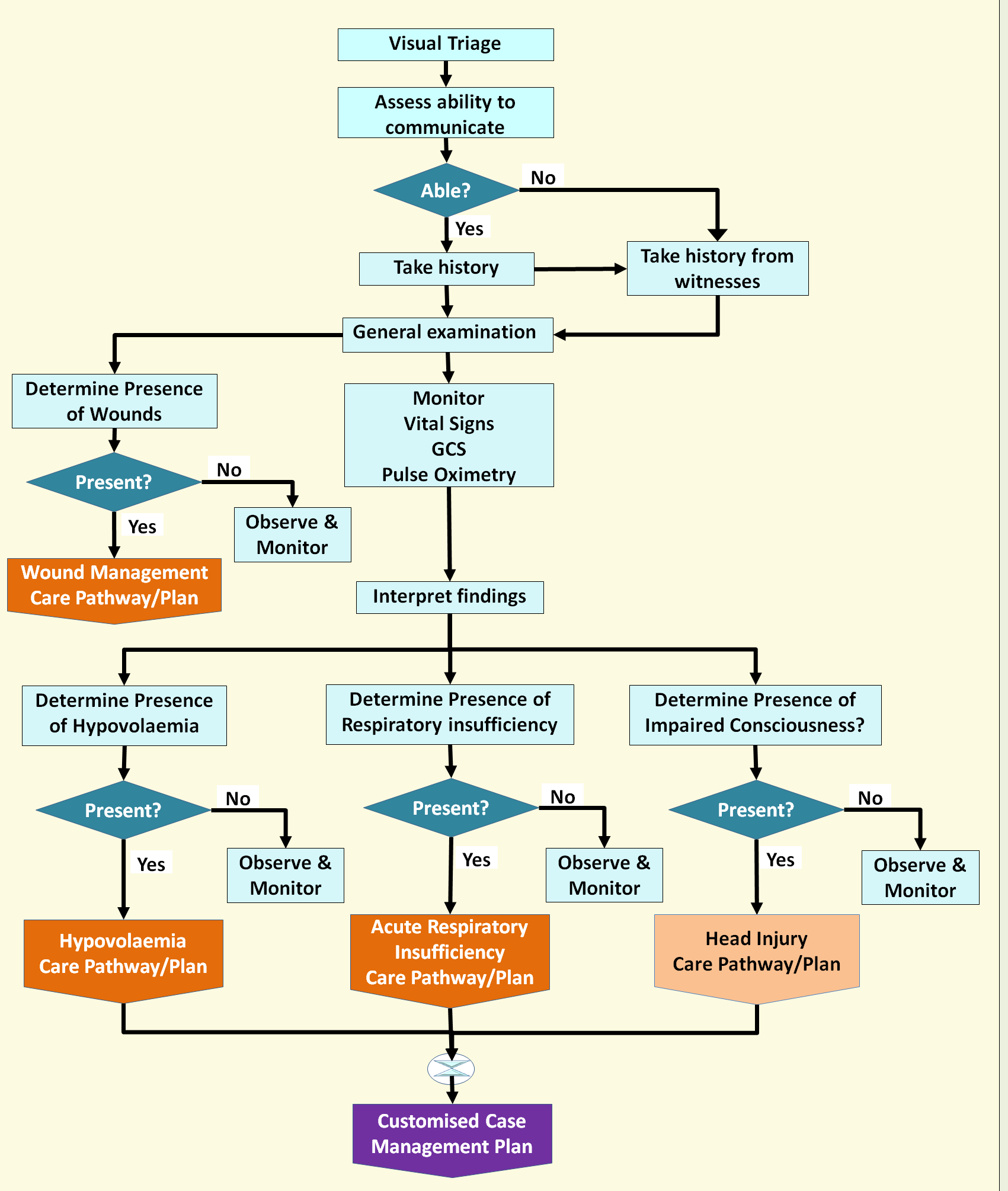
The work flow (care pathway) illustrates:
- the sequence of the processes
- the process layout (simultaneous, contingent on completion of the previous step or iterative)
- the decision-making steps that lead to alternative paths or variations
It is good to draw an outline of the processes (the critical pathway) to show the entire scope of the service. It is not necessary to depict the entire pathway completely on one page as it maybe quite long. Instead, it can be truncated and shown as a continuation on another page, Deviations and variations can be written separately and links/references to them made to the main document.
THE WORK SCHEDULE
The activities (processes, tasks) within the SOP is broken down into sets relevant for particular scheduled periods (visits or encounters) or phases of care. This is the schedule of implementation of the SOP/Care Plan and it contains:
- a title indicating the purpose for which it is used i.e. the health problem, the phase of care and any other indication
- objectives and expected outcome
- a list of all tasks grouped according to the method or technique or the professional competency
Care plans/SOP remains as a reference document until it is converted into an actual plan by customizing it for the individual patient.
It is helpful to present the overall schedule of the plan for the care episode as an outline in the form of a table. Details are not presented in this overall plan but would be written in the discrete plans for different phases or context of care.
Care Schedule or Care Matrix for the Whole Care Episode
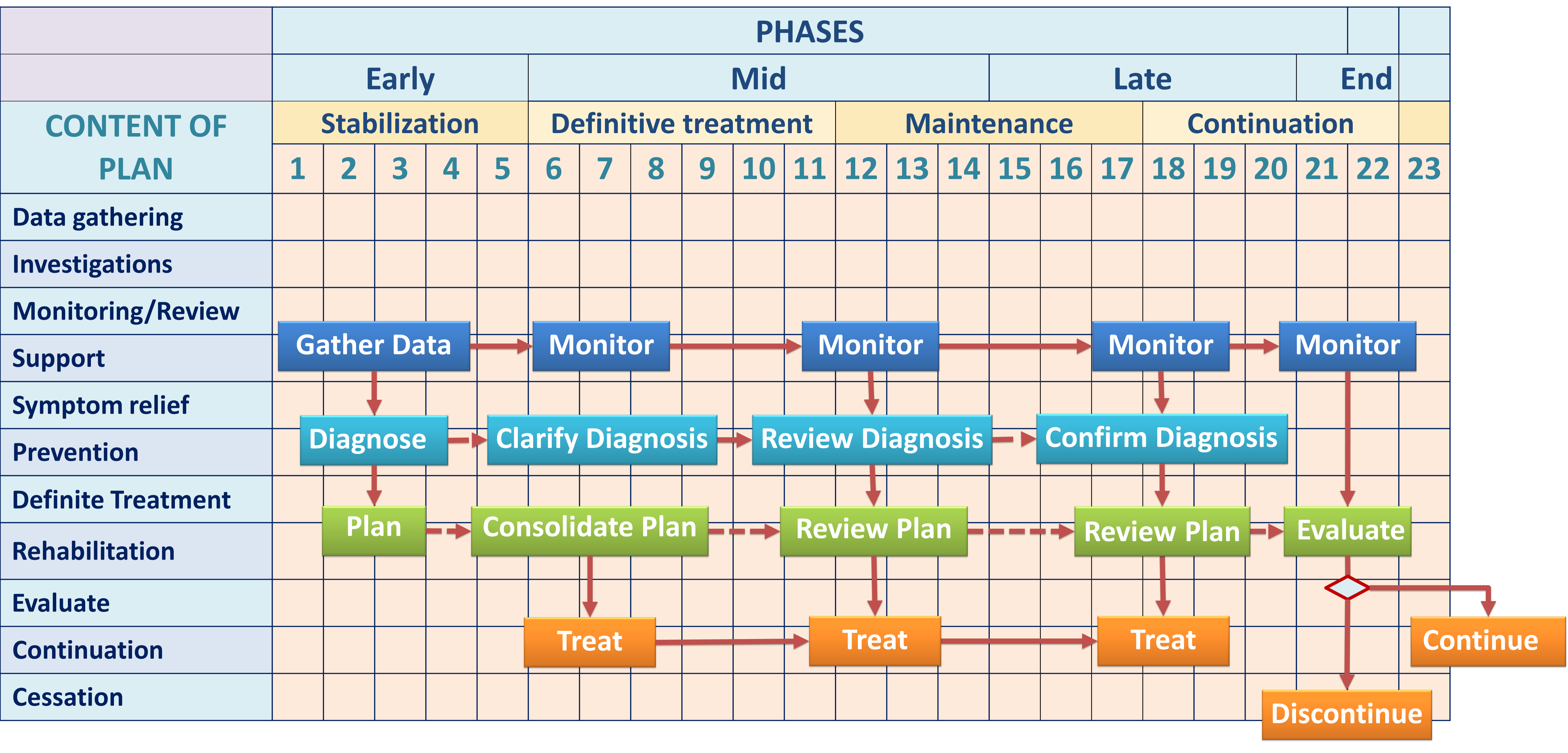
Criteria for Dividing the Care Episode into Different Phases of Care
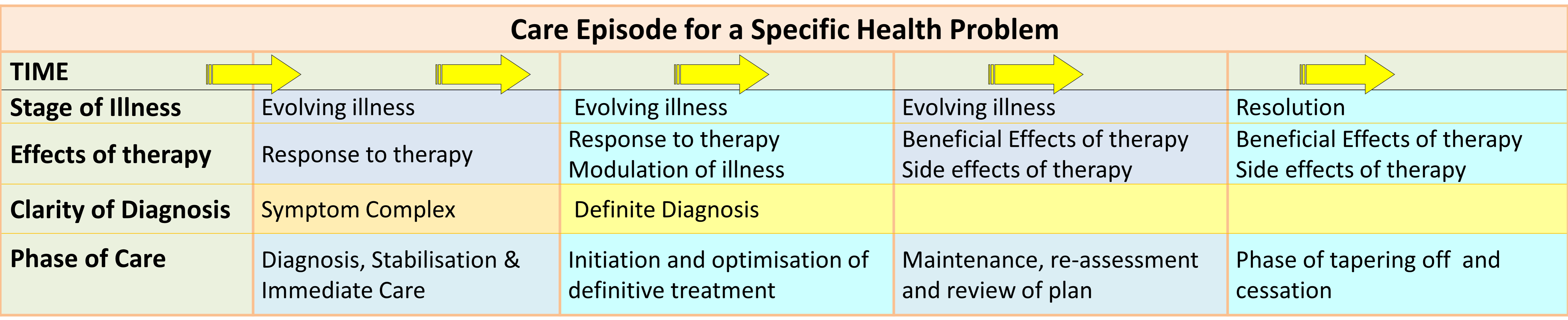
Example of Series of Care Plans for Different Phases of Care (Plan for Acute Myocardial Infarct)
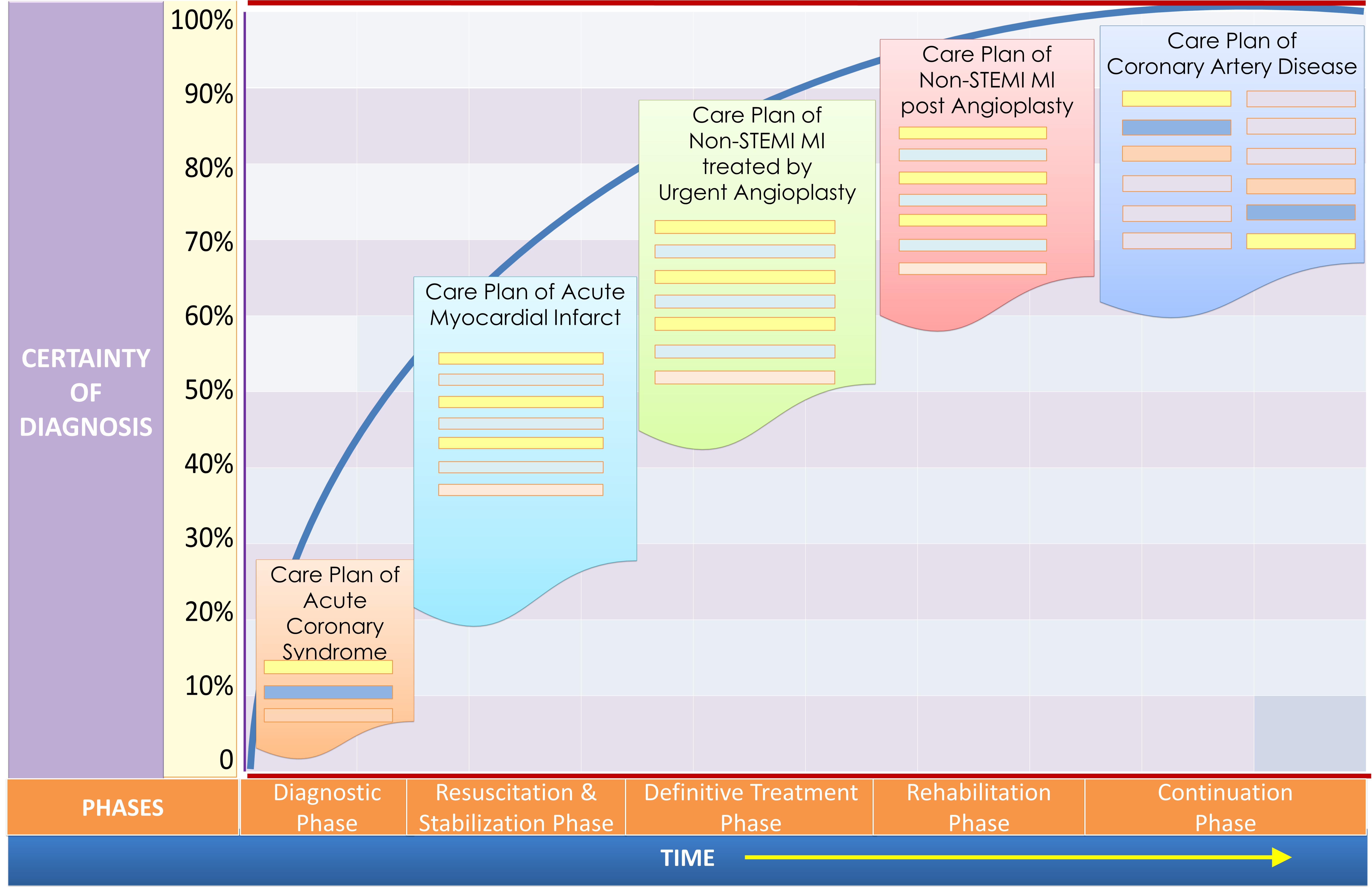
The development and design of Care Plans are described in detail below.
Task Lists
Care providers may then create their own task lists based on their role. In a computerized environment, these task lists are automatically generated but can still be amended to vary the urgency, frequency, duration, location and assignment.
Task lists are the means for executing the SOP/Care Plan. Care providers must be aware of the tasks that have been completed and those that are still pending. When a computerized system is used, the system is able to note the status of performance and provide reminders through prompts and alerts.
Multi Patient Task List View
The care set for a particular patient will consist of all or some of patient care processes. It may also include clinical administration tasks. For inpatients, these can be admission, referrals, transfer and discharge. For outpatients, these can be visit registration, follow up appointment, referral and discontinuation of visits.
ORDER SETS (CARE PACKAGE, CARE-SET, CARE-BUNDLE)
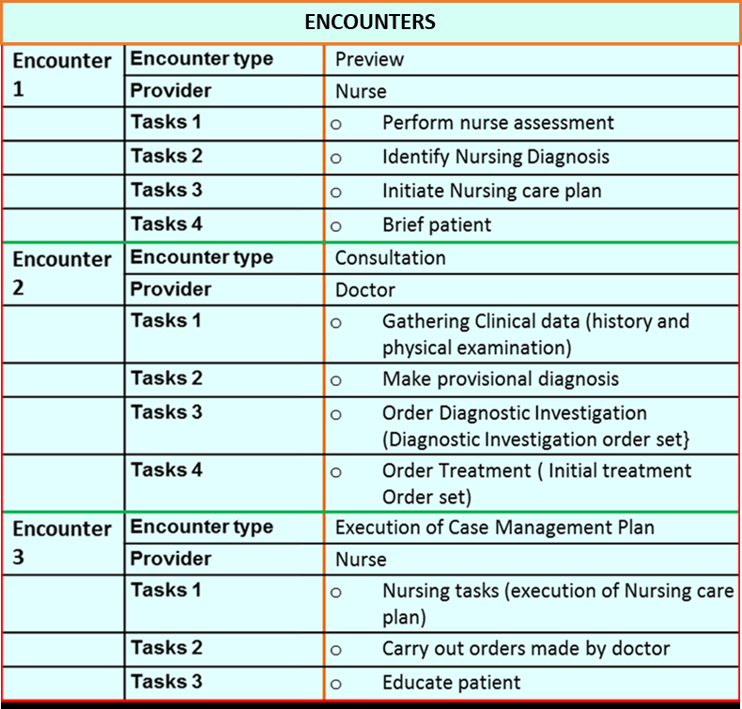
Quality Control Methods
This section addresses quality control and quality improvement activities. The quality procedure describes the steps to be taken to evaluate conformance to process specifications and outcome standards. Major parts of it are:
- measurement of a quality characteristic
- comparing with a set standard
- determining conformance
- improvement methods
It may be incorporated in the work procedure or written as a separate document (as per ISO 9002:2000 QMS standards).
GUIDE ON DOCUMENTATION (USE OF FORMS OR CHARTS)
Relationship between Plan, Performance and Documentation
Pertinent data that is generated as results of tasks or processes must be recorded in standardized forms. In the SOP, guides are given on the use of various data documentation forms or charts used by the organization. Documentation forms should anticipate the data generated by the tasks within the SOP/Care Plan. In addition, the forms/charts also provide prompts/reminders for the care provider to perform certain tasks to obtain the data. Thus, the form itself acts as a decision support instrument
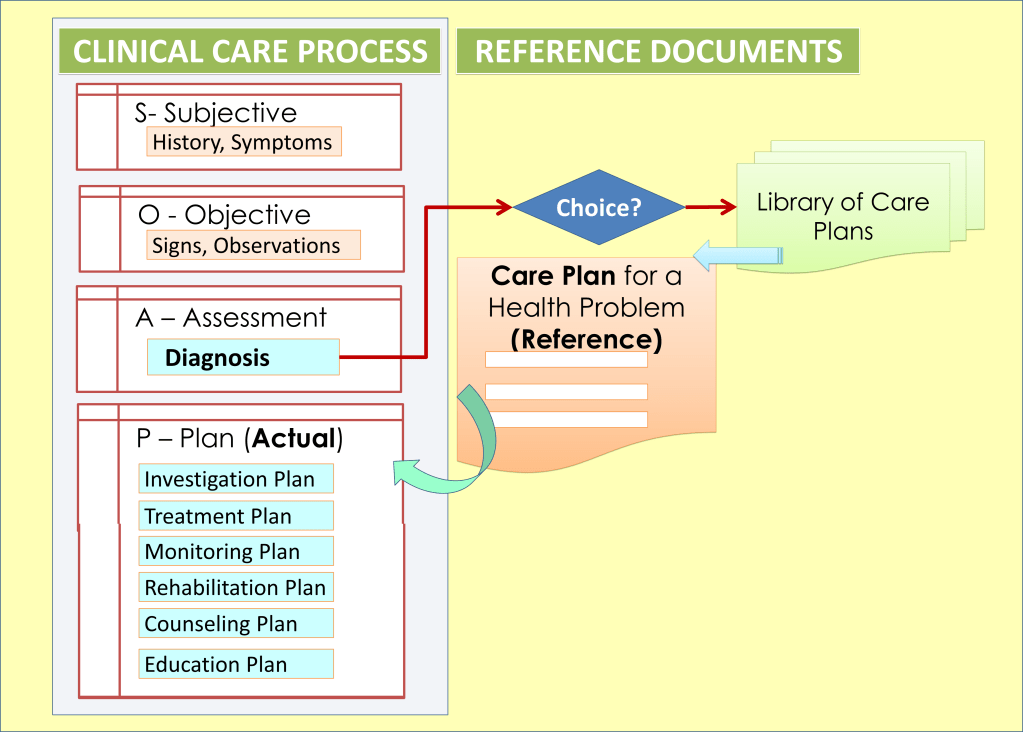
PROVISION OF CLINICAL DECISION SUPPORT
Clinical care is a knowledge driven and information dependent activity. Modern clinical practice must be re-engineered to take advantage of the advancement in knowledge and practice of clinical sciences, management science, and information and communications technology. Clinical Decision Support is the provision of guidance and knowledge at the point of care. It is an integral part of the SOP/Care Plan.
Clinical decision support is envisaged not as something separate but as built-in functions within the whole patient care. It is applied through several mechanisms:
- Guide to the data that must be gathered and captured
- Guide to making a diagnosis (diagnostic criteria)
- Provision and matching of care plans for various categories of patients
- Manual / Computerized analysis and interpretation of results (normal, abnormal, scoring, stratification, grading, staging, comparison with standards for quality control)
- Provision of guides, instructions, alerts, prompts, reminders and suggestions,
- before or during the performance of certain procedures
- In response to certain situations, occurrences, incidents, non-conformance and abnormalities
- indications and contraindications in use of a modality
SUPPORTIVE REFERENCE DOCUMENTS
Reference Documents
The SOP should contain reference documents that care providers can refer to when performing their tasks. The information provided should be endorsed officially by the organization . Examples of these include
- work instructions or protocols
- table of normal values,
- percentile charts,
- dosage regimens, food menu,
- expected / control limits, standards, specifications,
- regimens, recommended drug dosages and charges.
- lists of drugs (official drug formulary)
- glossary of terms ,
- diagnoses terminology,
- charge codes.
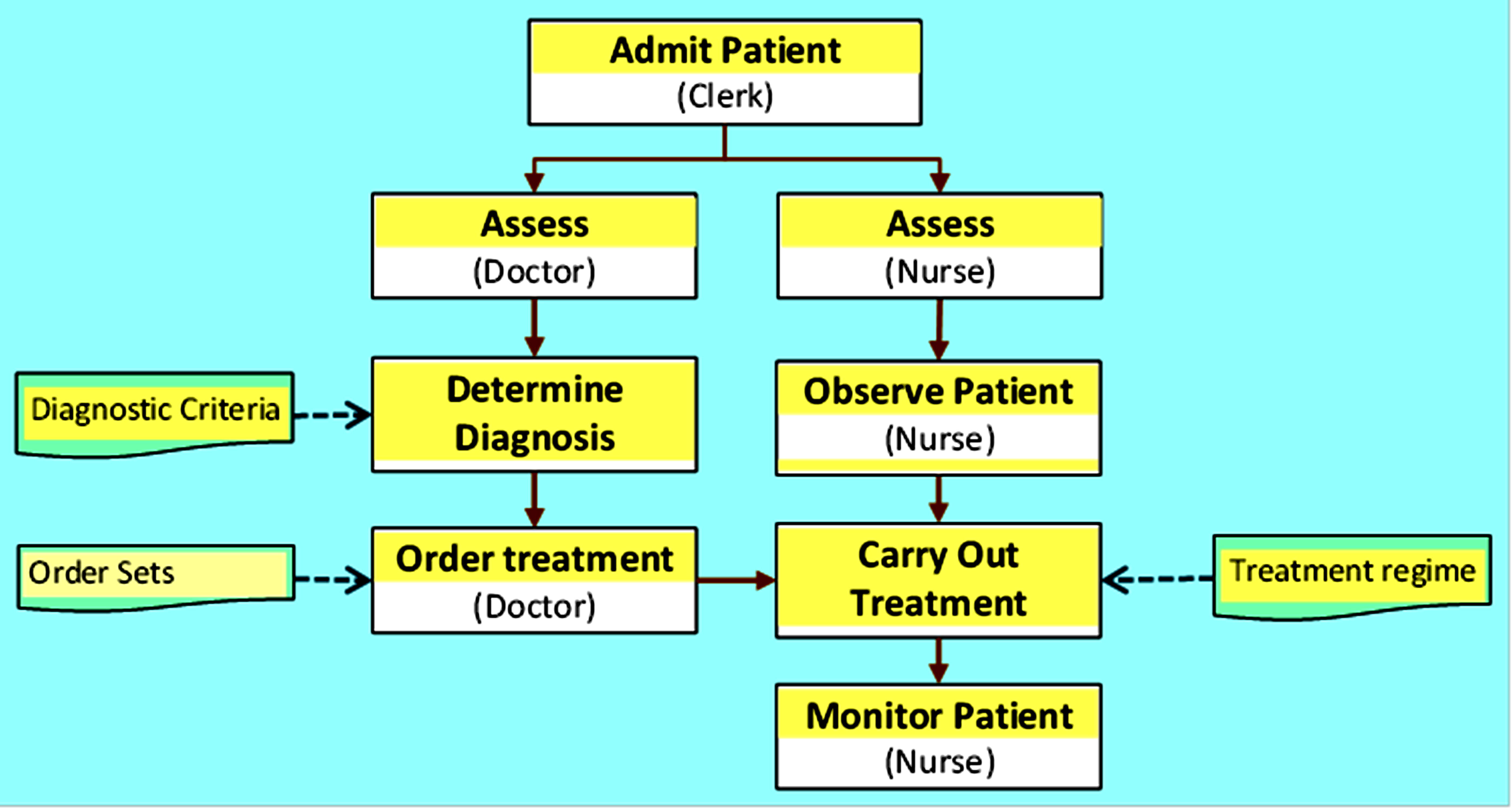
Work Instructions or Protocols
Work Instructions or Protocols provide further details on how certain processes are to be carried out. They are predetermined didactic reusable instructions for performing a certain specific task or process as prescribed or endorsed by the organization. They are usually instructions describing how to:
Reference tables or lists may become part of this work instruction.
Since processes depicted by a work instruction would be performed in a similar manner at any time, location or for any indication, they may be compiled separately as an addendum to the SOP or kept in separate manuals/folders and only referred to if required. In a computerized system they can be reached through hyperlinks.
- perform of-repeated routine tasks (insert a CV line, catheterize a patient, take a blood specimen, take consent etc.)
- document (use of standard forms or charts, ),
- operate machines (user manual),
- use instruments,
- use chemicals (safely and effectively),
- order items (food, drugs, blood etc.)
- serve or administer drugs,
- transfuse blood or other infusions
- other specific tasks
DIAGNOSTIC CRITERIA
A diagnosis is made by interpreting certain variables including signs, symptoms, the results of clinical tests, investigation findings (laboratory, imaging, and endoscopy), monitoring parameters, clinical progress and response to treatment. Through research and experience, the medical profession has identified sets of variables that predict a diagnosis i.e. the ‘diagnostic criteria’. This knowledge can be presented (as decision support) to care providers to aid them in making a diagnosis. In certain instances, especially when a scoring system is used, these predictions have a high level of accuracy. However, a rough guide can be also of use to the clinician.
Categorization, Risk Stratification / Severity Grading/ Staging
Having made the diagnosis the clinician needs to clarify further:
- which variant of the illness is affecting the patient
- which stage of the natural history of the illness has been reached
- what complications has accompanied the disease
- how the patient has responded to the disease
As such, grading and scoring systems for various diseases should be adopted for each disease and the care plan should have variations for different severity levels, stages and grades.
INDICATIONS AND CONTRAINDICATIONS FOR USE OF A MODALITY
Investigation and treatment modalities, however efficacious, have limitations such as unwanted side effects and interactions. They may not be effective in certain situations or when prerequisites are not met. Care providers need to be reminded of these indications and contraindications as part of the decision-making process.
ALTERNATIVES, VARIATIONS, OPTIONS AND CONTINGENCIES
The Reference Care Plan is a guide that contains the following :
The Objectives and Expected Outcome
The intended objective and expected outcome is precisely indicated. These may be the expected outcome, treatment end points, the degree of restoration or amelioration of the disrupted quality of life (ability to work, enjoy leisure, attend school and perform daily life activities) and avoidance of side effects. Details such as targets, limits and standards are understood by reference to the SOP.
Lists of Tasks
The list of tasks are grouped into functional categories i.e.:
- Administrative tasks (Admission, Referrals, Transfer and Discharge, visit registration, follow up appointment, referral and discontinuation of visits.)
- Clinical Data Gathering Tasks (Clerking or Assessment, Progress reviews)
- Investigations
- Monitoring tasks
- Treatment divided further based on modalities such as therapeutic procedures, medication to be supplied or administered, blood product supply and transfusion
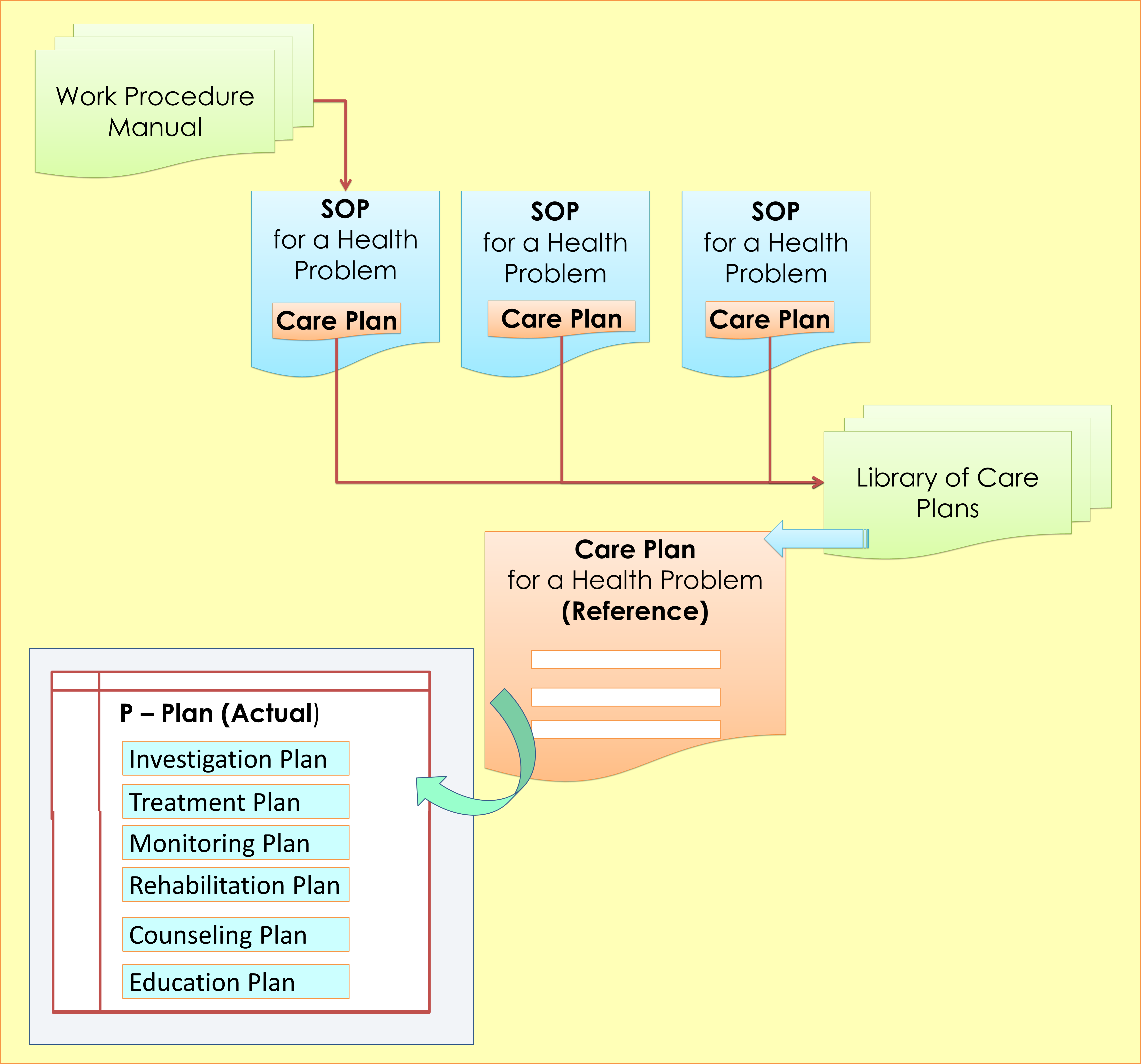
Relationship Between SOP, Reference Care Plan and Actual Care Plan
Specific disease entity which give rise to further stages or phases
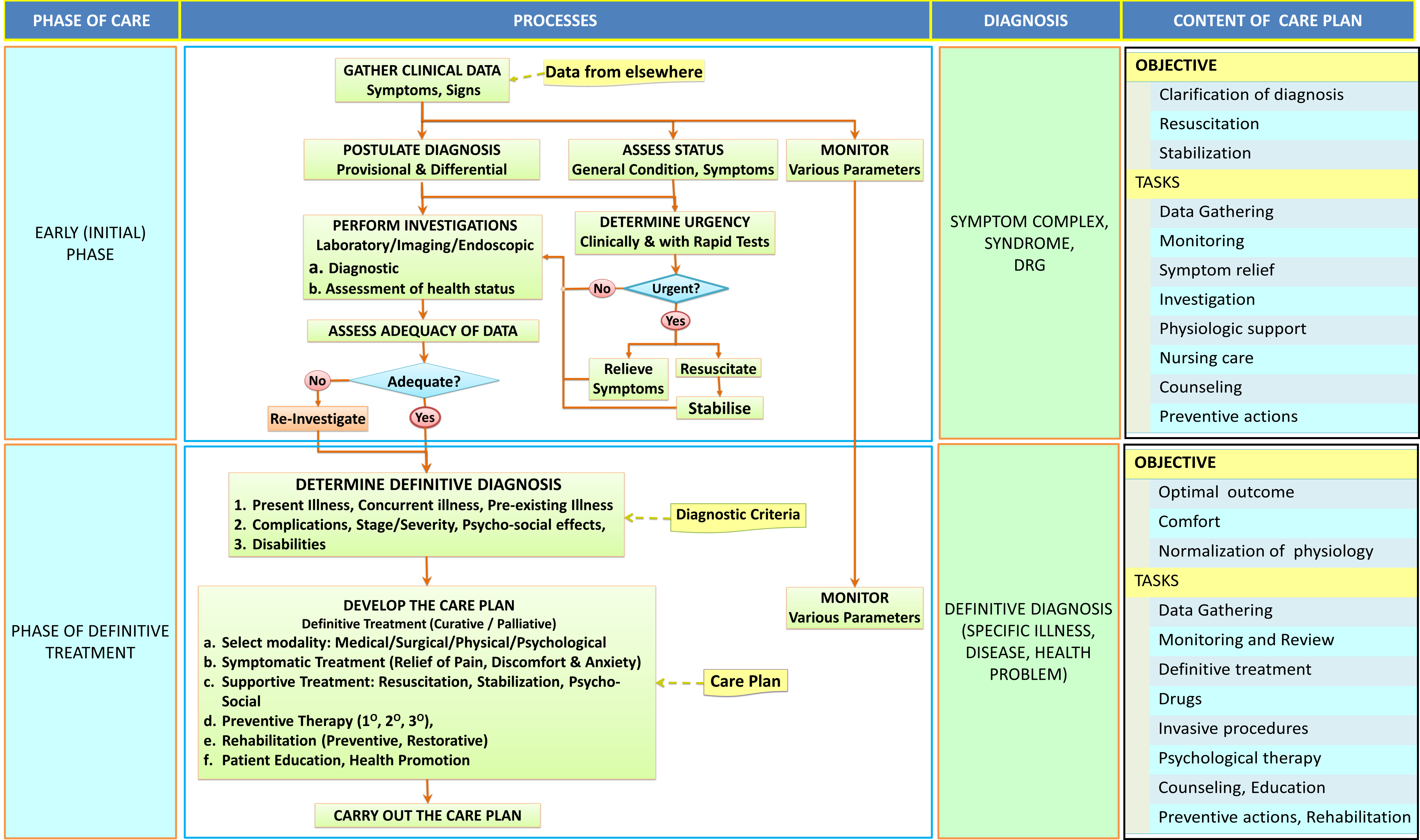
Two Main Phases of the Care Episode Based on Clarity of Diagnosis
Even when the definitive diagnosis is known and a specific care plan is applied, modifications need to be made constantly based on variables such as:
- changes in the patient’s condition in accordance with the stages of the disease process
- the workflow or the treatment regimen
- demands arising from the patient’s response and other effects of therapy
Outline of the Care Episode
Care plans also need to vary with other changes including:
The Reference Care Plan is in three parts:
Example: Reference Care Plan for Initial Phase of Acute Coronary Syndrome
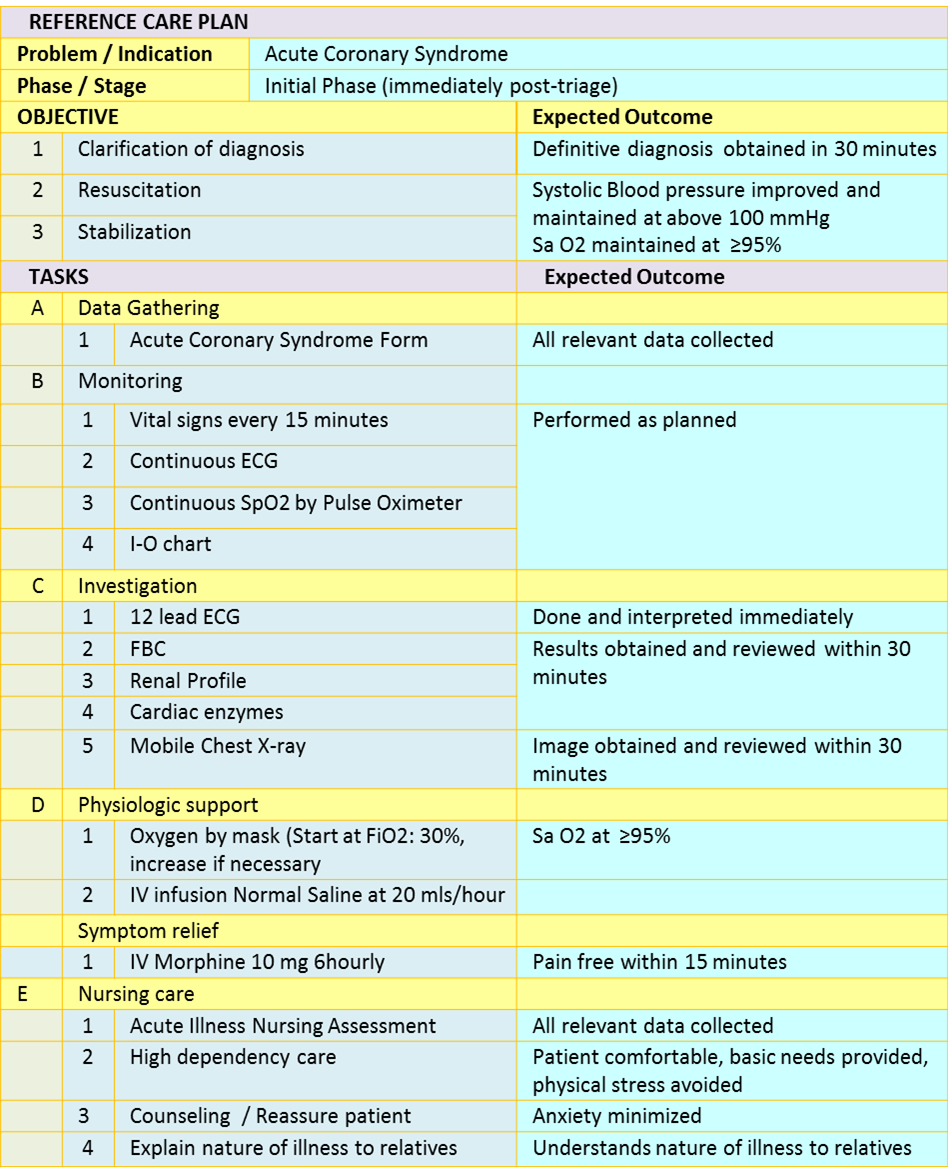
Customization of Case Management Plan for an Individual Patient with Multiple Needs
The Actual Care Plan is basically a work schedule made up of tasks grouped according to functions. In a paper-based information system, the care provider responsible for a particular function may write their own schedule with their own notes in the medical record. For example doctors may write their planned tasks in the medical notes. Nurses my write the Nursing Care Plan together with other entries in the Nursing Notes part while rehabilitation therapists, optometrists and audiologists and other allied health professionals may write their own plan in their respective sections in the medical record. Whatever is recorded is the actual plan and becomes part of the medical record.
Executing Plans via Orders
In a fully computerized Hospital Information System, a plan can be chosen by the doctor in charge (or any other health professional assigned as the primary provider). It will then trigger Care Sets (Order sets, care bundle) for various other the designated care providers of the functional group who will then modify these sets of planned tasks (orders). These allow the care provider categories freedom to customize their own respective plans. Once confirmed these planned tasks would be recorded as the actual task list. Later when the tasks are performed this fact together with the results emanating from it would be recorded as part of the Medical Record.
Plans are realized by executing orders (planned tasks). While in the Reference plan, tasks are grouped according to purpose or function, for purposes of execution they are assigned to identified members of the care team. For example rehabilitation tasks are allocated to the Physiotherapist or Occupational therapist. The dietitian takes on the provision of appropriate diet. The social worker will address the social support issues. These care providers will have to be alerted regarding their involvement in the care of the patient through e-mail (in-box), by phone or other methods of referral.
Actual Care Plan for Acute Coronary Syndrome
Order Set for “Acute Coronary Syndrome”
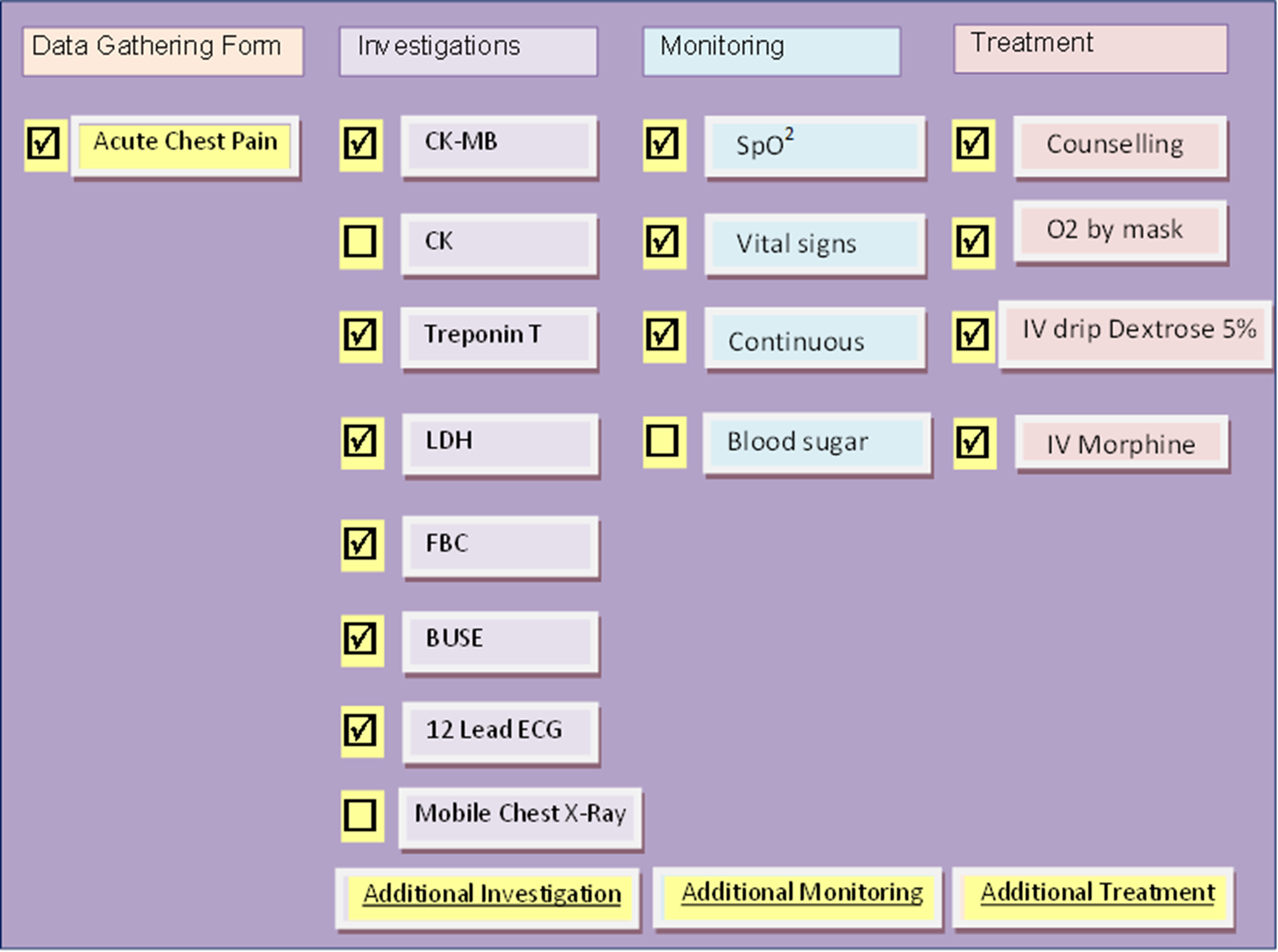
Care Set for Management of Acute Myocardial Infarct
The use of the Care Plan in a computerized Hospital Information System is discussed in the article on Clinical Information System.
The Relationship Between Stages in the Work Flow and Content of Care Plans
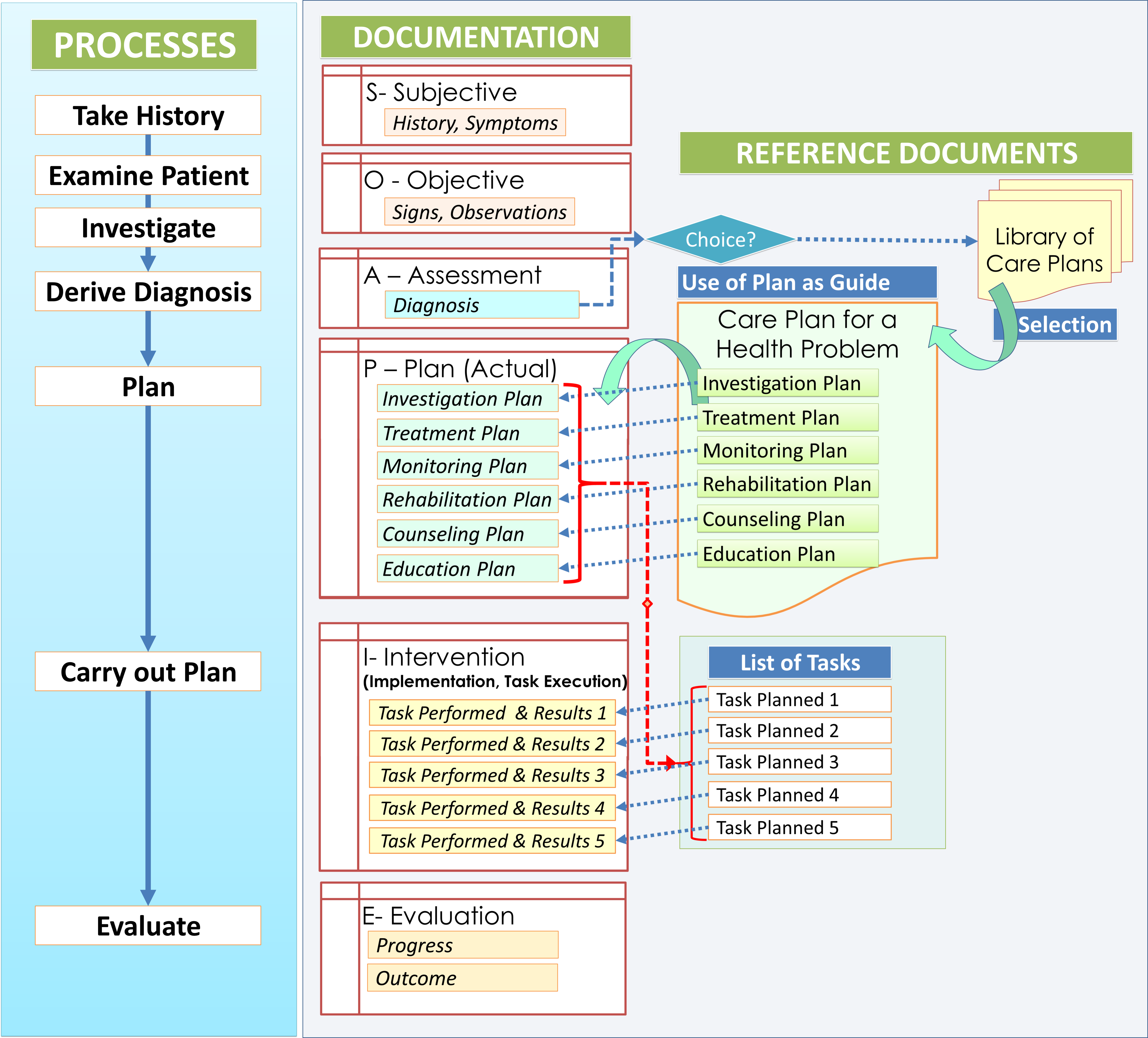
ORDER SETS (Care Package, Care-Set, Care-Bundle)
The tasks that addresses all aspects of the patient’s health problems for the short term, make up the content of the Actual Plan. It is often called the Care Set, Order Set or Care Bundle.
Each Care Plan is executed using pre-constituted but modifiable order sets. In a system based on paper the orders are transcribed (copied) manually from a printed copy of the Reference Plan or from a stand-alone computer. In a computerized Clinical Information System, the care provider may use the order set suggested by the system or choose one from a given list. Depending on the context or scenario, order sets can be didactic or flexible in content. In any case, the set can then be modified by exclusion or inclusion of orders. The tasks are then assigned to the relevant provider group as a task list. Tasks are performed according to the orders.
The care provider retains control of decisions and choices. The plan is a recommendation. Quality control mechanisms such as detection of deviations or variance from the plan, unexpected results and tasks not completed via check lists are put in place.
TASKS: THE MAIN CONTENT OF CARE PLAN
The essential content of Care Plans are tasks for all or some of the patient care processes that addresses all aspects of the patient’s health problems for both the short-term as well as the long-term. These pre-determined tasks take the form of sets of orders often called Order sets otherwise also called Care package, Care-set and Care-bundle. Although care is necessarily continuous and often simultaneous, the content is different for different periods or phases. These periods may or may not coincide with definite moments in time such as a certain day (e.g. day of admission, the morning before surgery, first day post-surgery or day of discharge. The care provider should be given the choice of modifying the care set by activating or inactivating the orders that it contains.
An order-set is made up of a combination and permutation of orders predetermined for each category of illness. Tasks are performed according to the orders. The care sets will consist of all patient care processes necessary for a defined period. It may also include clinical administration tasks.
The type of orders within an order set would include any or all that is necessary to carry out the patient care processes including:
- Administrative tasks (Admission, Referrals, Transfer and Discharge, visit registration, follow up appointment, referral and discontinuation of visits.)
- Generation, gathering and collection of data about the patient’s illness and the effect on his/her health.
- Data collection tasks e.g. Clerking or Assessment using a specific clerking form and Progress reviews guided by various note types.
- investigations by various techniques,
- Analysis and interpretation of data to determine the diagnosis and needs of patients
- Planning the case management
- Preventive actions,
- Treatment using various modalities including therapeutic procedures, medication to be supplied or administered, blood product supply and transfusion
- Monitoring and Review of progress of disease status of the patient’s health, effects of treatment
- Evaluation of outcome)
- Review of diagnosis and management
- Rehabilitation
- Patient education
- Provision of or advise on nutrition
- provider-patient communications (briefing, advice)
- Any other therapeutic tasks
- Continuation of care or Final disposal of the case
For inpatients, these can be admission, referrals, transfer and discharge. For outpatients, these can be visit registration, follow up appointment, referral and discontinuation of visits.
PROCESSES AND TASKS
Traditionally, the plan for the overall care of a patient is done by the doctor in charge (or any primary care provider). By choosing a Care Plan he/she communicates the to members of the care team on what needs to be done for the patient.
- Administrative tasks (Admission, Referrals, Transfer and Discharge, visit registration, follow up appointment, referral and discontinuation of visits.)
- Generation, gathering and collection of data about the patient’s illness and the effect on his/her health. Data collection tasks e.g. Clerking or Assessment using a specific clerking form and Progress reviews guided by various note types.
- Analysis and interpretation of data to determine the diagnosis and needs of patients
- Investigation tasks, Diagnostic tests
- Planning the case management
- Treatment using various modalities including therapeutic procedures, medication to be supplied or administered, blood product supply and transfusion
- Review of progress of disease (including assessment of outcome)
- Monitoring of the progress of the illness, status of the patient’s health, effects of treatment
- Review of diagnosis and management
- Rehabilitation
- Patient education
- Nutrition provision
- Any other therapeutic tasks
- Continuation of care or Final disposal of the case
Multi Patient Task List View
In a computerized Clinical Information System, planned tasks take the form sets of orders. The computerized provider Order Entry application (CPOE) is used to create task lists for various functions. The type of tasks within a care-set would include any or all that is necessary to carry out the patient care processes i.e.:
DECOMPOSITION OF ORDER SETS INTO TASK LISTS
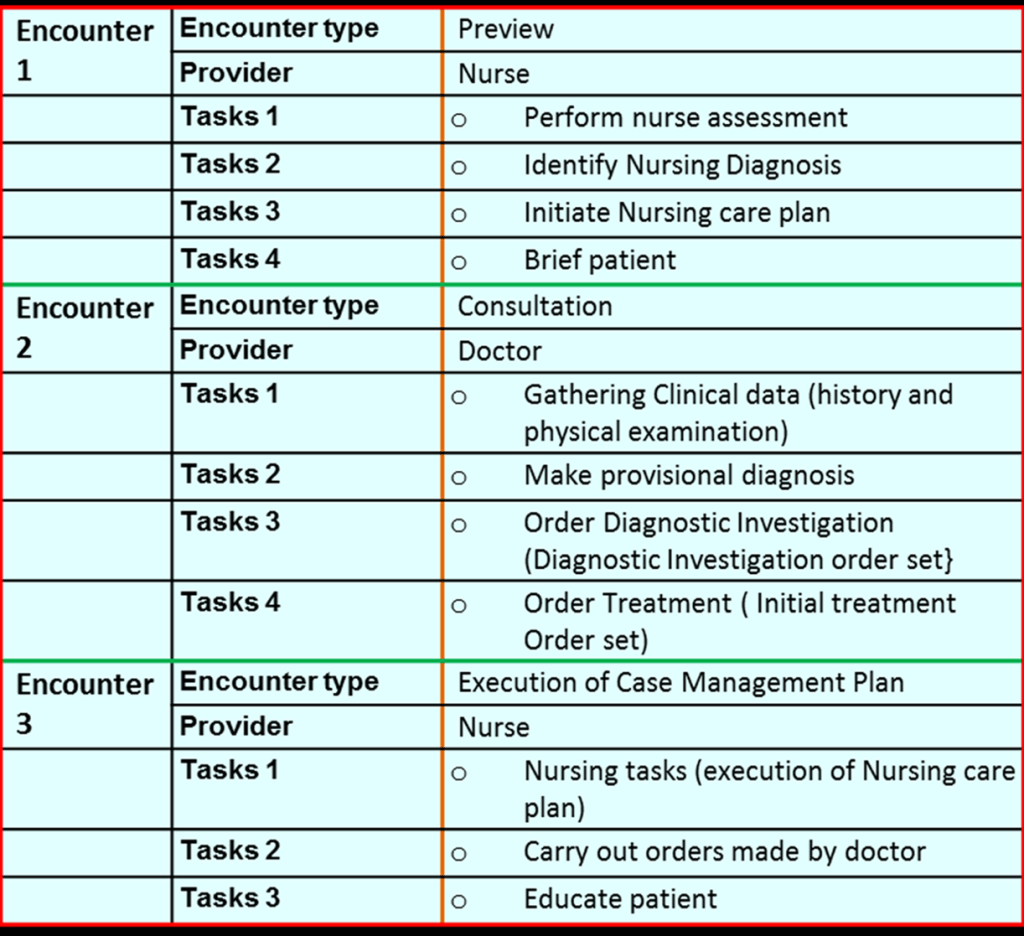
Traditionally, the plan for the overall care of a patient is done by the doctor in charge (or any other primary care provider). In a computerized environment, the care plan is predetermined by consensus and executed through Order/Care Sets and can be manually or automatically triggered. From this overall plan, the care providers responsible for each aspect of care may select and activate care plans applicable for the patient. The care provider should be given the choice of modifying the care set by deselecting some of the orders or placing additional orders. All or some of the items listed in a plan/order set can be made mandatory or pre-selected while others can be actively selected or deselected by users.
EXAMPLE Order Set for “Acute Coronary Syndrome”
The care provider retains control of decisions and choices. The plan is a recommendation. Quality control mechanisms such as detection of deviations or variance from the plan, unexpected results and tasks not completed via check lists should be put in place and documented.
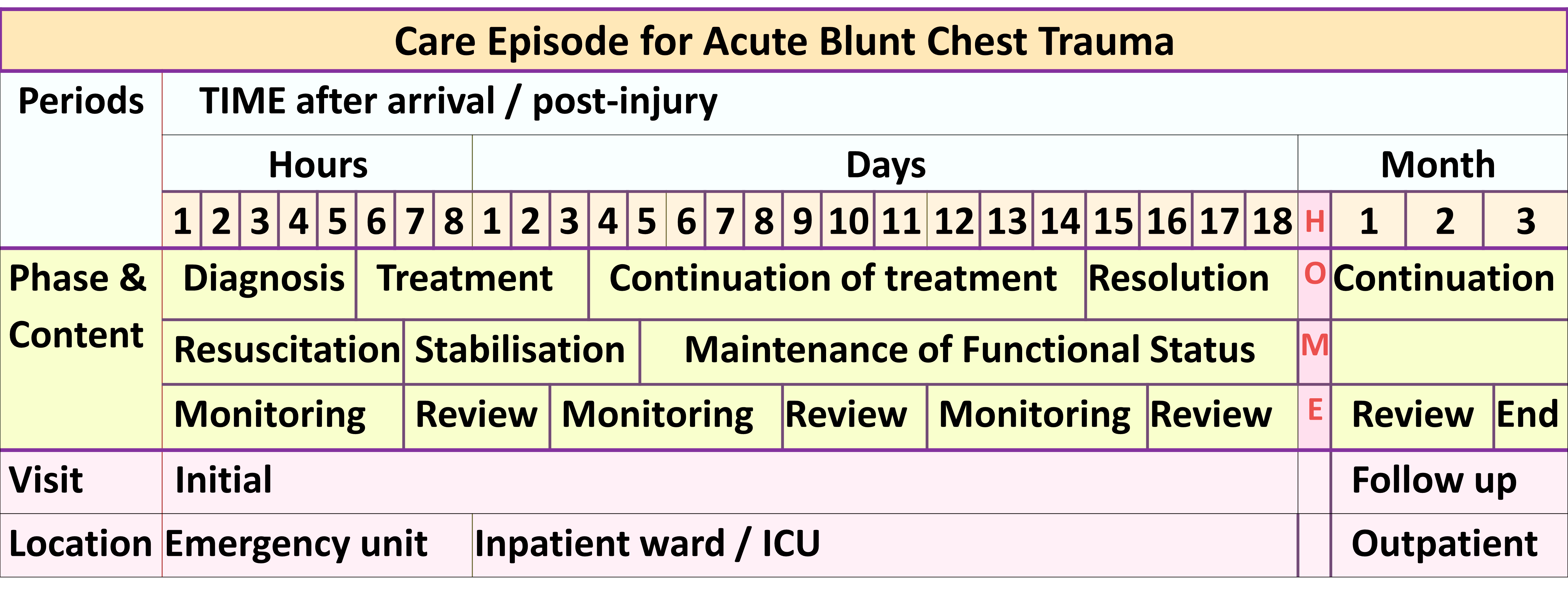
Division of Duration of Care into Periods
For a particular health problem, the care delivery may be divided into:
- Episode
- Phases
- Visits
- Encounters
- Tasks or Events
- Entire Care Episode
- A particular Phase
- A particular service
A care episode refers to the whole duration of service provided from beginning to end. It contains the sum of all visits.The division into Phases is conceptual rather than real. The differentiating factor is whether the illness is acute, sub-acute or chronic.Visits are instances when the patient comes to the health care facility. They can be categorized further according to service delivery systems i.e.
- Outpatient visit
- Emergency visit
- Inpatient visit
- Day Care visit
- Home Care visit
- Teleconsultation visit
Visits can also be categorized according to sequence
- First
- Follow up (FU 1, FU 2, FU 3 etc.)
- Final
The number of visits per episode is by nature variable but may be intentionally fixed in a service package. A visit requires one or more identified physical resources such as room/bed within a clinic complex or ward. During the visit, the patient may have one or more encounters with different care providers at the same or different resource. The duration of each encounter is defined as time slots.
Tier 2: Visits and Encounters for each Phase
The progression from one phase to the next need to be decided by the care provider based on the amount and quality of data available, the certainty of diagnosis, the appropriateness of a chosen care plan and the response to therapy. Since the Case Management Plan is an interdisciplinary effort, each care provider has the opportunity to operationalise the part of the plan in their area of expertise. Yet, there should be consultation with other members of the care team. The patient also needs to be aware of the plan, be allowed to make queries and be involved in it.
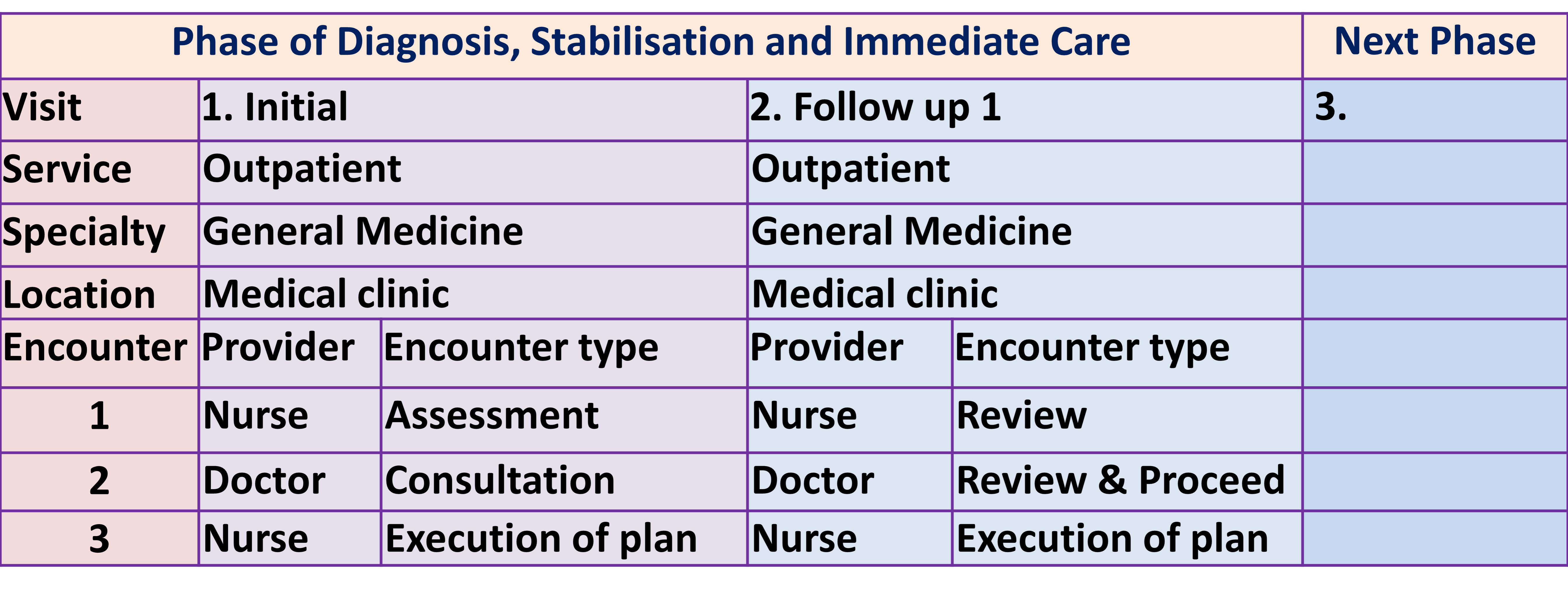
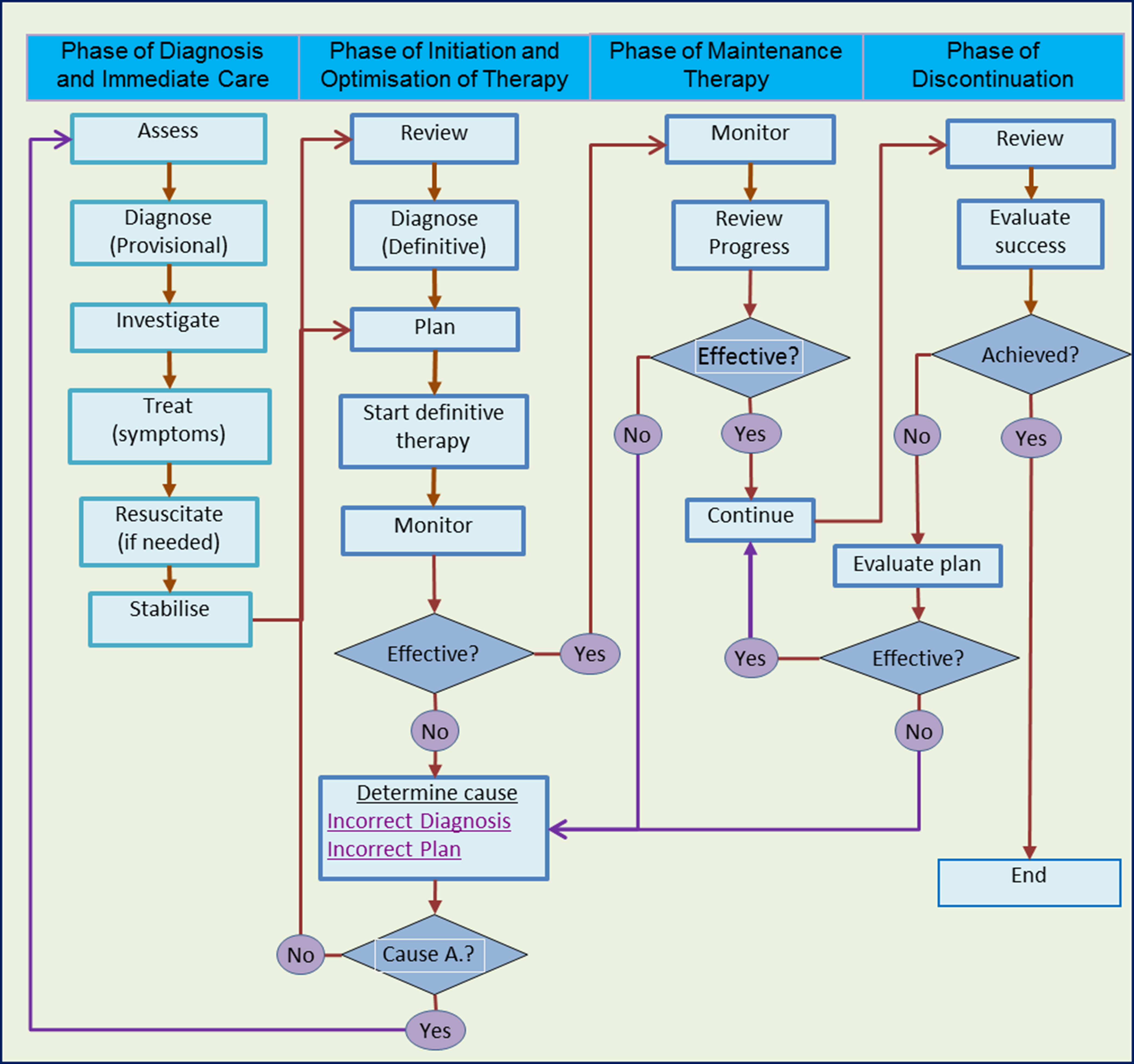
PRACTICAL CONSIDERATIONS IN EXECUTING PLANS
For a chosen plan, the transition from one phase of care to the next depends on:
- completion of planned tasks
- achievement of objectives for the phase
Failure to complete tasks can be due to non-conformance by care providers or non-compliance by patients. Failure to achieve objectives may be due to the two aforementioned issues or due to an inappropriate hence ineffective plan. The latter is likely to be due to inaccurate or wrong diagnosis, in which case further efforts need to be made to clarify the diagnosis. A change in plan may then become necessary.
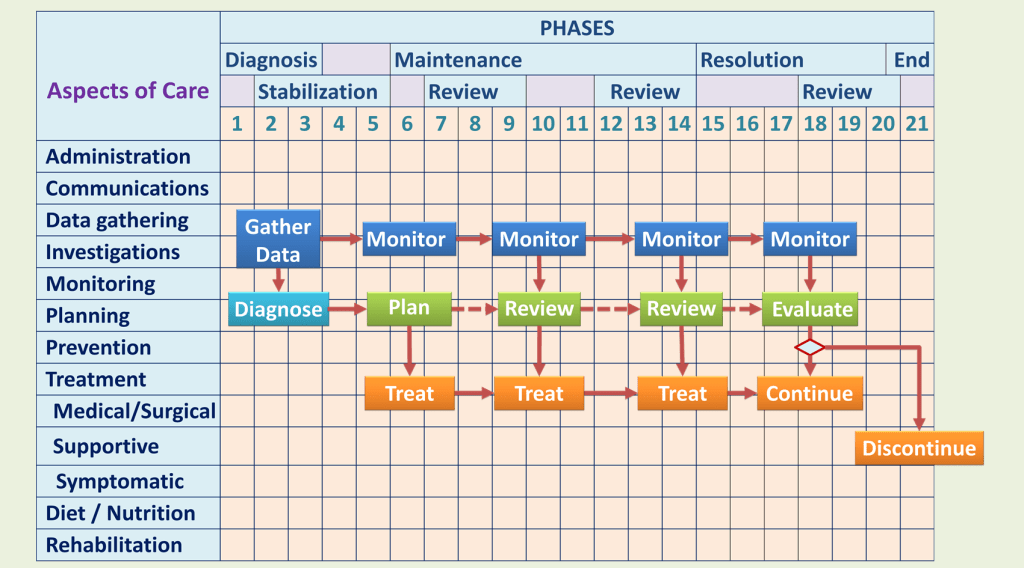
Phases of Care in a Patient with Blunt Chest Trauma
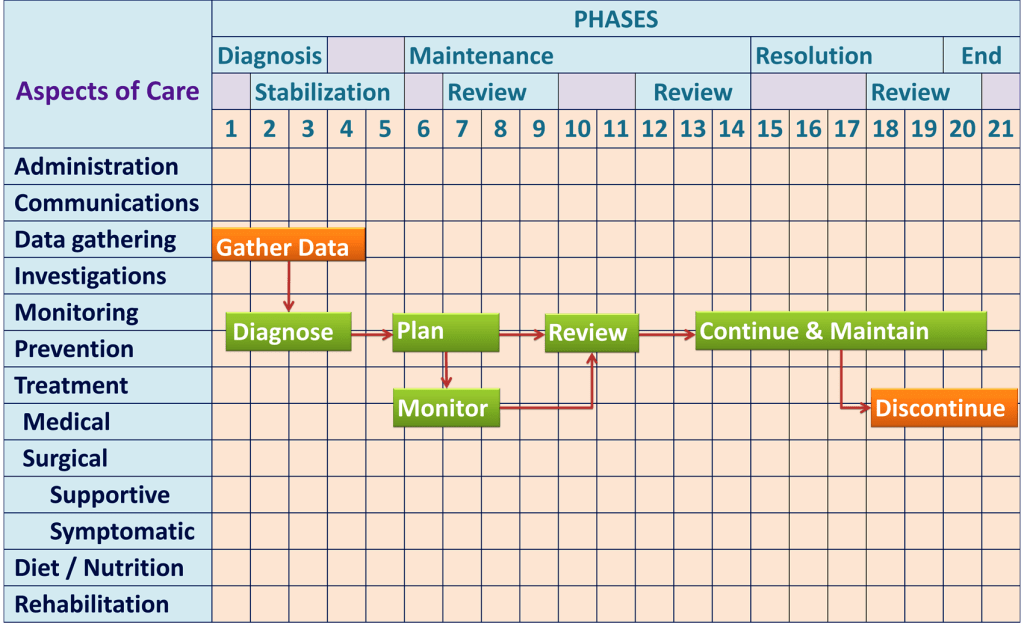
- quick action by defining the process sequence
- readiness of equipment,
- defining care-provider roles
- preparedness for any eventuality
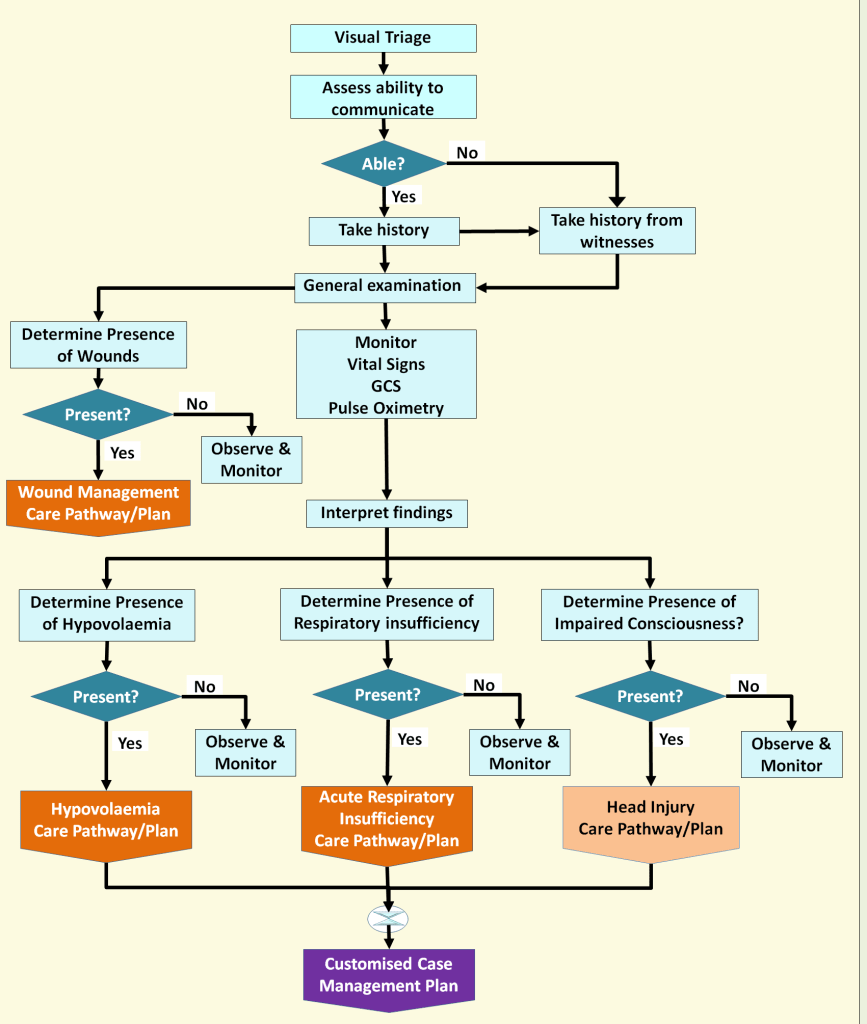
PRACTICAL CONSIDERATIONS IN EXECUTING PLANS
Care of a patient with an acute illness is characterized by varying levels of urgency and uncertainty. Setting priorities is of overriding importance. Most tasks need to be performed simultaneously. The Care plan is an indispensable aid in ensuring:
Customization of Case Management Plan for an Individual Patient with Multiple Needs
CARE PLAN FOR CHRONIC ILLNES
preventive, education An example of the model care plan for this phase is shown below. (yet to be written)
In this phase because of the above factors, modification and revision of the plan is often necessary.
VARIATION BASED ON EMERGENCE OF SPECIAL NEEDS
In managing a patient, an integrated plan that will cater for all of his/her needs is necessary. For a particular disease, there are individual variations in how the disease or health problem affects a patient. How the patient responds to them also varies. The continuation of a care regimen to the next phase is contingent on the completion or success of the previous phase.
To some extent the difference in response is contributed by the patient’s pre-morbid health status (pre-existing problems including chronic illness), physiological condition and psychological make up.
After making a diagnosis, the clinician categorizes his/her patient according to possible risks, severity of illness, stage of development and therefore prognosis. Categorization in turn allows the clinician to choose the right pathway and initiate an appropriate care plan. It is also a determinant of applicability, availability, timeliness and cost effectiveness. Grading and scoring systems for various diseases have been developed and tested.
Cessation and Introduction of New Plans
Plans need to change with variations in progress of the disease, severity, complications, different phases of care and outcomes. Changes can be made manually or be suggested based on a trigger. Planned tasks may end or continue as the phases evolved.
Tasks can continue or retained in new plan. Tasks no longer necessary are not included in next plan any task can be cancelled from the task list at any time
Whether the changes are slight or major, in a computerized system, it is best that the old plan is terminated and replaced by a new plan. Previous orders that are to retained are cancelled and the orders are remade. The new order set will then contain previous and new orders. Hence, the task list is also renewed. This will prevent confusion as to which order is to be retained and which to be continued.
 HEALTHCARE SERVICE DELIVERY
Excellent.
LikeLike
Than you.
LikeLike
very much helpful. thank you
LikeLike
Dear Dr Abdollah, your write-ups are extracts of years of experience and so well articulated. Thank you so much for this great work.
LikeLike
Glad you read that article. It is still a draft. I am finishing the final article right now. You have given me the motivation that need.
LikeLike
Very helpful information. Thank you
LikeLike